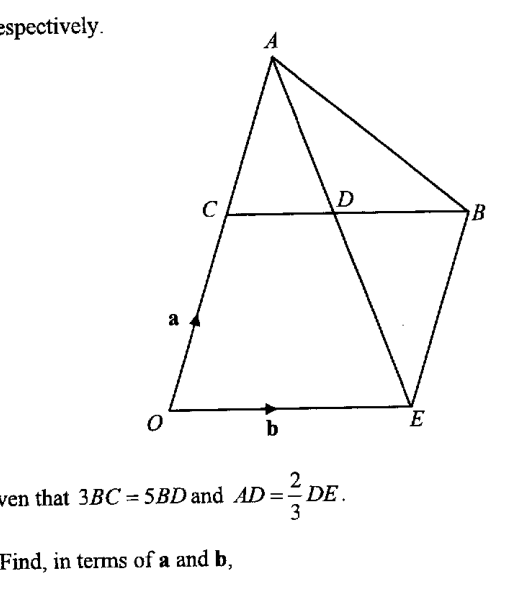
CBEO 是一个平行四边形。C 和 E 相对于 O 的位置向量分别为 a\mathbf{a} 和 b\mathbf{b}。

  1. (a)

    用 a\mathbf{a} 和 b\mathbf{b} 表示:

    1. (i)

      CD→\overrightarrow{CD}。

    2. (ii)

      AD→\overrightarrow{AD}。

  2. (b)

    AC‾\overline{AC} 是否平行于 OC‾\overline{OC}?用适当的计算步骤说明你的理由。

  3. (c)

    求

    1. (i)

      area of ΔADBarea of ΔACD\dfrac{\text{area of }\Delta ADB}{\text{area of }\Delta ACD}

    2. (ii)

      area of ΔADCarea of ΔAOE\dfrac{\text{area of }\Delta ADC}{\text{area of }\Delta AOE}

    3. (iii)

      area of ΔADBarea of CDEO\dfrac{\text{area of }\Delta ADB}{\text{area of }CDEO}

先不看答案,让 AI 诊断你卡在哪里?

它不会直接告诉你答案,而是问你卡在哪一步看看 AI 是怎么陪你一步步弄懂这道题的

完整解法

10(a)(i)

1. Relate $\\overrightarrow{BD}$ to $\\overrightarrow{BC}$ using the given ratio.

Since 3overrightarrowBC=5overrightarrowBD3\\overrightarrow{BC}=5\\overrightarrow{BD},
overrightarrowBD=frac35overrightarrowBC.\\overrightarrow{BD}=\\frac{3}{5}\\overrightarrow{BC}.

2. Find $\\overrightarrow{CD}$ from the whole vector $\\overrightarrow{CB}$.

In parallelogram CBEOCBEO, overrightarrowCB=overrightarrowOE=mathbfb\\overrightarrow{CB}=\\overrightarrow{OE}=\\mathbf{b}.

Since DD lies on CBCB,
overrightarrowCD=overrightarrowCB−overrightarrowDB.\\overrightarrow{CD}=\\overrightarrow{CB}-\\overrightarrow{DB}.
But overrightarrowDB=−overrightarrowBD\\overrightarrow{DB}=-\\overrightarrow{BD} is not needed if using lengths along the same direction from CC to BB:
overrightarrowCD=overrightarrowCB−overrightarrowBD\\overrightarrow{CD}=\\overrightarrow{CB}-\\overrightarrow{BD}
=mathbfb−frac35mathbfb=\\mathbf{b}-\\frac{3}{5}\\mathbf{b}
=frac25mathbfb.=\\frac{2}{5}\\mathbf{b}.

答案

overrightarrowCD=dfrac25mathbfb\\overrightarrow{CD}=\\dfrac{2}{5}\\mathbf{b}

10(a)(ii)

1. Find the position vector of $D$ using $\overrightarrow{OD}=\overrightarrow{OC}+\overrightarrow{CD}$.

From part (a)(i),
CD→=25b.\overrightarrow{CD}=\frac{2}{5}\mathbf{b}.
Hence
OD→=OC→+CD→=a+25b.\overrightarrow{OD}=\overrightarrow{OC}+\overrightarrow{CD}=\mathbf{a}+\frac{2}{5}\mathbf{b}.

2. Find $\overrightarrow{DE}$ in terms of $\mathbf{a}$ and $\mathbf{b}$.

DE→=OE→−OD→\overrightarrow{DE}=\overrightarrow{OE}-\overrightarrow{OD}
=b−(a+25b)=\mathbf{b}-\left(\mathbf{a}+\frac{2}{5}\mathbf{b}\right)
=35b−a.=\frac{3}{5}\mathbf{b}-\mathbf{a}.

3. Use $\overrightarrow{AD}=\frac{2}{3}\overrightarrow{DE}$ to find $\overrightarrow{AD}$.

Given
AD=23DE,AD=\frac{2}{3}DE,
and A,D,EA,D,E are collinear with DD between AA and EE, so
AD→:DE→=2:3.\overrightarrow{AD}:\overrightarrow{DE}=2:3.
Thus
AD→=23DE→.\overrightarrow{AD}=\frac{2}{3}\overrightarrow{DE}.
AD→=23(35b−a)\overrightarrow{AD}=\frac{2}{3}\left(\frac{3}{5}\mathbf{b}-\mathbf{a}\right)
=25b−23a.=\frac{2}{5}\mathbf{b}-\frac{2}{3}\mathbf{a}.

答案

AD→=35b−35a\overrightarrow{AD}=\dfrac{3}{5}\mathbf{b}-\dfrac{3}{5}\mathbf{a}

10(b)

1. Use the earlier result for $\overrightarrow{AD}$ and the position of $D$ to find $\overrightarrow{AC}$.

From part (a)(i),
CD→=25b\overrightarrow{CD}=\dfrac{2}{5}\mathbf{b}, so
DC→=−25b.\overrightarrow{DC}=-\dfrac{2}{5}\mathbf{b}.
From part (a)(ii),
AD→=35b−35a.\overrightarrow{AD}=\dfrac{3}{5}\mathbf{b}-\dfrac{3}{5}\mathbf{a}.
Hence
AC→=AD→+DC→\overrightarrow{AC}=\overrightarrow{AD}+\overrightarrow{DC}
=(35b−35a)−25b=\left(\dfrac{3}{5}\mathbf{b}-\dfrac{3}{5}\mathbf{a}\right)-\dfrac{2}{5}\mathbf{b}
=15b−35a.=\dfrac{1}{5}\mathbf{b}-\dfrac{3}{5}\mathbf{a}.

2. Compare $\overrightarrow{AC}$ with $\overrightarrow{OC}$ to decide whether the two lines are parallel.

Since
OC→=a,\overrightarrow{OC}=\mathbf{a},
for ACAC to be parallel to OCOC, AC→\overrightarrow{AC} must be a scalar multiple of a\mathbf{a}.

But
AC→=15b−35a,\overrightarrow{AC}=\dfrac{1}{5}\mathbf{b}-\dfrac{3}{5}\mathbf{a},
which contains a non-zero b\mathbf{b} term. Therefore AC→\overrightarrow{AC} is not a scalar multiple of OC→\overrightarrow{OC}.

答案

No. Since AC→=−35b\overrightarrow{AC}=-\dfrac{3}{5}\mathbf{b} is not a scalar multiple of OC→=a\overrightarrow{OC}=\mathbf{a}, ACAC is not parallel to OCOC.

10(c)(i)

1. Compare the areas using the bases on the same straight line $CB$.

Since DD, BB and CC lie on the same straight line, ΔADB\Delta ADB and ΔACD\Delta ACD have the same perpendicular height from AA to line CBCB.

Hence
area of ΔADBarea of ΔACD=BDCD.\frac{\text{area of }\Delta ADB}{\text{area of }\Delta ACD}=\frac{BD}{CD}.From part (a)(i), CD→=25b\overrightarrow{CD}=\dfrac{2}{5}\mathbf{b}. Also, from 3BC=5BD3BC=5BD, BD=35BCBD=\dfrac{3}{5}BC. Since CB=bCB=\mathbf{b},
CD:BD=25BC:35BC=2:3.CD:BD=\frac{2}{5}BC:\frac{3}{5}BC=2:3.
Therefore
area of ΔADBarea of ΔACD=BDCD=32.\frac{\text{area of }\Delta ADB}{\text{area of }\Delta ACD}=\frac{BD}{CD}=\frac{3}{2}.

答案

area of ΔADBarea of ΔACD=32\dfrac{\text{area of }\Delta ADB}{\text{area of }\Delta ACD}=\dfrac{3}{2}

10(c)(ii)

1. Relate the areas of $\Delta ADC$ and $\Delta AEC$ using bases on the same straight line $AE$.

Since A,D,EA,D,E are collinear and AD=23DEAD=\dfrac{2}{3}DE, we have
AD:DE=2:3,AD:DE=2:3,
so
AD:AE=2:5.AD:AE=2:5.
Triangles ADCADC and AECAEC have bases ADAD and AEAE on the same straight line AEAE, and share the same height from CC.

Hence
area of ΔADCarea of ΔAEC=ADAE=25.\frac{\text{area of }\Delta ADC}{\text{area of }\Delta AEC}=\frac{AD}{AE}=\frac{2}{5}.

2. Connect $\Delta AEC$ and $\Delta AOE$ using the same base $AE$.

From part (b), ACAC is parallel to OEOE. Since OO and CC lie on the same line parallel to AEAE? No direct equality of heights is needed if using the vector result: AC→=−35b\overrightarrow{AC}=-\dfrac{3}{5}\mathbf b and OE→=b\overrightarrow{OE}=\mathbf b, so AC∥OEAC \parallel OE.

Thus triangles AECAEC and AOEAOE have the same base AEAE and equal perpendicular heights, since CC and OO lie on a line parallel to AEAE.

Therefore
area of ΔAEC=area of ΔAOE.\text{area of }\Delta AEC=\text{area of }\Delta AOE.

3. Combine the area ratios to obtain the required ratio.

Therefore
area of ΔADCarea of ΔAOE=25.\frac{\text{area of }\Delta ADC}{\text{area of }\Delta AOE}=\frac{2}{5}.

答案

area of ΔADCarea of ΔAOE=25\dfrac{\text{area of }\Delta ADC}{\text{area of }\Delta AOE}=\dfrac{2}{5}

10(c)(iii)

1. Express the area of $\Delta ADB$ and $\Delta CDE$ in terms of the area of $\Delta AOE$.

From earlier parts,
area of ΔADBarea of ΔACD=32\frac{\text{area of }\Delta ADB}{\text{area of }\Delta ACD}=\frac{3}{2}
and
area of ΔACDarea of ΔAOE=25.\frac{\text{area of }\Delta ACD}{\text{area of }\Delta AOE}=\frac{2}{5}.
Hence
area of ΔADBarea of ΔAOE=32×25=35.\frac{\text{area of }\Delta ADB}{\text{area of }\Delta AOE}=\frac{3}{2}\times \frac{2}{5}=\frac{3}{5}.
Also, since AD:DE=2:3AD:DE=2:3, triangles ACDACD and CDECDE have bases ADAD and DEDE on the same straight line AEAE and the same height from CC.
area of ΔCDEarea of ΔACD=DEAD=32.\frac{\text{area of }\Delta CDE}{\text{area of }\Delta ACD}=\frac{DE}{AD}=\frac{3}{2}.
So
area of ΔCDEarea of ΔAOE=32×25=35.\frac{\text{area of }\Delta CDE}{\text{area of }\Delta AOE}=\frac{3}{2}\times \frac{2}{5}=\frac{3}{5}.

2. Find the area of quadrilateral $CDEO$ in terms of $\Delta AOE$, then form the required ratio.

Since AC→\overrightarrow{AC} is parallel to OE→\overrightarrow{OE}, triangles CEOCEO and AEOAEO have the same base OEOE and equal heights.
area of ΔCEO=area of ΔAOE.\text{area of }\Delta CEO=\text{area of }\Delta AOE.
Now
area of CDEO=area of ΔCDE+area of ΔCEO.\text{area of }CDEO=\text{area of }\Delta CDE+\text{area of }\Delta CEO.
Therefore
area of CDEO=35area of ΔAOE+area of ΔAOE=85area of ΔAOE.\text{area of }CDEO=\frac{3}{5}\text{area of }\Delta AOE+\text{area of }\Delta AOE=\frac{8}{5}\text{area of }\Delta AOE.
Hence
area of ΔADBarea of CDEO=35area of ΔAOE85area of ΔAOE=38.\frac{\text{area of }\Delta ADB}{\text{area of }CDEO}=\frac{\frac{3}{5}\text{area of }\Delta AOE}{\frac{8}{5}\text{area of }\Delta AOE}=\frac{3}{8}.

答案

area of ΔADBarea of CDEO=38\dfrac{\text{area of }\Delta ADB}{\text{area of }CDEO}=\dfrac{3}{8}

AI 分析,可能出错

用 AI 批改,圈出写错的那一步,并自动将你的薄弱点存入错题本,形成你的错因库。

同一知识点的其他题

  1. 1在图中,OA→=6a\overrightarrow{OA} = 6a,OB→=6b\overrightarrow{OB} = 6b 且 3AN→=AB→3\overrightarrow{AN} = \overrightarrow{AB}。M 是 OB 的中点。 用 aa…
  2. 2如图所示,OABC 是一个平行四边形,D 是 BC 的中点。BE 的延长线与 OC 的延长线交于点 F。 已知 BE : BF = 1 : 3,OC : OF = 1 : 2,OA = a,OC = c。 用 a 和 c 表示并化简以下向量…
  3. 3ABCD 是平行四边形。A 是点 (−6,−2)(-6,-2),B 是点 (−4,−7)(-4,-7)。BC→=(8−2)\overrightarrow{BC} = \begin{pmatrix}8\\-2\end{pmatrix}。 求线段 AB 的长度。 答案:...…
  4. 4已知 PQ→=(−56)\overrightarrow{PQ}=\begin{pmatrix}-5\\6\end{pmatrix},且 PP 的位置向量为 (2−4)\begin{pmatrix}2\\-4\end{pmatrix}。求 模长 ∣PQ→∣\left|\overrightarrow{PQ}\right|…
  5. 5在图中,OA‾=12 AP‾\overline{OA}=\tfrac{1}{2}\,\overline{AP} 且 OB‾=14 OQ‾\overline{OB}=\tfrac{1}{4}\,\overline{OQ}。M 是 OQ 的中点,且 MN‾=14 NP‾\overline{MN}=\tfrac{1}{4}\,\overline{NP}…