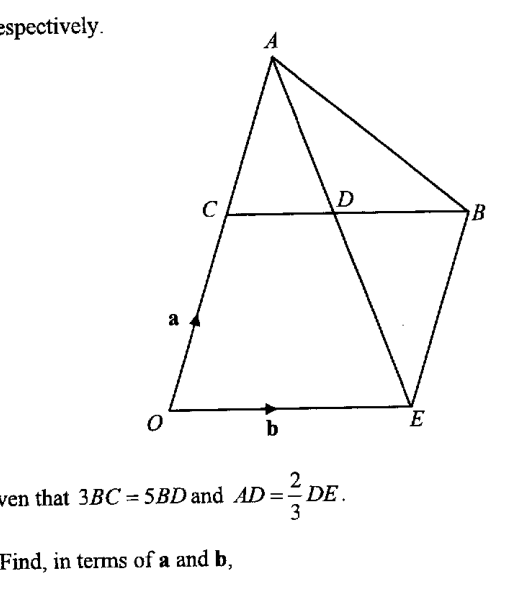
CBEO is a parallelogram. The position vectors of C and E, relative to O, are a\mathbf{a} and b\mathbf{b} respectively.

  1. (a)

    Find, in terms of a\mathbf{a} and b\mathbf{b},

    1. (i)

      CD→\overrightarrow{CD}.

    2. (ii)

      AD→\overrightarrow{AD}.

  2. (b)

    Is AC‾\overline{AC} parallel to OC‾\overline{OC}? Justify your answer with appropriate working.

  3. (c)

    Find

    1. (i)

      area of ΔADBarea of ΔACD\dfrac{\text{area of }\Delta ADB}{\text{area of }\Delta ACD}

    2. (ii)

      area of ΔADCarea of ΔAOE\dfrac{\text{area of }\Delta ADC}{\text{area of }\Delta AOE}

    3. (iii)

      area of ΔADBarea of CDEO\dfrac{\text{area of }\Delta ADB}{\text{area of }CDEO}

Work through it with AI →

It won't just hand you the answer — it asks where you're stuck.How the checker works

Worked solution

10(a)(i)

1. Relate $\\overrightarrow{BD}$ to $\\overrightarrow{BC}$ using the given ratio.

Since 3overrightarrowBC=5overrightarrowBD3\\overrightarrow{BC}=5\\overrightarrow{BD},
overrightarrowBD=frac35overrightarrowBC.\\overrightarrow{BD}=\\frac{3}{5}\\overrightarrow{BC}.

2. Find $\\overrightarrow{CD}$ from the whole vector $\\overrightarrow{CB}$.

In parallelogram CBEOCBEO, overrightarrowCB=overrightarrowOE=mathbfb\\overrightarrow{CB}=\\overrightarrow{OE}=\\mathbf{b}.

Since DD lies on CBCB,
overrightarrowCD=overrightarrowCB−overrightarrowDB.\\overrightarrow{CD}=\\overrightarrow{CB}-\\overrightarrow{DB}.
But overrightarrowDB=−overrightarrowBD\\overrightarrow{DB}=-\\overrightarrow{BD} is not needed if using lengths along the same direction from CC to BB:
overrightarrowCD=overrightarrowCB−overrightarrowBD\\overrightarrow{CD}=\\overrightarrow{CB}-\\overrightarrow{BD}
=mathbfb−frac35mathbfb=\\mathbf{b}-\\frac{3}{5}\\mathbf{b}
=frac25mathbfb.=\\frac{2}{5}\\mathbf{b}.

Answer

overrightarrowCD=dfrac25mathbfb\\overrightarrow{CD}=\\dfrac{2}{5}\\mathbf{b}

10(a)(ii)

1. Find the position vector of $D$ using $\overrightarrow{OD}=\overrightarrow{OC}+\overrightarrow{CD}$.

From part (a)(i),
CD→=25b.\overrightarrow{CD}=\frac{2}{5}\mathbf{b}.
Hence
OD→=OC→+CD→=a+25b.\overrightarrow{OD}=\overrightarrow{OC}+\overrightarrow{CD}=\mathbf{a}+\frac{2}{5}\mathbf{b}.

2. Find $\overrightarrow{DE}$ in terms of $\mathbf{a}$ and $\mathbf{b}$.

DE→=OE→−OD→\overrightarrow{DE}=\overrightarrow{OE}-\overrightarrow{OD}
=b−(a+25b)=\mathbf{b}-\left(\mathbf{a}+\frac{2}{5}\mathbf{b}\right)
=35b−a.=\frac{3}{5}\mathbf{b}-\mathbf{a}.

3. Use $\overrightarrow{AD}=\frac{2}{3}\overrightarrow{DE}$ to find $\overrightarrow{AD}$.

Given
AD=23DE,AD=\frac{2}{3}DE,
and A,D,EA,D,E are collinear with DD between AA and EE, so
AD→:DE→=2:3.\overrightarrow{AD}:\overrightarrow{DE}=2:3.
Thus
AD→=23DE→.\overrightarrow{AD}=\frac{2}{3}\overrightarrow{DE}.
AD→=23(35b−a)\overrightarrow{AD}=\frac{2}{3}\left(\frac{3}{5}\mathbf{b}-\mathbf{a}\right)
=25b−23a.=\frac{2}{5}\mathbf{b}-\frac{2}{3}\mathbf{a}.

Answer

AD→=35b−35a\overrightarrow{AD}=\dfrac{3}{5}\mathbf{b}-\dfrac{3}{5}\mathbf{a}

10(b)

1. Use the earlier result for $\overrightarrow{AD}$ and the position of $D$ to find $\overrightarrow{AC}$.

From part (a)(i),
CD→=25b\overrightarrow{CD}=\dfrac{2}{5}\mathbf{b}, so
DC→=−25b.\overrightarrow{DC}=-\dfrac{2}{5}\mathbf{b}.
From part (a)(ii),
AD→=35b−35a.\overrightarrow{AD}=\dfrac{3}{5}\mathbf{b}-\dfrac{3}{5}\mathbf{a}.
Hence
AC→=AD→+DC→\overrightarrow{AC}=\overrightarrow{AD}+\overrightarrow{DC}
=(35b−35a)−25b=\left(\dfrac{3}{5}\mathbf{b}-\dfrac{3}{5}\mathbf{a}\right)-\dfrac{2}{5}\mathbf{b}
=15b−35a.=\dfrac{1}{5}\mathbf{b}-\dfrac{3}{5}\mathbf{a}.

2. Compare $\overrightarrow{AC}$ with $\overrightarrow{OC}$ to decide whether the two lines are parallel.

Since
OC→=a,\overrightarrow{OC}=\mathbf{a},
for ACAC to be parallel to OCOC, AC→\overrightarrow{AC} must be a scalar multiple of a\mathbf{a}.

But
AC→=15b−35a,\overrightarrow{AC}=\dfrac{1}{5}\mathbf{b}-\dfrac{3}{5}\mathbf{a},
which contains a non-zero b\mathbf{b} term. Therefore AC→\overrightarrow{AC} is not a scalar multiple of OC→\overrightarrow{OC}.

Answer

No. Since AC→=−35b\overrightarrow{AC}=-\dfrac{3}{5}\mathbf{b} is not a scalar multiple of OC→=a\overrightarrow{OC}=\mathbf{a}, ACAC is not parallel to OCOC.

10(c)(i)

1. Compare the areas using the bases on the same straight line $CB$.

Since DD, BB and CC lie on the same straight line, ΔADB\Delta ADB and ΔACD\Delta ACD have the same perpendicular height from AA to line CBCB.

Hence
area of ΔADBarea of ΔACD=BDCD.\frac{\text{area of }\Delta ADB}{\text{area of }\Delta ACD}=\frac{BD}{CD}.From part (a)(i), CD→=25b\overrightarrow{CD}=\dfrac{2}{5}\mathbf{b}. Also, from 3BC=5BD3BC=5BD, BD=35BCBD=\dfrac{3}{5}BC. Since CB=bCB=\mathbf{b},
CD:BD=25BC:35BC=2:3.CD:BD=\frac{2}{5}BC:\frac{3}{5}BC=2:3.
Therefore
area of ΔADBarea of ΔACD=BDCD=32.\frac{\text{area of }\Delta ADB}{\text{area of }\Delta ACD}=\frac{BD}{CD}=\frac{3}{2}.

Answer

area of ΔADBarea of ΔACD=32\dfrac{\text{area of }\Delta ADB}{\text{area of }\Delta ACD}=\dfrac{3}{2}

10(c)(ii)

1. Relate the areas of $\Delta ADC$ and $\Delta AEC$ using bases on the same straight line $AE$.

Since A,D,EA,D,E are collinear and AD=23DEAD=\dfrac{2}{3}DE, we have
AD:DE=2:3,AD:DE=2:3,
so
AD:AE=2:5.AD:AE=2:5.
Triangles ADCADC and AECAEC have bases ADAD and AEAE on the same straight line AEAE, and share the same height from CC.

Hence
area of ΔADCarea of ΔAEC=ADAE=25.\frac{\text{area of }\Delta ADC}{\text{area of }\Delta AEC}=\frac{AD}{AE}=\frac{2}{5}.

2. Connect $\Delta AEC$ and $\Delta AOE$ using the same base $AE$.

From part (b), ACAC is parallel to OEOE. Since OO and CC lie on the same line parallel to AEAE? No direct equality of heights is needed if using the vector result: AC→=−35b\overrightarrow{AC}=-\dfrac{3}{5}\mathbf b and OE→=b\overrightarrow{OE}=\mathbf b, so AC∥OEAC \parallel OE.

Thus triangles AECAEC and AOEAOE have the same base AEAE and equal perpendicular heights, since CC and OO lie on a line parallel to AEAE.

Therefore
area of ΔAEC=area of ΔAOE.\text{area of }\Delta AEC=\text{area of }\Delta AOE.

3. Combine the area ratios to obtain the required ratio.

Therefore
area of ΔADCarea of ΔAOE=25.\frac{\text{area of }\Delta ADC}{\text{area of }\Delta AOE}=\frac{2}{5}.

Answer

area of ΔADCarea of ΔAOE=25\dfrac{\text{area of }\Delta ADC}{\text{area of }\Delta AOE}=\dfrac{2}{5}

10(c)(iii)

1. Express the area of $\Delta ADB$ and $\Delta CDE$ in terms of the area of $\Delta AOE$.

From earlier parts,
area of ΔADBarea of ΔACD=32\frac{\text{area of }\Delta ADB}{\text{area of }\Delta ACD}=\frac{3}{2}
and
area of ΔACDarea of ΔAOE=25.\frac{\text{area of }\Delta ACD}{\text{area of }\Delta AOE}=\frac{2}{5}.
Hence
area of ΔADBarea of ΔAOE=32×25=35.\frac{\text{area of }\Delta ADB}{\text{area of }\Delta AOE}=\frac{3}{2}\times \frac{2}{5}=\frac{3}{5}.
Also, since AD:DE=2:3AD:DE=2:3, triangles ACDACD and CDECDE have bases ADAD and DEDE on the same straight line AEAE and the same height from CC.
area of ΔCDEarea of ΔACD=DEAD=32.\frac{\text{area of }\Delta CDE}{\text{area of }\Delta ACD}=\frac{DE}{AD}=\frac{3}{2}.
So
area of ΔCDEarea of ΔAOE=32×25=35.\frac{\text{area of }\Delta CDE}{\text{area of }\Delta AOE}=\frac{3}{2}\times \frac{2}{5}=\frac{3}{5}.

2. Find the area of quadrilateral $CDEO$ in terms of $\Delta AOE$, then form the required ratio.

Since AC→\overrightarrow{AC} is parallel to OE→\overrightarrow{OE}, triangles CEOCEO and AEOAEO have the same base OEOE and equal heights.
area of ΔCEO=area of ΔAOE.\text{area of }\Delta CEO=\text{area of }\Delta AOE.
Now
area of CDEO=area of ΔCDE+area of ΔCEO.\text{area of }CDEO=\text{area of }\Delta CDE+\text{area of }\Delta CEO.
Therefore
area of CDEO=35area of ΔAOE+area of ΔAOE=85area of ΔAOE.\text{area of }CDEO=\frac{3}{5}\text{area of }\Delta AOE+\text{area of }\Delta AOE=\frac{8}{5}\text{area of }\Delta AOE.
Hence
area of ΔADBarea of CDEO=35area of ΔAOE85area of ΔAOE=38.\frac{\text{area of }\Delta ADB}{\text{area of }CDEO}=\frac{\frac{3}{5}\text{area of }\Delta AOE}{\frac{8}{5}\text{area of }\Delta AOE}=\frac{3}{8}.

Answer

area of ΔADBarea of CDEO=38\dfrac{\text{area of }\Delta ADB}{\text{area of }CDEO}=\dfrac{3}{8}

AI analysis — may contain mistakes.

Worked this one out on paper? Snap your steps and Gigle's AI math checker will circle the step where it went wrong.

More questions on this topic

  1. 1In the diagram, OA→=6a\overrightarrow{OA} = 6a, OB→=6b\overrightarrow{OB} = 6b and 3AN→=AB→3\overrightarrow{AN} = \overrightarrow{AB}.…
  2. 2In the diagram, OABC is a parallelogram and D is the midpoint of BC. BE and OC produced intersect at point F. It is give…
  3. 3ABCD is a parallelogram. A is the point (−6,−2)(-6,-2) and B is the point (−4,−7)(-4,-7). BC→=(8−2)\overrightarrow{BC} = \begin{pmatrix}8\\-2\end{pmatrix}…
  4. 4It is given that PQ→=(−56)\overrightarrow{PQ}=\begin{pmatrix}-5\\6\end{pmatrix} and the position vector of PP is (2−4)\begin{pmatrix}2\\-4\end{pmatrix}…
  5. 5In the diagram, OA‾=12 AP‾\overline{OA}=\tfrac{1}{2}\,\overline{AP} and OB‾=14 OQ‾\overline{OB}=\tfrac{1}{4}\,\overline{OQ}. M is the mi…