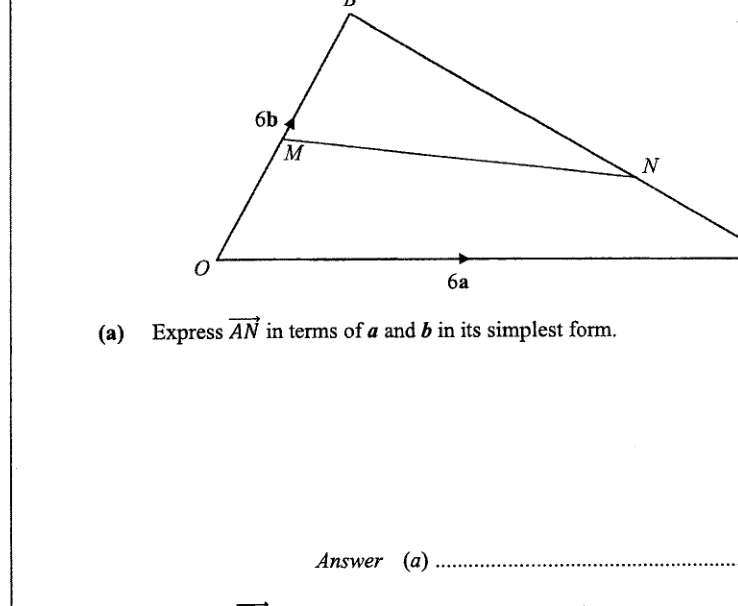
In the diagram, OA→=6a\overrightarrow{OA} = 6a, OB→=6b\overrightarrow{OB} = 6b and 3AN→=AB→3\overrightarrow{AN} = \overrightarrow{AB}. M is the mid-point of OB.

  1. (a)

    Express AN→\overrightarrow{AN} in terms of aa and bb in its simplest form.

  2. (b)

    Express ON→\overrightarrow{ON} in terms of aa and bb in its simplest form.

  3. (c)

    Hence, or otherwise, show that NM→=b−4a\overrightarrow{NM} = b - 4a.

  4. (d)

    P is a point, not shown on the diagram, such that MP→=3MN→\overrightarrow{MP} = 3\overrightarrow{MN}.

    1. (i)

      Find the position vector of P.

    2. (ii)

      Write down 2 facts about the points O, A and P.

Work through it with AI →

It won't just hand you the answer — it asks where you're stuck.How the checker works

Worked solution

22(a)

1. Express $\overrightarrow{AB}$ in terms of $a$ and $b$.

AB→=AO→+OB→\overrightarrow{AB}=\overrightarrow{AO}+\overrightarrow{OB}
Since OA→=6a\overrightarrow{OA}=6a, then AO→=−6a\overrightarrow{AO}=-6a.

AB→=−6a+6b=6b−6a\overrightarrow{AB}=-6a+6b=6b-6a

2. Use $3\overrightarrow{AN}=\overrightarrow{AB}$ to find $\overrightarrow{AN}$.

3AN→=AB→3\overrightarrow{AN}=\overrightarrow{AB}
3AN→=6b−6a3\overrightarrow{AN}=6b-6a
AN→=13(6b−6a)=2b−2a\overrightarrow{AN}=\frac{1}{3}(6b-6a)=2b-2a

Answer

AN→=2b−2a\overrightarrow{AN}=2b-2a

22(b)

1. Express $\overrightarrow{ON}$ using a suitable vector path and simplify.

ON→=OA→+AN→\overrightarrow{ON}=\overrightarrow{OA}+\overrightarrow{AN}
=6a+(2b−2a)=6a+(2b-2a)
=4a+2b=4a+2b

Answer

ON→=4a+2b\overrightarrow{ON}=4a+2b

22(c)

1. Find the position vector of $M$ using that $M$ is the midpoint of $OB$.

Since MM is the mid-point of OBOB,
OM→=12OB→=12(6b)=3b.\overrightarrow{OM}=\frac{1}{2}\overrightarrow{OB}=\frac{1}{2}(6b)=3b.

2. Express $\overrightarrow{NM}$ using a vector path through $O$ and simplify.

From part (b), ON→=4a+2b\overrightarrow{ON}=4a+2b.

NM→=NO→+OM→\overrightarrow{NM}=\overrightarrow{NO}+\overrightarrow{OM}
=−ON→+OM→=-\overrightarrow{ON}+\overrightarrow{OM}
=−(4a+2b)+3b=-(4a+2b)+3b
=b−4a.=b-4a.

Answer

NM→=b−4a\overrightarrow{NM}=b-4a

22(d)(i)

1. Find $\overrightarrow{MP}$ using the given relation and the earlier result for $\overrightarrow{NM}$.

From part (c),
NM→=b−4a\overrightarrow{NM}=b-4a.

Hence
MN→=−(b−4a)=4a−b\overrightarrow{MN}=-(b-4a)=4a-b.

Given MP→=3MN→\overrightarrow{MP}=3\overrightarrow{MN},
MP→=3(4a−b)=12a−3b.\overrightarrow{MP}=3(4a-b)=12a-3b.

2. Use the path from $O$ to $P$ through $M$ to find the position vector of $P$.

Since MM is the mid-point of OBOB and OB→=6b\overrightarrow{OB}=6b,
OM→=3b.\overrightarrow{OM}=3b.

Therefore
OP→=OM→+MP→\overrightarrow{OP}=\overrightarrow{OM}+\overrightarrow{MP}
=3b+(12a−3b)=3b+(12a-3b)
=12a.=12a.

Answer

OP→=12a\overrightarrow{OP}=12a

22(d)(ii)

1. Compare the position vectors of A and P.

Given OA→=6a\overrightarrow{OA}=6a and from part (d)(i), OP→=12a\overrightarrow{OP}=12a.

So
OP→=2OA→\overrightarrow{OP}=2\overrightarrow{OA}.

2. State the two geometrical facts about O, A and P.

Since OP→\overrightarrow{OP} is a positive scalar multiple of OA→\overrightarrow{OA}, the points OO, AA and PP lie on the same straight line.

Also, OP→=2OA→\overrightarrow{OP}=2\overrightarrow{OA}, so OA=APOA=AP. Hence AA is the midpoint of OPOP.

Answer

The points OO, AA and PP are collinear, and AA is the midpoint of OPOP.

AI analysis — may contain mistakes.

Worked this one out on paper? Snap your steps and Gigle's AI math checker will circle the step where it went wrong.

More questions on this topic

  1. 1In the diagram, OABC is a parallelogram and D is the midpoint of BC. BE and OC produced intersect at point F. It is give…
  2. 2ABCD is a parallelogram. A is the point (−6,−2)(-6,-2) and B is the point (−4,−7)(-4,-7). BC→=(8−2)\overrightarrow{BC} = \begin{pmatrix}8\\-2\end{pmatrix}…
  3. 3It is given that PQ→=(−56)\overrightarrow{PQ}=\begin{pmatrix}-5\\6\end{pmatrix} and the position vector of PP is (2−4)\begin{pmatrix}2\\-4\end{pmatrix}…