如图所示,OABC 是一个平行四边形,D 是 BC 的中点。BE 的延长线与 OC 的延长线交于点 F。 已知 BE : BF = 1 : 3,OC : OF = 1 : 2,OA = a,OC = c。
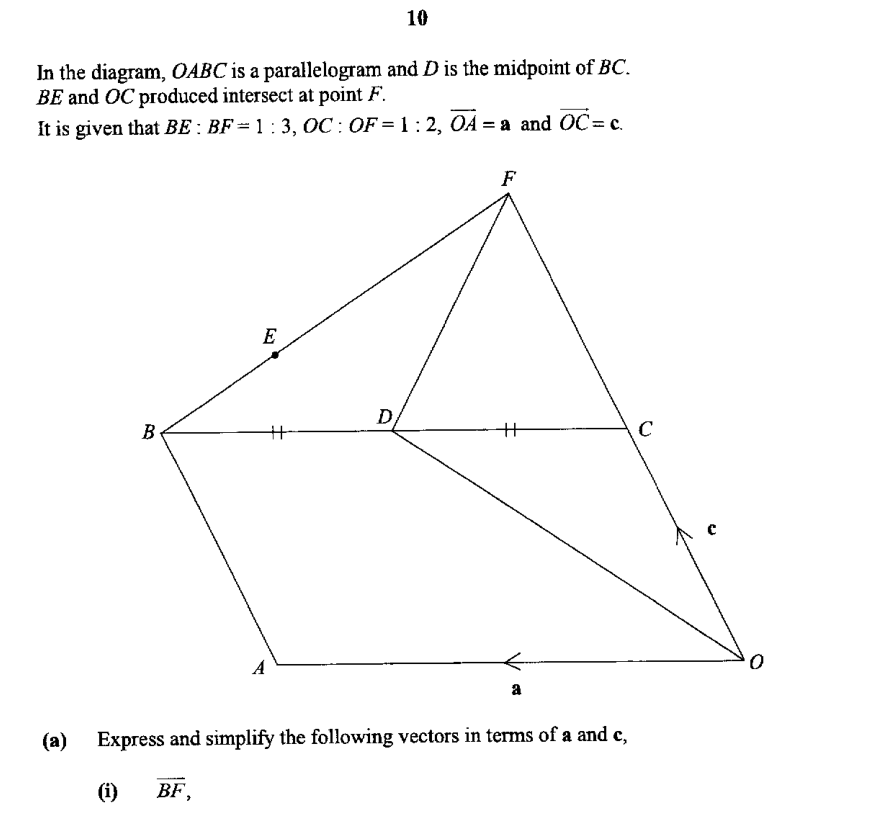
  1. (a)

    用 a 和 c 表示并化简以下向量,

    1. (i)

      BF→\overrightarrow{BF},

      答案 BF→=\overrightarrow{BF} = ...

    2. (ii)

      AE→\overrightarrow{AE},

      答案 AE→=\overrightarrow{AE} = ...

    3. (iii)

      OD→\overrightarrow{OD}。

      答案 OD→=\overrightarrow{OD} = ...

  2. (b)

    请写出清晰的解答过程,判断点 O、D 和 E 是否在同一条直线上。

    答案

  3. (c)

    求 area of triangle CDEarea of parallelogram OABC\dfrac{\text{area of triangle CDE}}{\text{area of parallelogram OABC}} 的值。

先不看答案,让 AI 诊断你卡在哪里?

它不会直接告诉你答案,而是问你卡在哪一步看看 AI 是怎么陪你一步步弄懂这道题的

完整解法

6(a)(i)

1. Express \(\overrightarrow{BF}\) using position vectors from \(O\).

Since OABCOABC is a parallelogram,
OB→=OA→+OC→=a+c.\overrightarrow{OB}=\overrightarrow{OA}+\overrightarrow{OC}=\mathbf{a}+\mathbf{c}.
Given OC:OF=1:2OC:OF=1:2,
OF→=2OC→=2c.\overrightarrow{OF}=2\overrightarrow{OC}=2\mathbf{c}.
Hence
BF→=OF→−OB→=2c−(a+c)=c−a.\overrightarrow{BF}=\overrightarrow{OF}-\overrightarrow{OB}=2\mathbf{c}-(\mathbf{a}+\mathbf{c})=\mathbf{c}-\mathbf{a}.

答案

BF→=c−a\overrightarrow{BF}=\mathbf{c}-\mathbf{a}

6(a)(ii)

1. Express $\overrightarrow{BE}$ using the ratio $BE:BF=1:3$ and the known vector $\overrightarrow{BF}$.

Since BE:BF=1:3BE:BF=1:3 and B,E,FB,E,F are collinear,
BE→=13BF→.\overrightarrow{BE}=\frac{1}{3}\overrightarrow{BF}.
Using BF→=c−a\overrightarrow{BF}=\mathbf{c}-\mathbf{a},
BE→=13(c−a).\overrightarrow{BE}=\frac{1}{3}(\mathbf{c}-\mathbf{a}).

2. Add vectors along the path $A \to B \to E$ and simplify.

In parallelogram OABCOABC,
AB→=OC→=c.\overrightarrow{AB}=\overrightarrow{OC}=\mathbf{c}.
Hence
AE→=AB→+BE→\overrightarrow{AE}=\overrightarrow{AB}+\overrightarrow{BE}
=c+13(c−a)=\mathbf{c}+\frac{1}{3}(\mathbf{c}-\mathbf{a})
=43c−13a.=\frac{4}{3}\mathbf{c}-\frac{1}{3}\mathbf{a}.

答案

AE→=43c−13a\overrightarrow{AE}=\dfrac{4}{3}\mathbf{c}-\dfrac{1}{3}\mathbf{a}

6(a)(iii)

1. Express the position vector of midpoint $D$ using the position vectors of $B$ and $C$.

In parallelogram OABCOABC,
OB→=OA→+AB→=a+c\overrightarrow{OB}=\overrightarrow{OA}+\overrightarrow{AB}=\mathbf{a}+\mathbf{c} since AB→=OC→=c\overrightarrow{AB}=\overrightarrow{OC}=\mathbf{c}.

Since DD is the midpoint of BCBC,
OD→=12(OB→+OC→)\overrightarrow{OD}=\frac{1}{2}\left(\overrightarrow{OB}+\overrightarrow{OC}\right)
=12((a+c)+c)=\frac{1}{2}\left((\mathbf{a}+\mathbf{c})+\mathbf{c}\right)
=12a+c.=\frac{1}{2}\mathbf{a}+\mathbf{c}.

答案

OD→=12a+c\overrightarrow{OD}=\dfrac{1}{2}\mathbf{a}+\mathbf{c}

6(b)

1. Find $\overrightarrow{OE}$ using the earlier result for $\overrightarrow{AE}$.

From part (a)(ii),
AE→=43c−13a\overrightarrow{AE}=\dfrac{4}{3}\mathbf{c}-\dfrac{1}{3}\mathbf{a}.

Hence
OE→=OA→+AE→\overrightarrow{OE}=\overrightarrow{OA}+\overrightarrow{AE}
=a+(43c−13a)=\mathbf{a}+\left(\dfrac{4}{3}\mathbf{c}-\dfrac{1}{3}\mathbf{a}\right)
=23a+43c.=\dfrac{2}{3}\mathbf{a}+\dfrac{4}{3}\mathbf{c}.

2. Compare $\overrightarrow{OE}$ with $\overrightarrow{OD}$.

From part (a)(iii),
OD→=12a+c.\overrightarrow{OD}=\dfrac{1}{2}\mathbf{a}+\mathbf{c}.

Now
43OD→=43(12a+c)\dfrac{4}{3}\overrightarrow{OD}=\dfrac{4}{3}\left(\dfrac{1}{2}\mathbf{a}+\mathbf{c}\right)
=23a+43c.=\dfrac{2}{3}\mathbf{a}+\dfrac{4}{3}\mathbf{c}.

Therefore
OE→=43OD→.\overrightarrow{OE}=\dfrac{4}{3}\overrightarrow{OD}.

3. Conclude whether the points are collinear.

Since OE→\overrightarrow{OE} is a scalar multiple of OD→\overrightarrow{OD}, the vectors are parallel and both start from OO.

Therefore, OO, DD and EE lie on a straight line.

答案

Since OE→=43OD→\overrightarrow{OE}=\dfrac{4}{3}\overrightarrow{OD}, points OO, DD and EE lie on a straight line.

6(c)

1. Relate the base $CD$ of the triangle to the base $OA$ of the parallelogram.

Since DD is the midpoint of BCBC and BC=OABC=OA in the parallelogram,

CD=12BC=12OA.CD=\frac{1}{2}BC=\frac{1}{2}OA.

2. Relate the height of triangle $CDE$ to the height of the parallelogram and calculate the area ratio.

From part (b),

OE→=43OD→.\overrightarrow{OE}=\frac{4}{3}\overrightarrow{OD}.

Hence EE lies beyond DD on the straight line ODOD. Since DD is on BCBC, the perpendicular distance of EE from BCBC is 13\frac{1}{3} of the height of the parallelogram.

Therefore,

area of △CDEarea of parallelogram OABC=12×CD×13hOA×h\frac{\text{area of }\triangle CDE}{\text{area of parallelogram }OABC} =\frac{\frac{1}{2}\times CD\times \frac{1}{3}h}{OA\times h}

=12×12OA×13hOA×h=\frac{\frac{1}{2}\times \frac{1}{2}OA\times \frac{1}{3}h}{OA\times h}

=112.=\frac{1}{12}.

答案

area of triangle CDEarea of parallelogram OABC=112\dfrac{\text{area of triangle }CDE}{\text{area of parallelogram }OABC}=\dfrac{1}{12}

AI 分析,可能出错

用 AI 批改,圈出写错的那一步,并自动将你的薄弱点存入错题本,形成你的错因库。

同一知识点的其他题

  1. 1在图中,OA→=6a\overrightarrow{OA} = 6a,OB→=6b\overrightarrow{OB} = 6b 且 3AN→=AB→3\overrightarrow{AN} = \overrightarrow{AB}。M 是 OB 的中点。 用 aa…
  2. 2ABCD 是平行四边形。A 是点 (−6,−2)(-6,-2),B 是点 (−4,−7)(-4,-7)。BC→=(8−2)\overrightarrow{BC} = \begin{pmatrix}8\\-2\end{pmatrix}。 求线段 AB 的长度。 答案:...…
  3. 3已知 PQ→=(−56)\overrightarrow{PQ}=\begin{pmatrix}-5\\6\end{pmatrix},且 PP 的位置向量为 (2−4)\begin{pmatrix}2\\-4\end{pmatrix}。求 模长 ∣PQ→∣\left|\overrightarrow{PQ}\right|…