The diagram shows two congruent isosceles triangles, PQS and RSQ. PQ and RS are parallel to the x-axis.
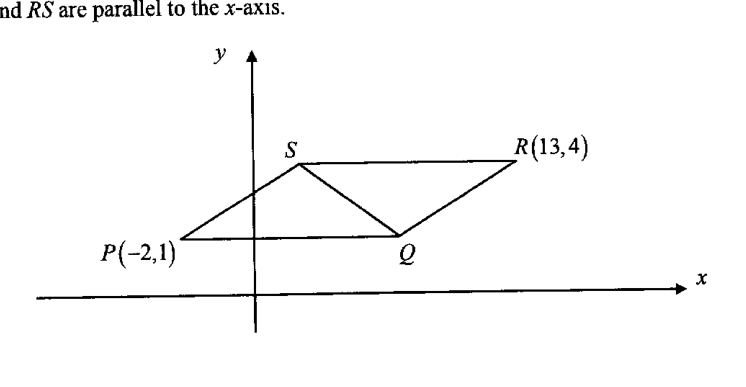
- (a)
Write down the coordinates of the point Q.
Answer ( ... , ... )
- (b)
Find the equation of the line PR.
Answer ...
- (c)
W is a point on the x-axis such that RW is perpendicular to RS.
Write down the coordinates of the point W.Answer ( ... , ... )
- (d)
Find the perimeter of PQRS.
Answer ... units
It won't just hand you the answer — it asks where you're stuck.How the checker works
Worked solution
18(a)
1. Use the horizontal sides and congruence to determine the coordinates of $Q$.
Since is parallel to the -axis and , point has -coordinate .
Since is on the -axis and is horizontal at , .
So
The triangles are congruent, so the corresponding horizontal sides are equal:
Starting from and moving units to the right,
Hence .
18(b)
1. Find the gradient of $PR$ using $P(-2,1)$ and $R(13,4)$.
2. Substitute the gradient and one point into $y=mx+c$ to find the equation.
Using and point ,
So the equation is
18(c)
1. Identify the point on the $x$-axis vertically below $R$.
Since is parallel to the -axis, is horizontal.
Therefore is vertical. Point is , so a vertical line through has .
Since is on the -axis, its -coordinate is .
Hence .
18(d)
1. Find the two horizontal side lengths $PQ$ and $RS$.
Using , , and ,
2. Find one slanted side length using Pythagoras' theorem.
For ,
horizontal difference
vertical difference
Since the triangles are congruent, .
3. Add all four side lengths to find the perimeter of $PQRS$.
units
AI analysis — may contain mistakes.
Worked this one out on paper? Snap your steps and Gigle's AI math checker will circle the step where it went wrong.
More questions on this topic
- 1直角坐标系中,点,,,且到轴、轴的距离分别为,,则点的坐标为 ___ .
- 2Sketch the graph in the spaces below. Hence, state the number of solutions for the equat…
- 3若点P(b-3,-2b)在y轴上,则点P关于x轴对称的点的坐标为( ) A. (-3,0) B. (3,0) C. (0,-6) D. (0,6)
- 4Solutions to this question by accurate drawing will not be accepted. The diagram below shows a triangle ABC, with …
- 5在平面直角坐标系中,点,,,若轴,轴,则点的坐标为 A. B. …