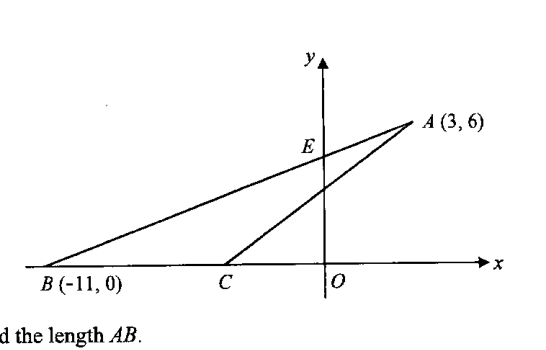
Solutions to this question by accurate drawing will not be accepted. The diagram below shows a triangle ABC, with and . Triangle has an area of . is a point on the line passing through the -axis.
- (a)
Find the length .
Answer: ...
- (b)
Find the equation of the line .
Answer: ...
- (c)
State the coordinates of .
Answer: (... , ...)
- (d)
Find the coordinates of C.
Answer: (... , ...)
- (e)
Given that ABDC is a parallelogram, find the coordinates of D.
Answer: (... , ...)
- (f)
The line l has equation .
Explain whether line l will ever cut the line AB when both lines are extended.
Show your workings clearly.
It won't just hand you the answer — it asks where you're stuck.How the checker works
Worked solution
18(a)
1. Substitute the coordinates into the distance formula.
For and ,
2. Evaluate and simplify the length.
units
18(b)
1. Find the gradient of line $AB$.
Using and ,
2. Substitute the gradient and one point into $y=mx+c$ to find the equation.
Using and point ,
So the equation is
18(c)
1. Use the fact that a point on the $y$-axis has $x=0$ and substitute into the equation of $AB$.
From part (b),
At the -axis, , so
Hence .
18(d)
1. Use the triangle area formula to find the length of $BC$.
Since and lie on the -axis, is horizontal.
The height from to the -axis is units.
2. Find the coordinates of $C$ using its position on the $x$-axis.
Point is and is on the -axis between and .
So is units to the right of :
Since lies on the -axis, .
18(e)
1. Use equal opposite sides of the parallelogram to find the coordinates of $D$.
From part (d), .
Since is a parallelogram,
So
18(f)
1. Write the equation of line $l$ in gradient-intercept form and compare with line $AB$.
For line ,
From part (b), line is
2. Use the gradients and intercepts to decide whether the lines intersect.
Both lines have gradient , but their -intercepts are different:
Therefore, the two lines are parallel and distinct, so they will never cut each other even when extended.
Line will not cut line . They are parallel since both have gradient but different -intercepts.
AI analysis — may contain mistakes.
Worked this one out on paper? Snap your steps and Gigle's AI math checker will circle the step where it went wrong.
More questions on this topic
- 1The curve has equation . Without using a calculator, find the set of values that …
- 2The points A, B, C, D and E are shown in the diagram below such that ABC and AED are straight lines and BE = …
- 3已知两定点,,平面内一动点到的距离与到的距离之比为,直线与点的轨迹交于,两点. (…
- 4已知圆的方程,过圆外一点作一条直线与圆交于两点,那么…
- 5In the diagram, A(1, 2), B(8, 5), C(13, 7) and D(13, 2) are four points. Show that , correct to 3 signif…