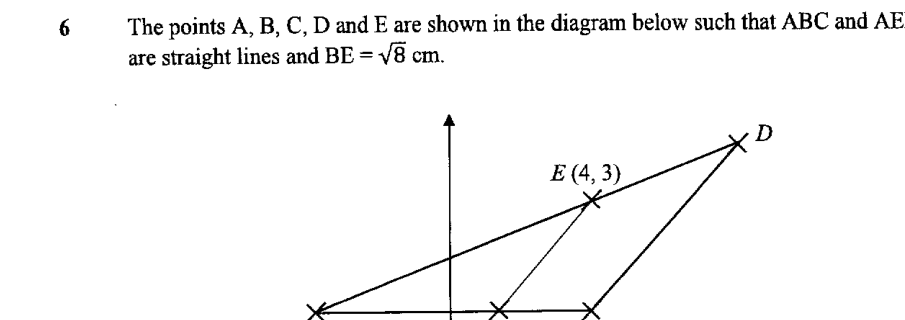
The points A, B, C, D and E are shown in the diagram below such that ABC and AED are straight lines and BE = cm.
- (a)
Without using a calculator, find
- (i)
sin ABE.
Answer: ...
- (ii)
cos ABE
Answer: ...
- (i)
- (b)
Using your answer in (a)(i), calculate the area of triangle ABE
Answer: ...
- (c)
Given that triangle ABE and triangle ACD are similar, calculate the area of triangle ACD.
Answer: ...
It won't just hand you the answer — it asks where you're stuck.How the checker works
Worked solution
6(a)(i)
1. Identify the opposite side and hypotenuse for angle ABE, then apply the sine ratio.
From to , the vertical change is
For , the opposite side is cm and the hypotenuse is cm.
6(a)(ii)
1. Use the obtuse angle property of cosine with the sine value from part (a)(i).
From part (a)(i),
.
Since is obtuse, its cosine is negative. Hence
6(b)
1. Find the length of side $AB$ from the coordinates.
Since and lie on the same horizontal line,
.
2. Apply the area formula using two sides and the included angle.
6(c)
1. Find the linear scale factor from triangle ABE to triangle ACD using corresponding sides.
Since triangles and are similar, corresponds to .
From the coordinates,
Linear scale factor from to is
2. Use the square of the linear scale factor to find the area of triangle ACD.
For similar triangles,
Using the area of from part (b),
or
AI analysis — may contain mistakes.
Worked this one out on paper? Snap your steps and Gigle's AI math checker will circle the step where it went wrong.
More questions on this topic
- 1In the diagram, there are two right-angled triangles ΔABD and ΔCEB such that AD = 12 cm, BD = 15 cm and BE = 20 cm. Find…
- 2In triangle ABC, , and . Express as a fraction in its…
- 3The diagram shows the positions of a harbour, H, a lighthouse, L, and two buoys P and Q. HPQ is a straight line. The bea…
- 4A piece of wood which was 50 cm long, was in the shape of a uniform cylinder. A prism is cut out from the wood such that…
- 5In the diagram, BA and BC are tangents to the circle with centre O. BO meets the circle at D, OA = 10 cm and BC = 28 cm.…