The diagram shows the positions of a harbour, H, a lighthouse, L, and two buoys P and Q. HPQ is a straight line. The bearing of P from H is 306°. HP = 3 km, PL = 2.5 km and angle HPL = 124°.
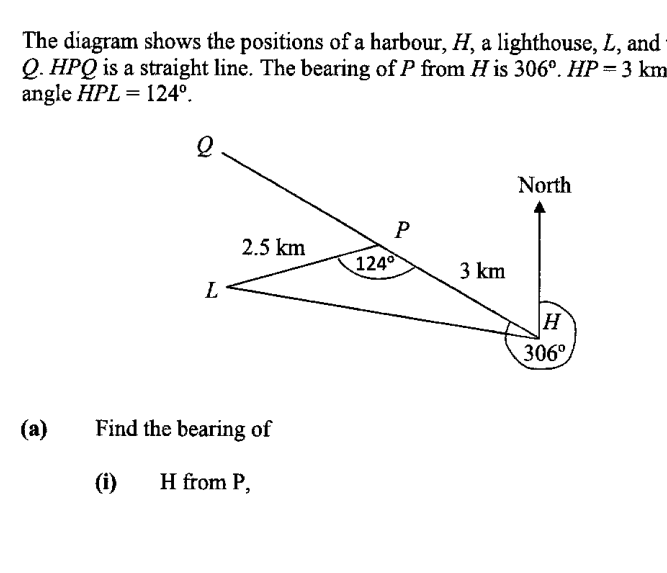
- (a)
Find the bearing of
- (i)
H from P,
Answer: ...
- (ii)
L from P.
Answer: ...
- (i)
- (b)
A helicopter is 500 m vertically above P. Find the angle of elevation from L to the helicopter.
Answer: ...
- (c)
Calculate HL.
Answer: ...
- (d)
A ship sailed from the harbour along the line HPQ at an average speed of 4.5 m/s. At 0809 hours, it reached a point X which is nearest to the lighthouse.
Find the time it left the harbour. Correct your answer to the nearest minute.
Answer: ...
It won't just hand you the answer — it asks where you're stuck.How the checker works
Worked solution
12(a)(i)
1. Find the reverse bearing from P to H
The bearing of P from H is .
The bearing of H from P is the reverse bearing, so subtract :
12(a)(ii)
1. Find the bearing of L from P using the bearing of H from P and the angle HPL
From part (a)(i), the bearing of H from P is .
Given , and is on the other side of North from ,
Written as a three-figure bearing: .
12(b)
1. Use the tangent ratio to find the angle of elevation
Let the angle of elevation be . Since ,
12(c)
1. Apply the cosine rule to triangle HPL
In , , and .
2. Calculate and give the length HL
So,
12(d)
1. Find the distance from P to the nearest point X on the line HPQ
Since is the point on nearest to , .
As is the extension of ,
In right-angled triangle ,
2. Find the total distance sailed from H to X
3. Use speed to find the travel time and subtract it from 0809 hours
Average speed .
The ship reached at hours, so it left about minutes earlier.
hours
AI analysis — may contain mistakes.
Worked this one out on paper? Snap your steps and Gigle's AI math checker will circle the step where it went wrong.
More questions on this topic
- 1In the diagram, PQRS is a vertical rectangular wall of height 2.5 m and length 7.5 m. T is a point on level ground from…
- 2The diagram shows four points P, Q, R and S which lie on level ground in a garden. P is due south of Q. The bearing of S…
- 3In the diagram, ABCDEFGH is a cuboid with dimensions 8 cm by 6 cm by 15 cm. V is the centre of the rectangular base. Sho…
- 4The figure above shows a solid. The cross-section of the solid is a sector of a circle of radius 5 cm and angle 30°. The…
- 5The diagram shows a parallelogram ABCD on horizontal ground where AC is a path. AB = 15 m and BC = 8 m. The bearing of B…