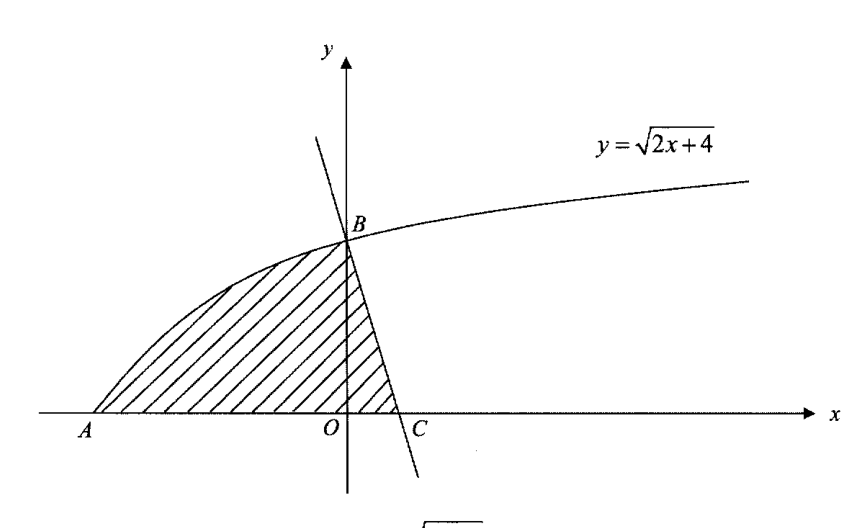
The diagram shows part of the curve y=2x+4y = \sqrt{2x + 4}, meeting the xx-axis at the point AA and the yy-axis at the point BB. The normal to the curve at BB meets the xx-axis at the point CC.

  1. (i)

    Write down the coordinates of BB.

  2. (ii)

    Find the coordinates of CC.

  3. (iii)

    Find the area of the shaded region.

Work through it with AI →

It won't just hand you the answer — it asks where you're stuck.How the checker works

Worked solution

9(i)

1. Find the y-coordinate of point B by setting x = 0

At point BB, the curve crosses the yy-axis, so x=0x = 0.
y=2(0)+4y = \sqrt{2(0) + 4}
y=4=2y = \sqrt{4} = 2

Answer

(0,2)(0, 2)

9(ii)

1. Find the derivative of the curve equation

y=(2x+4)12y = (2x + 4)^{\frac{1}{2}}
dydx=12(2x+4)−12⋅2=12x+4\frac{dy}{dx} = \frac{1}{2}(2x + 4)^{-\frac{1}{2}} \cdot 2 = \frac{1}{\sqrt{2x + 4}}

2. Find the gradient of the tangent at point $B$

At BB, x=0x = 0.
Gradient of tangent, mt=12(0)+4=12m_t = \frac{1}{\sqrt{2(0) + 4}} = \frac{1}{2}

3. Find the gradient and equation of the normal at $B$

Gradient of normal, mn=−1mt=−2m_n = -\frac{1}{m_t} = -2
Since BB is (0,2)(0, 2), the equation of the normal is:
y−2=−2(x−0)y - 2 = -2(x - 0)
y=−2x+2y = -2x + 2

4. Find the coordinates of $C$ by setting $y = 0$

At CC, the normal meets the xx-axis, so y=0y = 0.
0=−2x+20 = -2x + 2
2x=2  ⟹  x=12x = 2 \implies x = 1
Coordinates of CC are (1,0)(1, 0).

Answer

(1,0)(1, 0)

9(iii)

1. Find the coordinates of points A, B, and C from the earlier parts

For AA, y=0  ⟹  2x+4=0  ⟹  x=−2y = 0 \implies \sqrt{2x+4} = 0 \implies x = -2. So A(−2,0)A(-2, 0).
For BB, x=0  ⟹  y=4=2x = 0 \implies y = \sqrt{4} = 2. So B(0,2)B(0, 2).
dydx=12(2x+4)−12(2)=12x+4\frac{dy}{dx} = \frac{1}{2}(2x+4)^{-\frac{1}{2}}(2) = \frac{1}{\sqrt{2x+4}}.
At x=0x = 0, gradient of tangent =12= \frac{1}{2}.
Gradient of normal =−2= -2.
Equation of normal at BB: y−2=−2(x−0)  ⟹  y=−2x+2y - 2 = -2(x - 0) \implies y = -2x + 2.
For CC, y=0  ⟹  −2x+2=0  ⟹  x=1y = 0 \implies -2x + 2 = 0 \implies x = 1. So C(1,0)C(1, 0).

2. Set up the expression for the total shaded area

The shaded area is the sum of the area under the curve from x=−2x = -2 to x=0x = 0 and the area of the triangle formed by the normal from x=0x = 0 to x=1x = 1.
Area=∫−202x+4 dx+Area of △OBC\text{Area} = \int_{-2}^{0} \sqrt{2x+4} \, dx + \text{Area of } \triangle OBC

3. Evaluate the definite integral for the area under the curve

∫−20(2x+4)12 dx=[(2x+4)3232×2]−20\int_{-2}^{0} (2x+4)^{\frac{1}{2}} \, dx = \left[ \frac{(2x+4)^{\frac{3}{2}}}{\frac{3}{2} \times 2} \right]_{-2}^{0}
=[(2x+4)323]−20= \left[ \frac{(2x+4)^{\frac{3}{2}}}{3} \right]_{-2}^{0}
=4323−0=83= \frac{4^{\frac{3}{2}}}{3} - 0 = \frac{8}{3}

4. Calculate the area of the triangle and find the total area

Area of △OBC=12×base×height=12×1×2=1\text{Area of } \triangle OBC = \frac{1}{2} \times \text{base} \times \text{height} = \frac{1}{2} \times 1 \times 2 = 1
Total Area=83+1=113=323\text{Total Area} = \frac{8}{3} + 1 = \frac{11}{3} = 3\frac{2}{3}

Answer

3233\frac{2}{3}

AI analysis — may contain mistakes.

Worked this one out on paper? Snap your steps and Gigle's AI math checker will circle the step where it went wrong.

More questions on this topic

  1. 1The curve CC has equation y=x2+x+3x−2y = \frac{x^2 + x + 3}{x - 2}. Without using a calculator, find the set of values that yy…
  2. 2Find the gradient function of the curve y=2x2−ln⁡x+cy = 2x^2 - \ln x + c. The curve touches the positive xx-axis at point TT. Fi…
  3. 3The radius of a circle increases at a rate of 3 cm s^{-1}. Find, in terms of π\pi, the rate of increase of the area whe…
  4. 4定积分∫01(2x−x2)dx\int_{0}^{1}(\sqrt{2x{-}x^{2}})dx等于()({ }) A. π4\dfrac{\pi}{4} B. π2\dfrac{\pi}{2} C. π−14\dfrac{\pi{-}1}{4}…
  5. 5已知两定点M(0,1)M(0,1),N(1,2)N(1,2),平面内一动点PP到MM的距离与PP到NN的距离之比为2 \sqrt {2},直线y=kx−1y=kx-1与点PP的轨迹交于AA,BB两点. (…