上面给出了 的图像。在不同的图上分别画出以下函数的图像: 你的草图应清晰地标出任何驻点、与坐标轴的交点坐标以及任何渐近线的方程。
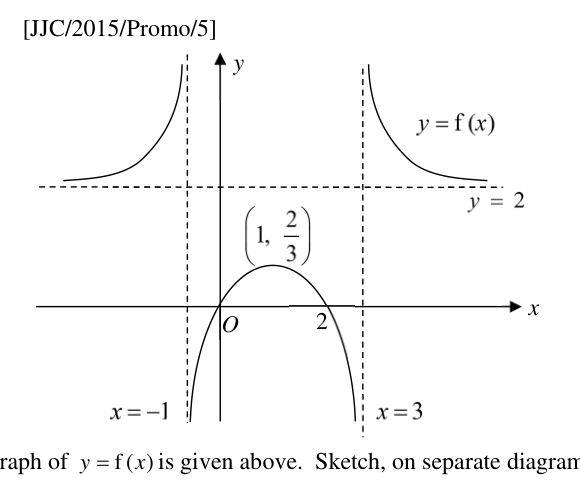
- (i)
,
- (ii)
,
- (iii)
。
它不会直接告诉你答案,而是问你卡在哪一步看看 AI 是怎么陪你一步步弄懂这道题的
完整解法
5(i)
1. Establish the coordinate mapping for the transformation
The transformation from to maps each point on the original graph to a new point .
The relationship between the -coordinates is given by:
2. Determine the new equations of the asymptotes
- Vertical asymptote
- Vertical asymptote
- The horizontal asymptote is unaffected by horizontal transformations, so it remains .
3. Calculate the new coordinates of the stationary point and intercepts
- The -intercept at . The new intercept is .
- The -intercept at . The new intercept is .
- The local maximum at . The new stationary point is .
Note: Since is now a vertical asymptote, there is no -intercept.
A sketch showing three branches with:
- Vertical asymptotes: and (the -axis)
- Horizontal asymptote:
- -intercepts at and
- Local maximum point at
5(ii)
1. Deduce the equations of the asymptotes for the derivative graph.
As , the graph of approaches the horizontal asymptote , meaning the gradient flattens out and approaches . Hence, the horizontal asymptote for is .
As and , the graph of approaches vertical asymptotes, so the curve becomes infinitely steep. Hence, the vertical asymptotes remain and .
2. Identify the x-intercept of the derivative graph from the stationary point of f(x).
The graph of has a local maximum (stationary point) at . At this maximum turning point, the gradient of the tangent is .
Hence, has an -intercept at .
3. Determine the sign and behaviour of the derivative graph in each region to complete the sketch.
Analyse the gradient of across the three intervals:
- For : is increasing, so . The gradient increases from (at ) to (near ).
- For : is increasing from , so . The gradient decreases from steepest at (near ) to (at ).
- For : is decreasing towards , so . The gradient becomes increasingly negative, dropping from to (near ).
- For : is decreasing from , so . The gradient starts very steep at (near ) and becomes less steep, approaching (at ).
The concavity of does not change sign within any of the three branches, meaning there are no stationary points for . Sketch the three branches satisfying these gradient changes.
A correct sketch of must include:
- Horizontal Asymptote:
- Vertical Asymptotes: and
- Axial Intercept:
- Left branch (): A curve above the -axis, increasing from to approach the asymptote upwards.
- Middle branch (): A curve decreasing continuously from the top of , passing through the positive -axis and the -axis at , and approaching the bottom of .
- Right branch (): A curve below the -axis, increasing from the bottom of to approach from below.
5(iii)
1. Find the vertical asymptotes and $x$-intercepts of the reciprocal graph
The -intercepts of occur at and . These become vertical asymptotes for , yielding the lines and .
The vertical asymptotes of are and . As and , , which means . Thus, has -intercepts at and .
2. Find the new horizontal asymptote and stationary point
The horizontal asymptote of is . Therefore, the horizontal asymptote of the reciprocal graph is .
The local maximum point of is . Since taking the reciprocal of positive values inverses the nature of the stationary point, will have a local minimum at .
3. Determine the limits and asymptotic behaviour to shape the branches
For and , is positive and greater than (approaching as ). Thus, is positive, less than , and approaches the horizontal asymptote from below.
Between the vertical asymptotes and , changes sign as it passes through and . Consequently:
- As ,
- As ,
This shows the curve cuts through smoothly. A similar crossing from negative to positive occurs at .
A sketch of the graph showing:
- Vertical asymptotes at (the -axis) and .
- A horizontal asymptote at .
- -intercepts at and .
- A local minimum point at .
The curve consists of three continuous branches bounded by the vertical asymptotes:
- For , it approaches from below as , passes down through , and tends to as .
- For , a U-shaped curve tending to as it approaches the vertical asymptotes and , passing through the local minimum at .
- For , it emerges from as , passes up through , and approaches from below as .
AI 分析,可能出错
用 AI 批改,圈出写错的那一步,并自动将你的薄弱点存入错题本,形成你的错因库。