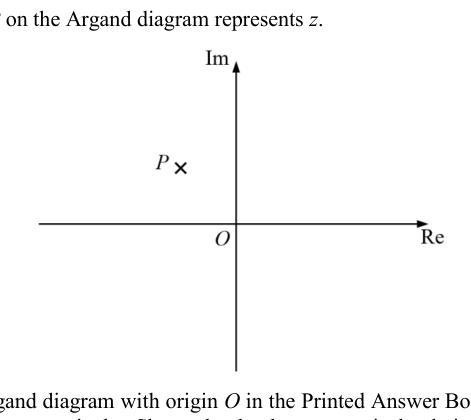
回答本题时请勿使用计算器。 复数 zz 的模为 1,辐角为 θ\theta,其中 π2<θ<π\frac{\pi}{2} < \theta < \pi,且复数 ww 由 w=i3zw = \mathrm{i}\sqrt{3}z 给出。阿尔冈图上的点 PP 表示 zz。

  1. (a)

    在答题纸中带有原点 OO 的阿尔冈图副本上,描出分别表示 ww 和 z−wz - w 的点 QQ 和 RR。清楚地展示点 PP、QQ 和 RR 之间的几何关系。

  2. (b)

    求四边形 ORPQORPQ 的面积。

  3. (c)

    已知 θ=3π4\theta = \frac{3\pi}{4}。

    求 zz 的形式 x+yix + y\mathrm{i},其中 xx 和 yy 为实数。

  4. (d)

    证明 z−w=k[(3−1)+(3+1)i]z - w = k\left[\left(\sqrt{3} - 1\right) + \left(\sqrt{3} + 1\right)\mathrm{i}\right],其中 kk 是一个待确定的常数。

  5. (e)

    由此证明 tan⁡5π12=3+13−1\tan\frac{5\pi}{12} = \frac{\sqrt{3} + 1}{\sqrt{3} - 1}。

先不看答案,让 AI 诊断你卡在哪里?

它不会直接告诉你答案,而是问你卡在哪一步看看 AI 是怎么陪你一步步弄懂这道题的

完整解法

4(a)

1. Determine the position of $Q$ based on the relationship $w = \mathrm{i}\sqrt{3}z$.

Since w=i3zw = \mathrm{i}\sqrt{3}z, the modulus is ∣w∣=∣i3∣∣z∣=3∣z∣|w| = |\mathrm{i}\sqrt{3}| |z| = \sqrt{3}|z|.
The argument is arg⁡(w)=arg⁡(i)+arg⁡(z)=π2+θ\arg(w) = \arg(\mathrm{i}) + \arg(z) = \frac{\pi}{2} + \theta.
Thus, to plot QQ, we rotate the segment OPOP by 90∘90^\circ (π2\frac{\pi}{2} radians) anticlockwise and scale its length by a factor of 3\sqrt{3}. Because PP is in the 2nd quadrant, adding 90∘90^\circ places QQ in the 3rd quadrant.

2. Determine the position of $R$ using vector addition/subtraction.

The point RR represents z−wz - w. In vector form, OR⃗=OP⃗−OQ⃗\vec{OR} = \vec{OP} - \vec{OQ}.
We can rearrange this as OP⃗=OR⃗+OQ⃗\vec{OP} = \vec{OR} + \vec{OQ}, meaning that PP is the fourth vertex of a parallelogram formed by O,R,O, R, and QQ.
Alternatively, observe that QP⃗=OP⃗−OQ⃗=z−w=OR⃗\vec{QP} = \vec{OP} - \vec{OQ} = z - w = \vec{OR}. Therefore, RR is obtained by drawing a vector from OO that is parallel and equal in length to QPQP.

3. State and visually indicate the required geometrical relationship.

Because OR⃗=QP⃗\vec{OR} = \vec{QP} and OQ⃗=RP⃗\vec{OQ} = \vec{RP}, the four points O,R,P,O, R, P, and QQ form a parallelogram (ORPQORPQ).
To 'show clearly' this relationship on the Argand diagram, the line segments OR,RP,PQ,OR, RP, PQ, and QOQO should be drawn (often with dashed lines for RPRP and QPQP) to explicitly display the parallelogram.

答案
  • QQ is plotted in the 3rd quadrant such that OQ⊥OPOQ \perp OP and the length of OQOQ is 3\sqrt{3} (approx. 1.731.73) times the length of OPOP.
  • RR is plotted such that OR⃗=QP⃗\vec{OR} = \vec{QP}, completing the shape.
  • Geometrical relationship: The points O,R,PO, R, P, and QQ form a parallelogram. This is shown on the diagram by drawing the line segments OQ,QP,PR,OQ, QP, PR, and RORO to form the parallelogram ORPQORPQ.

4(b)

1. Deduce the shape of the quadrilateral $ORPQ$.

Let the position vectors in the Argand diagram be OP⃗=z\vec{OP} = z, OQ⃗=w\vec{OQ} = w, and OR⃗=z−w\vec{OR} = z - w.
We find the vector QP⃗\vec{QP}:
QP⃗=OP⃗−OQ⃗=z−w\vec{QP} = \vec{OP} - \vec{OQ} = z - w
Since OR⃗=z−w=QP⃗\vec{OR} = z - w = \vec{QP}, the line segments OROR and QPQP are parallel and equal in length. Therefore, the quadrilateral ORPQORPQ is a parallelogram.

2. Evaluate the lengths of the line segments $OP$ and $OQ$, and the angle between them.

Using the given ∣z∣=1|z| = 1 and w=i3zw = \mathrm{i}\sqrt{3}z:
∣OP∣=∣z∣=1|OP| = |z| = 1
∣OQ∣=∣w∣=∣i3z∣=3∣z∣=3|OQ| = |w| = |\mathrm{i}\sqrt{3}z| = \sqrt{3}|z| = \sqrt{3}
The factor of i\mathrm{i} in w=i3zw = \mathrm{i}\sqrt{3}z indicates that the vector OQ⃗\vec{OQ} is rotated π2\frac{\pi}{2} radians (90∘90^\circ) anticlockwise from OP⃗\vec{OP}.
Thus, OP⊥OQOP \perp OQ.

3. Calculate the area of the parallelogram.

Treating OQOQ as the base of the parallelogram ORPQORPQ:
Since OP⊥OQOP \perp OQ, the perpendicular height of the parallelogram from the line OQOQ to the opposite side RPRP is exactly the length ∣OP∣|OP|.
Area of ORPQ=base×height=∣OQ∣×∣OP∣\text{Area of } ORPQ = \text{base} \times \text{height} = |OQ| \times |OP|
Area=3×1=3\text{Area} = \sqrt{3} \times 1 = \sqrt{3}

答案

3\sqrt{3}

4(c)

1. Substitute the given modulus and argument into the trigonometric form of a complex number

A complex number zz with modulus rr and argument θ\theta is given by z=r(cos⁡θ+isin⁡θ)z = r(\cos\theta + \mathrm{i}\sin\theta).

Given ∣z∣=1|z| = 1 (from the main question stem) and θ=3π4\theta = \frac{3\pi}{4},
z=1(cos⁡3π4+isin⁡3π4)z = 1\left(\cos\frac{3\pi}{4} + \mathrm{i}\sin\frac{3\pi}{4}\right)

2. Evaluate the exact trigonometric values to express $z$ in Cartesian form

Since calculators are not allowed, we use the exact values for the trigonometric ratios:
cos⁡3π4=−22\cos\frac{3\pi}{4} = -\frac{\sqrt{2}}{2}
sin⁡3π4=22\sin\frac{3\pi}{4} = \frac{\sqrt{2}}{2}

Substituting these in gives:
z=−22+22iz = -\frac{\sqrt{2}}{2} + \frac{\sqrt{2}}{2}\mathrm{i}

答案

−22+22i-\frac{\sqrt{2}}{2} + \frac{\sqrt{2}}{2}\mathrm{i}

4(d)

1. Find the cartesian form of $z$ using the given modulus and argument.

From part (c), we are given θ=3π4\theta = \frac{3\pi}{4} and ∣z∣=1|z| = 1.
z=cos⁡3π4+isin⁡3π4z = \cos\frac{3\pi}{4} + \mathrm{i}\sin\frac{3\pi}{4}
z=−22+22iz = -\frac{\sqrt{2}}{2} + \frac{\sqrt{2}}{2}\mathrm{i}

2. Substitute $z$ into the expression for $z - w$ and expand.

Substitute w=i3zw = \mathrm{i}\sqrt{3}z into z−wz - w:
z−w=z−i3z=z(1−i3)z - w = z - \mathrm{i}\sqrt{3}z = z(1 - \mathrm{i}\sqrt{3})
z−w=(−22+22i)(1−i3)z - w = \left( -\frac{\sqrt{2}}{2} + \frac{\sqrt{2}}{2}\mathrm{i} \right)(1 - \mathrm{i}\sqrt{3})
Expanding the product:
=−22+i62+i22−i262= -\frac{\sqrt{2}}{2} + \mathrm{i}\frac{\sqrt{6}}{2} + \mathrm{i}\frac{\sqrt{2}}{2} - \mathrm{i}^2\frac{\sqrt{6}}{2}
=−22+62+(62+22)i= -\frac{\sqrt{2}}{2} + \frac{\sqrt{6}}{2} + \left( \frac{\sqrt{6}}{2} + \frac{\sqrt{2}}{2} \right)\mathrm{i}

3. Factorise the expanded expression to match the required form and determine $k$.

z−w=(6−22)+(6+22)iz - w = \left( \frac{\sqrt{6} - \sqrt{2}}{2} \right) + \left( \frac{\sqrt{6} + \sqrt{2}}{2} \right)\mathrm{i}
Extracting 22\frac{\sqrt{2}}{2} as a common factor:
z−w=22[(3−1)+(3+1)i]z - w = \frac{\sqrt{2}}{2} \left[ (\sqrt{3} - 1) + (\sqrt{3} + 1)\mathrm{i} \right]
Comparing this to k[(3−1)+(3+1)i]k\left[\left(\sqrt{3} - 1\right) + \left(\sqrt{3} + 1\right)\mathrm{i}\right], we can see that the expression matches the required form with:
k=22k = \frac{\sqrt{2}}{2}

答案

k=22k = \frac{\sqrt{2}}{2}

4(e)

1. Find the argument of $z - w$ algebraically by factorising.

z−w=z−i3z=z(1−i3)z - w = z - \mathrm{i}\sqrt{3}z = z(1 - \mathrm{i}\sqrt{3})
arg⁡(z−w)=arg⁡(z)+arg⁡(1−i3)\arg(z - w) = \arg(z) + \arg(1 - \mathrm{i}\sqrt{3})
From part (c), arg⁡(z)=θ=3π4\arg(z) = \theta = \frac{3\pi}{4}. The complex number 1−i31 - \mathrm{i}\sqrt{3} lies in the fourth quadrant:
arg⁡(1−i3)=tan⁡−1(−31)=−π3\arg(1 - \mathrm{i}\sqrt{3}) = \tan^{-1}\left(\frac{-\sqrt{3}}{1}\right) = -\frac{\pi}{3}
arg⁡(z−w)=3π4−π3=9π12−4π12=5π12\arg(z - w) = \frac{3\pi}{4} - \frac{\pi}{3} = \frac{9\pi}{12} - \frac{4\pi}{12} = \frac{5\pi}{12}

2. Find the argument of $z - w$ using the Cartesian form from part (d).

From part (d), z−w=k[(3−1)+(3+1)i]z - w = k\left[(\sqrt{3} - 1) + (\sqrt{3} + 1)\mathrm{i}\right], where k=22k = \frac{\sqrt{2}}{2}.
Since k>0k > 0, 3−1>0\sqrt{3} - 1 > 0, and 3+1>0\sqrt{3} + 1 > 0, the complex number z−wz - w lies in the first quadrant.
arg⁡(z−w)=tan⁡−1(k(3+1)k(3−1))=tan⁡−1(3+13−1)\arg(z - w) = \tan^{-1}\left(\frac{k(\sqrt{3} + 1)}{k(\sqrt{3} - 1)}\right) = \tan^{-1}\left(\frac{\sqrt{3} + 1}{\sqrt{3} - 1}\right)

3. Equate the two expressions for the argument to prove the identity.

Equating the two values for arg⁡(z−w)\arg(z - w):
5π12=tan⁡−1(3+13−1)\frac{5\pi}{12} = \tan^{-1}\left(\frac{\sqrt{3} + 1}{\sqrt{3} - 1}\right)
Taking the tangent of both sides:
tan⁡5π12=3+13−1(shown)\tan\frac{5\pi}{12} = \frac{\sqrt{3} + 1}{\sqrt{3} - 1} \quad \text{(shown)}

答案

Shown\text{Shown}

AI 分析,可能出错

用 AI 批改,圈出写错的那一步,并自动将你的薄弱点存入错题本,形成你的错因库。

同一知识点的其他题

  1. 1解方程 iz5=−32i z^5 = -32,将根写成 reiθre^{i\theta} 的形式,其中 r>0r>0 且 −π<θ≤π-\pi<\theta\le\pi。在阿甘特图上描绘出代表这些根的点 P1,P2,P3,P4P_1, P_2, P_3, P_4 和 P5P_5,其…
  2. 2解方程 iz5=−32iz^5=-32,求出其根并表示为 reiθre^{i\theta} 的形式,其中 r>0r>0 且 −π<θ≤π-\pi<\theta\le\pi。在阿甘图上描绘出代表这些根的点 P1,P2,P3,P4P_1, P_2, P_3, P_4 和 P5P_5,其…
  3. 3复数 zz 满足方程 2 z3=1+22a−1 i,\sqrt{2}\,z^{3} = 1 + \dfrac{2}{2a - 1}\,i , 其中 aa 是实数。 已知 arg⁡(z3)=−π4\arg\bigl(z^{3}\bigr) = -\dfrac{\pi}{4}。 证…
  4. 4复数 aa 的模为 rr,辐角为 θ\theta,其中 r∈R+r \in \mathbb{R}^+ 且 0<θ<π20 < \theta < \frac{\pi}{2}。复数 bb 满足 b=−2iab = -2ia,复数 cc 为纯虚数且虚部为负…
  5. 5点 A 表示一个固定的复数 aa,满足 −π2<arg⁡a<0-\dfrac{\pi}{2}<\arg a<0。复数 iaia 和 a+iaa+ia 分别由点 B 和 C 表示。在清晰标注的阿甘图(Argand diagram)上,画出点 A、B、C 以及表示…