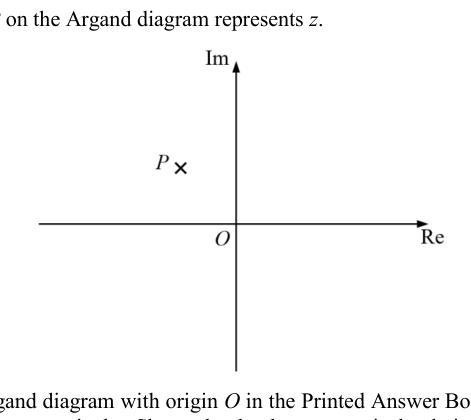
Do not use a calculator in answering this question. The complex number has modulus 1 and argument , where , and the complex number is given by . The point on the Argand diagram represents .
- (a)
On the copy of the Argand diagram with origin in the Printed Answer Booklet, plot the points and to represent and respectively. Show clearly the geometrical relationship between the points , and .
- (b)
Find the area of the quadrilateral .
- (c)
It is given that .
Find in the form , where and are real numbers.
- (d)
Show that , where is a constant to be determined.
- (e)
Hence show that .
It won't just hand you the answer — it asks where you're stuck.How the checker works
Worked solution
4(a)
1. Determine the position of $Q$ based on the relationship $w = \mathrm{i}\sqrt{3}z$.
Since , the modulus is .
The argument is .
Thus, to plot , we rotate the segment by ( radians) anticlockwise and scale its length by a factor of . Because is in the 2nd quadrant, adding places in the 3rd quadrant.
2. Determine the position of $R$ using vector addition/subtraction.
The point represents . In vector form, .
We can rearrange this as , meaning that is the fourth vertex of a parallelogram formed by and .
Alternatively, observe that . Therefore, is obtained by drawing a vector from that is parallel and equal in length to .
3. State and visually indicate the required geometrical relationship.
Because and , the four points and form a parallelogram ().
To 'show clearly' this relationship on the Argand diagram, the line segments and should be drawn (often with dashed lines for and ) to explicitly display the parallelogram.
- is plotted in the 3rd quadrant such that and the length of is (approx. ) times the length of .
- is plotted such that , completing the shape.
- Geometrical relationship: The points , and form a parallelogram. This is shown on the diagram by drawing the line segments and to form the parallelogram .
4(b)
1. Deduce the shape of the quadrilateral $ORPQ$.
Let the position vectors in the Argand diagram be , , and .
We find the vector :
Since , the line segments and are parallel and equal in length. Therefore, the quadrilateral is a parallelogram.
2. Evaluate the lengths of the line segments $OP$ and $OQ$, and the angle between them.
Using the given and :
The factor of in indicates that the vector is rotated radians () anticlockwise from .
Thus, .
3. Calculate the area of the parallelogram.
Treating as the base of the parallelogram :
Since , the perpendicular height of the parallelogram from the line to the opposite side is exactly the length .
4(c)
1. Substitute the given modulus and argument into the trigonometric form of a complex number
A complex number with modulus and argument is given by .
Given (from the main question stem) and ,
2. Evaluate the exact trigonometric values to express $z$ in Cartesian form
Since calculators are not allowed, we use the exact values for the trigonometric ratios:
Substituting these in gives:
4(d)
1. Find the cartesian form of $z$ using the given modulus and argument.
From part (c), we are given and .
2. Substitute $z$ into the expression for $z - w$ and expand.
Substitute into :
Expanding the product:
3. Factorise the expanded expression to match the required form and determine $k$.
Extracting as a common factor:
Comparing this to , we can see that the expression matches the required form with:
4(e)
1. Find the argument of $z - w$ algebraically by factorising.
From part (c), . The complex number lies in the fourth quadrant:
2. Find the argument of $z - w$ using the Cartesian form from part (d).
From part (d), , where .
Since , , and , the complex number lies in the first quadrant.
3. Equate the two expressions for the argument to prove the identity.
Equating the two values for :
Taking the tangent of both sides:
AI analysis — may contain mistakes.
Worked this one out on paper? Snap your steps and Gigle's AI math checker will circle the step where it went wrong.
More questions on this topic
- 1Solve the equation , giving your roots in the form , where and . Ske…
- 2Solve the equation , giving your roots in the form , where and . Sketch…
- 3The complex number satisfies the equation where is a real numbe…
- 4The complex number has modulus and argument , where and …
- 5The point A represents a fixed complex number a such that . The complex numbers and …