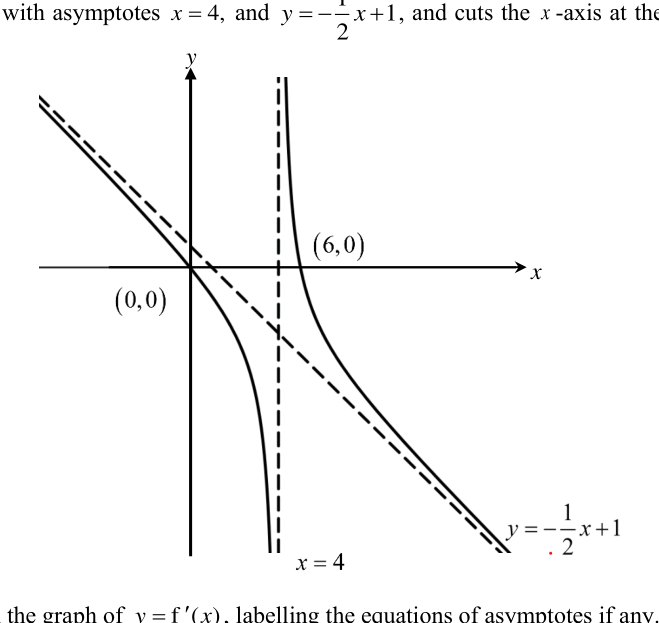
下图显示了曲线 C1C_1 的图像,其方程为 y=f(x)y = \mathrm{f}(x),定义域为 x∈R∖{4}x \in \mathbb{R} \setminus \{4\},渐近线为 x=4x = 4 和 y=−12x+1y = -\frac{1}{2}x + 1,且与 xx 轴交于原点和 (6,0)(6,0)。

  1. (a)

    草拟 y=f′(x)y = \mathrm{f}'(x) 的图像,并标出渐近线的方程(若有)。

  2. (b)

    已知另一条曲线 C2C_2 的方程为 (y+1)2k2−(x−4)2=1\frac{(y+1)^2}{k^2} - (x-4)^2 = 1,其中 kk 是正常数。描述一系列将 y2−x2=1y^2 - x^2 = 1 的图像变换到 C2C_2 图像上的几何变换。

  3. (c)

    确定 kk 的取值范围,使得 C1C_1 和 C2C_2 恰好相交 2 次。

先不看答案,让 AI 诊断你卡在哪里?

它不会直接告诉你答案,而是问你卡在哪一步看看 AI 是怎么陪你一步步弄懂这道题的

完整解法

6(a)

1. Identify the asymptotes of the derivative graph.

As x→±∞x \to \pm\infty, the curve y=f(x)y = \mathrm{f}(x) approaches the oblique asymptote y=−12x+1y = -\frac{1}{2}x + 1.
The gradient of the curve approaches the gradient of this line, which is −12-\frac{1}{2}.
Therefore, y=f′(x)y = \mathrm{f}'(x) has a horizontal asymptote at y=−12y = -\frac{1}{2}.

As x→4x \to 4, the curve of f(x)\mathrm{f}(x) becomes infinitely steep, meaning the gradient approaches infinity in magnitude.
Therefore, x=4x = 4 remains a vertical asymptote for y=f′(x)y = \mathrm{f}'(x).

2. Determine the shape and sign of the graph of $y = \mathrm{f}'(x)$.

For x<4x < 4, the graph of y=f(x)y = \mathrm{f}(x) is decreasing. As it moves from x→−∞x \to -\infty towards x=4x=4, its gradient changes from −12-\frac{1}{2} to increasingly negative values, so f′(x)→−∞\mathrm{f}'(x) \to -\infty as x→4−x \to 4^-.

For x>4x > 4, the graph of y=f(x)y = \mathrm{f}(x) is also decreasing. As it moves from x=4x=4 towards x→∞x \to \infty, its gradient changes from −∞-\infty back to −12-\frac{1}{2}.

Because the gradient is always strictly negative and steeper than the oblique asymptote, the entire graph of f′(x)\mathrm{f}'(x) lies below y=−12y = -\frac{1}{2}. Both branches start near y=−12y = -\frac{1}{2} as x→±∞x \to \pm\infty and curve downwards to −∞-\infty as they approach x=4x = 4.

答案

A sketch of y=f′(x)y = \mathrm{f}'(x) on Cartesian axes showing:

  • A horizontal asymptote at y=−12y = -\frac{1}{2}
  • A vertical asymptote at x=4x = 4
  • Two curve branches, one for x<4x < 4 and one for x>4x > 4, both lying entirely below y=−12y = -\frac{1}{2}
  • As x→±∞x \to \pm\infty, the curves approach y=−12y = -\frac{1}{2} from below
  • As x→4−x \to 4^- and x→4+x \to 4^+, the curves approach −∞-\infty

6(b)

1. Identify the scaling transformation required to modify the $y$ term.

Starting with y2−x2=1y^2 - x^2 = 1, replacing yy with yk\frac{y}{k} gives:
(yk)2−x2=1  ⟹  y2k2−x2=1\left(\frac{y}{k}\right)^2 - x^2 = 1 \implies \frac{y^2}{k^2} - x^2 = 1
This corresponds to a scaling parallel to the yy-axis by a scale factor of kk.

2. Identify the translation required to shift the graph to its final position.

Next, replacing xx with (x−4)(x-4) and yy with (y+1)(y+1) gives:
(y+1)2k2−(x−4)2=1\frac{(y+1)^2}{k^2} - (x-4)^2 = 1
This corresponds to a translation of 4 units in the positive xx-direction and 1 unit in the negative yy-direction.

3. State the full sequence of transformations in the correct order.

Since the scaling was applied to yy before the translation of yy, the correct sequence is the scaling followed by the translation.

答案
  1. A scaling parallel to the yy-axis by a scale factor of kk.
  2. A translation by 4 units in the positive xx-direction and 1 unit in the negative yy-direction (or translation by the vector (4−1)\begin{pmatrix} 4 \\ -1 \end{pmatrix}).

6(c)

1. Determine the equation of the curve $C_1$.

Since C1C_1 has a vertical asymptote x=4x=4 and an oblique asymptote y=−12x+1y=-\frac{1}{2}x+1, we can express its equation in the standard rational form:
y=−12x+1+Ax−4y = -\frac{1}{2}x + 1 + \frac{A}{x-4}
Given that C1C_1 passes through the origin (0,0)(0,0):
0=−12(0)+1+A0−4  ⟹  0=1−A4  ⟹  A=40 = -\frac{1}{2}(0) + 1 + \frac{A}{0-4} \implies 0 = 1 - \frac{A}{4} \implies A = 4
To verify, we check with the other given xx-intercept (6,0)(6,0):
y=−12(6)+1+46−4=−3+1+2=0y = -\frac{1}{2}(6) + 1 + \frac{4}{6-4} = -3 + 1 + 2 = 0
which is consistent. Thus, the equation of C1C_1 is y=−12x+1+4x−4y = -\frac{1}{2}x + 1 + \frac{4}{x-4}.

2. Set up the intersection equation between $C_1$ and $C_2$.

We find the intersections of C1C_1 and C2C_2. Rearranging C1C_1:
y+1=−12(x−4)+4x−4y + 1 = -\frac{1}{2}(x-4) + \frac{4}{x-4}
The equation of C2C_2 is given by:
(y+1)2k2−(x−4)2=1\frac{(y+1)^2}{k^2} - (x-4)^2 = 1
Let X=x−4X = x-4 and Y=y+1Y = y+1. Then C1C_1 becomes Y=−12X+4XY = -\frac{1}{2}X + \frac{4}{X} and C2C_2 becomes Y2k2−X2=1\frac{Y^2}{k^2} - X^2 = 1, which can be rewritten as Y2−k2X2=k2Y^2 - k^2 X^2 = k^2.
Substituting YY into C2C_2:
(−12X+4X)2−k2X2=k2\left(-\frac{1}{2}X + \frac{4}{X}\right)^2 - k^2 X^2 = k^2

3. Simplify the intersection condition to a polynomial in $X^2$.

Expand the squared term:
14X2−4+16X2−k2X2=k2\frac{1}{4}X^2 - 4 + \frac{16}{X^2} - k^2 X^2 = k^2
Group the terms:
(14−k2)X2−(k2+4)+16X2=0\left(\frac{1}{4} - k^2\right)X^2 - (k^2 + 4) + \frac{16}{X^2} = 0
Multiply throughout by X2X^2 (since x≠4  ⟹  X≠0x \neq 4 \implies X \neq 0):
(14−k2)X4−(k2+4)X2+16=0\left(\frac{1}{4} - k^2\right)X^4 - (k^2 + 4)X^2 + 16 = 0
Let U=X2U = X^2. Since X≠0X \neq 0 for x∈R∖{4}x \in \mathbb{R} \setminus \{4\}, we require valid real intersections to correspond to U>0U > 0.
(14−k2)U2−(k2+4)U+16=0\left(\frac{1}{4} - k^2\right)U^2 - (k^2 + 4)U + 16 = 0

4. Analyze the conditions for exactly two intersections (linear case).

For C1C_1 and C2C_2 to intersect exactly 2 times, there must be exactly 2 valid values for XX. Since X=±UX = \pm\sqrt{U}, this requires the equation in UU to have exactly one positive real root.
Case 1: The leading coefficient is zero.
14−k2=0  ⟹  k=12 (since k>0)\frac{1}{4} - k^2 = 0 \implies k = \frac{1}{2} \text{ (since } k > 0 \text{)}
Substitute k=12k = \frac{1}{2} into the equation:
0⋅U2−(14+4)U+16=0  ⟹  −4.25U+16=0  ⟹  U=164.25>00 \cdot U^2 - \left(\frac{1}{4} + 4\right)U + 16 = 0 \implies -4.25U + 16 = 0 \implies U = \frac{16}{4.25} > 0
This yields exactly 1 positive root for UU (meaning exactly two XX values), so k=12k = \frac{1}{2} is a valid solution.

5. Analyze the conditions for exactly two intersections (quadratic case) to find the final range.

Case 2: The leading coefficient is non-zero (14−k2≠0\frac{1}{4} - k^2 \neq 0).
The quadratic equation has a yy-intercept of C=16≠0C = 16 \neq 0. To have exactly one positive root (and one negative root, since 0 is not a root), the product of the roots must be negative.
Product of roots=1614−k2<0\text{Product of roots} = \frac{16}{\frac{1}{4} - k^2} < 0
Since the numerator 16>016 > 0, the denominator must be negative:
14−k2<0  ⟹  k2>14\frac{1}{4} - k^2 < 0 \implies k^2 > \frac{1}{4}
Given k>0k > 0, this yields k>12k > \frac{1}{2}.
(Note: The discriminant Δ=(k2+4)2−64(14−k2)=k4+72k2>0\Delta = (k^2+4)^2 - 64(\frac{1}{4}-k^2) = k^4 + 72k^2 > 0 for all k>0k>0, so the roots are never equal, ruling out a double positive root).

Combining the results from Case 1 and Case 2, the range of values for kk is k≥12k \ge \frac{1}{2}.

答案

k≥12k \ge \frac{1}{2}

AI 分析,可能出错

用 AI 批改,圈出写错的那一步,并自动将你的薄弱点存入错题本,形成你的错因库。

同一知识点的其他题

  1. 1曲线 C1C_1 的方程为 p2x2−y2=p2p^2x^2 - y^2 = p^2,其中 p>1p > 1。 画出 C1C_1 的草图,用 pp 表示出其与坐标轴的所有交点坐标、所有驻点坐标以及所有渐近线方程。 C1C_1 经过单一变换得到 C2C_2。…
  2. 2图中给出了 y=f(∣x∣)y = \mathrm{f}(|x|) 和 y=f′(x)y = \mathrm{f}'(x) 的图像。 y=f(∣x∣)y = \mathrm{f}(|x|) 的图像在 (−3,4)(-3, 4) 和 (3,4)(3, 4) 处有转折点,交 xx 轴于 (−2,0)(-2, 0)…
  3. 3图示为曲线 y=f(1−x)y = \text{f}(1-x)。该曲线的极大值点为 (−1,5)(-1, 5),且有两条渐近线 x=−2x = -2 and y=1y = 1。 在不同的图上,分别画出下列函数的图像草图: y=f(x)y = \text{f}(x), y=g′(x)y = \text{g}'(x)…
  4. 4函数 y=f(x)y = \text{f}(x) 的图像在 (2,3)(2,3) 处有一个极大值转折点,且经过原点。直线 x=−1x = -1 和 y=2y = 2 是该图像的渐近线,如下图所示。 求使 y=1f(x)y = \frac{1}{\text{f}(x)}…
  5. 5下图显示了 y=f(x)y = f(x) 的图像。该曲线在 (0,a)(0,a) 处有一个极值点,且直线 y=±kxy = \pm kx 是该曲线的渐近线,其中 aa 和 kk 是正实常数。 [续] 现在已知 f(x)=a1+x2\mathrm{f}(x) = a\sqrt{1+x^2}…