The diagram below shows the graph of curve , with equation , defined for , with asymptotes , and , and cuts the -axis at the origin and .
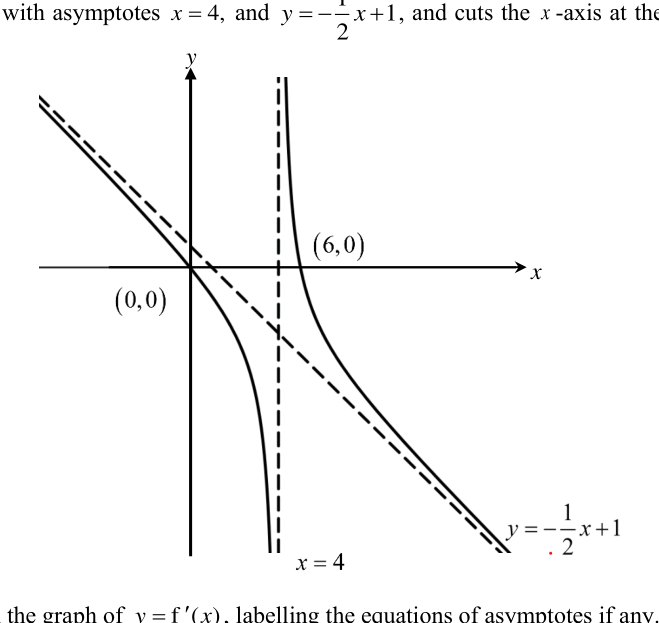
- (a)
Sketch the graph of , labelling the equations of asymptotes if any.
- (b)
Given another curve has equation , where is a positive constant. Describe a sequence of transformations that transform the graph of onto the graph of .
- (c)
Determine the range of values of for which and intersect exactly 2 times.
It won't just hand you the answer — it asks where you're stuck.How the checker works
Worked solution
6(a)
1. Identify the asymptotes of the derivative graph.
As , the curve approaches the oblique asymptote .
The gradient of the curve approaches the gradient of this line, which is .
Therefore, has a horizontal asymptote at .
As , the curve of becomes infinitely steep, meaning the gradient approaches infinity in magnitude.
Therefore, remains a vertical asymptote for .
2. Determine the shape and sign of the graph of $y = \mathrm{f}'(x)$.
For , the graph of is decreasing. As it moves from towards , its gradient changes from to increasingly negative values, so as .
For , the graph of is also decreasing. As it moves from towards , its gradient changes from back to .
Because the gradient is always strictly negative and steeper than the oblique asymptote, the entire graph of lies below . Both branches start near as and curve downwards to as they approach .
A sketch of on Cartesian axes showing:
- A horizontal asymptote at
- A vertical asymptote at
- Two curve branches, one for and one for , both lying entirely below
- As , the curves approach from below
- As and , the curves approach
6(b)
1. Identify the scaling transformation required to modify the $y$ term.
Starting with , replacing with gives:
This corresponds to a scaling parallel to the -axis by a scale factor of .
2. Identify the translation required to shift the graph to its final position.
Next, replacing with and with gives:
This corresponds to a translation of 4 units in the positive -direction and 1 unit in the negative -direction.
3. State the full sequence of transformations in the correct order.
Since the scaling was applied to before the translation of , the correct sequence is the scaling followed by the translation.
- A scaling parallel to the -axis by a scale factor of .
- A translation by 4 units in the positive -direction and 1 unit in the negative -direction (or translation by the vector ).
6(c)
1. Determine the equation of the curve $C_1$.
Since has a vertical asymptote and an oblique asymptote , we can express its equation in the standard rational form:
Given that passes through the origin :
To verify, we check with the other given -intercept :
which is consistent. Thus, the equation of is .
2. Set up the intersection equation between $C_1$ and $C_2$.
We find the intersections of and . Rearranging :
The equation of is given by:
Let and . Then becomes and becomes , which can be rewritten as .
Substituting into :
3. Simplify the intersection condition to a polynomial in $X^2$.
Expand the squared term:
Group the terms:
Multiply throughout by (since ):
Let . Since for , we require valid real intersections to correspond to .
4. Analyze the conditions for exactly two intersections (linear case).
For and to intersect exactly 2 times, there must be exactly 2 valid values for . Since , this requires the equation in to have exactly one positive real root.
Case 1: The leading coefficient is zero.
Substitute into the equation:
This yields exactly 1 positive root for (meaning exactly two values), so is a valid solution.
5. Analyze the conditions for exactly two intersections (quadratic case) to find the final range.
Case 2: The leading coefficient is non-zero ().
The quadratic equation has a -intercept of . To have exactly one positive root (and one negative root, since 0 is not a root), the product of the roots must be negative.
Since the numerator , the denominator must be negative:
Given , this yields .
(Note: The discriminant for all , so the roots are never equal, ruling out a double positive root).
Combining the results from Case 1 and Case 2, the range of values for is .
AI analysis — may contain mistakes.
Worked this one out on paper? Snap your steps and Gigle's AI math checker will circle the step where it went wrong.
More questions on this topic
- 1A curve has the equation where . Sketch , stating the coordinates of any points o…
- 2The diagram shows the graphs of and . The graph of has t…
- 3The diagram shows the curve . The curve has a maximum point at and two asymptotes …
- 4The graph of has a maximum turning point at and passes through the origin. The lines …
- 5The diagram shows the graph of . The curve has a turning point at and the lines are asymp…