图示为曲线 。该曲线的极大值点为 ,且有两条渐近线 and 。 在不同的图上,分别画出下列函数的图像草图:
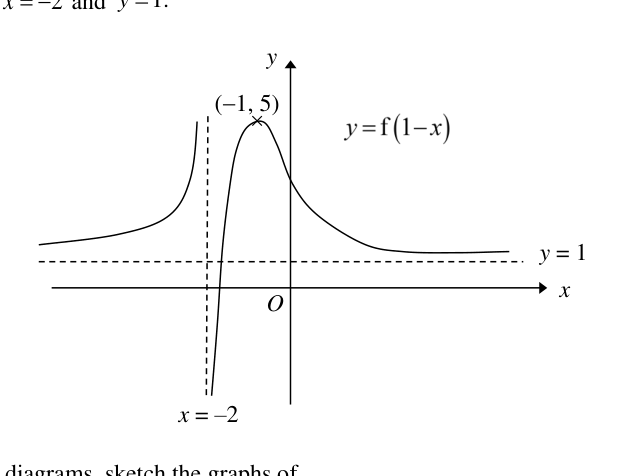
- (a)
,
- (b)
,其中 。
它不会直接告诉你答案,而是问你卡在哪一步看看 AI 是怎么陪你一步步弄懂这道题的
完整解法
3(a)
1. Establish the algebraic mapping between the given graph and the required graph.
We are given the graph of and need to sketch .
Let a point on the given graph be . This means .
Let . Then the equation becomes .
Therefore, a point on the given curve maps to the point on the target curve .
2. Apply the mapping to the key features of the graph (turning point and asymptotes).
Apply the mapping to the given key features:
- Maximum point: For . The new maximum point is .
- Vertical asymptote: For . The new vertical asymptote is .
- Horizontal asymptote: The -values are unaffected by horizontal transformations, so the horizontal asymptote remains .
3. Determine the orientation and shape of the transformed branches.
The transformation effectively reverses the horizontal direction of the graph (a reflection in the vertical line ).
- The original right branch (for ) now becomes the new left branch (for ). As , , so as , . The branch rises to the maximum at and plunges to as .
- The original left branch (for ) now becomes the new right branch (for ). As , , so as , . The branch descends from near and flattens out towards .
Graph Sketch Instructions:
- Axes & Asymptotes: Draw a horizontal dashed line for the asymptote and a vertical dashed line for the asymptote .
- Turning Point: Plot and label the local maximum point at .
- Curve Shape:
- Left Branch (): Draw a curve starting near on the far left, rising to the maximum point at , then curving steeply downwards to negative infinity as it approaches from the left.
- Right Branch (): Draw a curve starting from positive infinity just to the right of , curving downwards to asymptotically approach as .
3(b)
1. Recognize the relationship between $\text{g}(x)$ and the given graph.
The question defines . Since the given diagram is exactly the graph of , the given graph is . We must sketch the derivative of this exact graph.
2. Identify the $x$-intercepts of $y = \text{g}'(x)$.
The graph of has a maximum turning point at . At this point, the gradient is zero, which means . Therefore, has an -intercept at .
3. Determine the asymptotes of $y = \text{g}'(x)$.
As from both the left and the right, the curve of becomes increasingly steep with a positive slope, meaning the gradient approaches . Thus, is a vertical asymptote for , with the curve tending to on both sides.
As , the graph of flattens out as it approaches the horizontal asymptote . This means the gradient approaches . Thus, (the -axis) is a horizontal asymptote for .
4. Determine the intervals of positive and negative gradient to finalize the shape.
For and , the function is strictly increasing, so (the graph lies above the -axis).
For , is strictly decreasing, so (the graph lies below the -axis).
Because must return to as , the branch for must have a local minimum point below the -axis before approaching .
A sketch of showing:
- A vertical asymptote at with both adjacent branches tending to .
- A horizontal asymptote at (the -axis).
- An -intercept at .
- For , the curve lies above the -axis, increasing from towards .
- For , the curve descends from , passes through to a local minimum below the -axis, and then approaches from below as .
AI 分析,可能出错
用 AI 批改,圈出写错的那一步,并自动将你的薄弱点存入错题本,形成你的错因库。