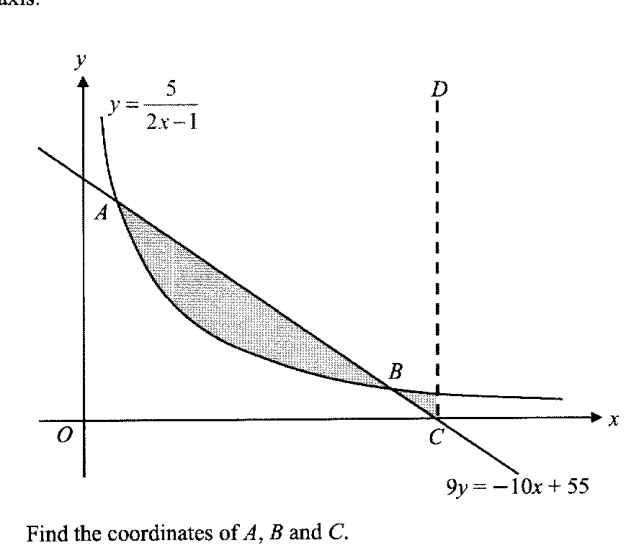
1. Find the coordinates of A, B, and C (from part i) to determine the limits of integration.
From part (i), solving y=2x−15 and 9y=−10x+55 simultaneously gives x=1 and x=5.
A is (1,5) and B is (5,95).
The line meets the x-axis at C, so −10x+55=0⟹x=5.5.
C is (5.5,0).
2. Set up the integrals for the two shaded regions.
The shaded region is split into two parts at x=5 (point B).
For 1⩽x⩽5, the line is above the curve.
For 5⩽x⩽5.5, the curve is above the line.
Total Area = ∫15(9−10x+55−2x−15)dx+∫55.5(2x−15−9−10x+55)dx
3. Integrate the functions.
∫9−10x+55dx=9−5x2+55x
∫2x−15dx=25ln(2x−1)
4. Evaluate the definite integrals to find the total area.
Area 1 (from x=1 to x=5):
Area under line = [9−5(25)+55(5)]−[9−5(1)+55(1)]=9150−950=9100
Area under curve = [25ln(9)]−[25ln(1)]=25ln9=5ln3
Area 1 = 9100−5ln3≈5.6181
Area 2 (from x=5 to x=5.5):
Area under curve = [25ln(10)]−[25ln(9)]=25ln(910)
Area under line = [9−5(5.5)2+55(5.5)]−9150=9151.25−9150=91.25=365
Area 2 = 25ln(910)−365≈0.1245
Total Area = 5.6181+0.1245=5.7426≈5.74 (to 3 s.f.)