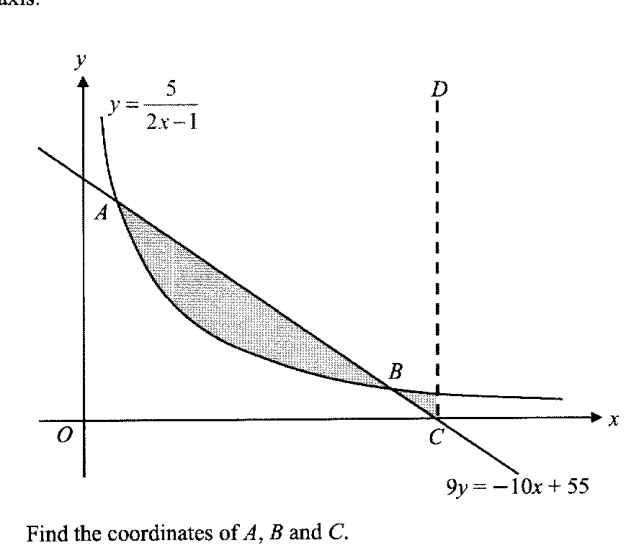
The diagram shows part of the curve . The line intersects the curve at points and and meets the -axis at point . is a straight line parallel to the -axis.
- (i)
Find the coordinates of , and .
- (ii)
Find the area of the shaded region.
It won't just hand you the answer — it asks where you're stuck.How the checker works
Worked solution
10(ii)
1. Find the coordinates of A, B, and C (from part i) to determine the limits of integration.
From part (i), solving and simultaneously gives and .
is and is .
The line meets the -axis at , so .
is .
2. Set up the integrals for the two shaded regions.
The shaded region is split into two parts at (point B).
For , the line is above the curve.
For , the curve is above the line.
Total Area =
3. Integrate the functions.
4. Evaluate the definite integrals to find the total area.
Area 1 (from to ):
Area under line =
Area under curve =
Area 1 =
Area 2 (from to ):
Area under curve =
Area under line =
Area 2 =
Total Area = (to 3 s.f.)
(to 3 s.f.)
AI analysis — may contain mistakes.
Worked this one out on paper? Snap your steps and Gigle's AI math checker will circle the step where it went wrong.
More questions on this topic
- 1Answer all questions. Given that , find the values of when and . Answ…
- 2The equation of a curve is , where is a constant. In the case where , find the set of…
- 3The expression is exactly divisible by . When is divided by …
- 4It is given that is a binomial expansion where and are positive constants. W…
- 5A circle with centre O passes through the points P(-1,7) and Q(0,8). State the relationship between the perpendicular bi…