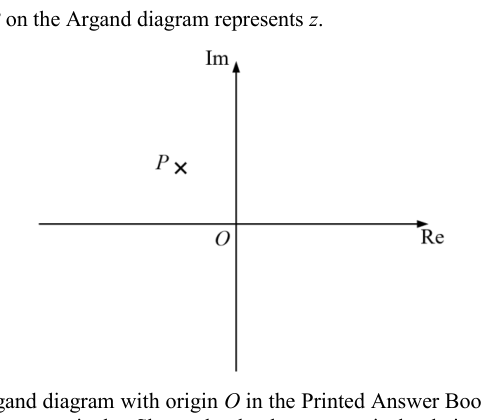
回答本题时请勿使用计算器。 复数 的模为 1,辐角为 ,其中 ,复数 由 给出。阿尔甘图(复平面)上的点 表示 。
- (a)
在答题册中带有原点 的阿甘图副本上,标出分别表示 和 的点 和 。清楚地展示点 、 和 之间的几何关系。
- (b)
求四边形 的面积。
已知 。
- (c)
求形如 的 ,其中 和 是实数。
- (d)
证明 ,其中 是待定的常数。
- (e)
由此证明 。
- (c)
它不会直接告诉你答案,而是问你卡在哪一步看看 AI 是怎么陪你一步步弄懂这道题的
完整解法
4(a)
1. Determine the position of point $Q$ representing $w$.
We are given .
The modulus is .
The argument is .
Thus, is obtained by rotating anticlockwise by about the origin, and scaling its distance from the origin by a factor of . Since is in the second quadrant, will lie in the third quadrant, with and .
2. Determine the position of point $R$ representing $z-w$.
The complex number corresponds to the position vector .
Rearranging this vector equation gives .
By the parallelogram law of vector addition, the vectors and form the adjacent sides of a parallelogram with the diagonal being .
Therefore, points and form a parallelogram in that order.
3. Show the geometrical relationship between $P, Q,$ and $R$ on the diagram.
To clearly show the relationship on the diagram, the student should:
- Draw the line segments and to construct the parallelogram .
- Use parallel arrows on and , and on and to indicate they are parallel.
- Add a right-angle symbol (square) at to signify that the side is perpendicular to the diagonal .
- Point is plotted in the third quadrant such that (anticlockwise) and the length .
- Point is plotted such that forms a parallelogram.
- The geometrical relationship is clearly shown on the diagram by drawing the parallelogram (indicating parallel sides and ) and marking a right angle between the diagonal and side .
4(b)
1. Determine the lengths of $OP$ and $OQ$ and the angle between them.
Since , multiplying by corresponds to an anticlockwise rotation of radians on the Argand diagram. Thus, .
2. Deduce the shape of quadrilateral $ORPQ$ and calculate its area.
Using vector addition on the Argand diagram, .
This shows that is a parallelogram with adjacent sides and , and diagonal .
The area of the parallelogram is twice the area of the right-angled triangle :
4[2](c)
1. Express $z$ in polar form using its modulus and argument
Given and ,
2. Evaluate the exact trigonometric ratios to find the Cartesian form
Since and ,
(Alternatively, )
4[2](d)
1. Substitute $z$ from part (c) into the expression for $z-w$.
From part (c), we found .
2. Expand the product of the two complex numbers.
3. Factorise the real and imaginary parts to match the required form and identify $k$.
Comparing this with , we have . (Alternatively, )
4[2](e)
1. Find the exact argument of $z-w$ using the product of complex numbers.
Since and ,
2. Equate the tangent of the argument to the ratio of the imaginary and real parts from part (d) to show the result.
From part (d), .
Because , both the real and imaginary parts are positive, meaning lies in the first quadrant.
For a complex number in the first quadrant, .
AI 分析,可能出错
用 AI 批改,圈出写错的那一步,并自动将你的薄弱点存入错题本,形成你的错因库。