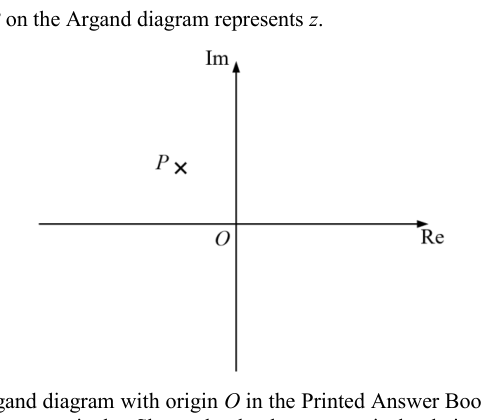
Do not use a calculator in answering this question. The complex number zz has modulus 1 and argument θ\theta, where π2<θ<π\dfrac{\pi}{2}<\theta<\pi, and the complex number ww is given by w=i3 zw = i\sqrt{3}\,z. The point PP on the Argand diagram represents zz.

  1. (a)

    On the copy of the Argand diagram with origin OO in the Printed Answer Booklet, plot the points QQ and RR to represent ww and z−wz-w respectively. Show clearly the geometrical relationship between the points PP, QQ and RR.

  2. (b)

    Find the area of the quadrilateral ORPQORPQ.

  3. It is given that θ=3π4\theta = \dfrac{3\pi}{4}.

    1. (c)

      Find zz in the form x+yix+yi, where xx and yy are real numbers.

    2. (d)

      Show that z−w=k[(3−1)+(3+1)i]z-w = k\bigl[ (\sqrt{3}-1) + (\sqrt{3}+1)i\bigr], where kk is a constant to be determined.

    3. (e)

      Hence show that tan⁡5π12=3+13−1\tan\dfrac{5\pi}{12} = \dfrac{\sqrt{3}+1}{\sqrt{3}-1}.

Work through it with AI →

It won't just hand you the answer — it asks where you're stuck.How the checker works

Worked solution

4(a)

1. Determine the position of point $Q$ representing $w$.

We are given w=i3zw = i\sqrt{3}z.
The modulus is ∣w∣=∣i3∣∣z∣=3(1)=3|w| = |i\sqrt{3}| |z| = \sqrt{3}(1) = \sqrt{3}.
The argument is arg⁡(w)=arg⁡(i)+arg⁡(z)=π2+θ\arg(w) = \arg(i) + \arg(z) = \frac{\pi}{2} + \theta.
Thus, QQ is obtained by rotating PP anticlockwise by 90∘90^\circ about the origin, and scaling its distance from the origin by a factor of 3\sqrt{3}. Since PP is in the second quadrant, QQ will lie in the third quadrant, with OQ⊥OPOQ \perp OP and OQ=3OPOQ = \sqrt{3}OP.

2. Determine the position of point $R$ representing $z-w$.

The complex number z−wz-w corresponds to the position vector OR⃗=OP⃗−OQ⃗\vec{OR} = \vec{OP} - \vec{OQ}.
Rearranging this vector equation gives OQ⃗+OR⃗=OP⃗\vec{OQ} + \vec{OR} = \vec{OP}.
By the parallelogram law of vector addition, the vectors OQ⃗\vec{OQ} and OR⃗\vec{OR} form the adjacent sides of a parallelogram with the diagonal being OP⃗\vec{OP}.
Therefore, points O,R,P,O, R, P, and QQ form a parallelogram ORPQORPQ in that order.

3. Show the geometrical relationship between $P, Q,$ and $R$ on the diagram.

To clearly show the relationship on the diagram, the student should:

  • Draw the line segments OR,RP,PQ,OR, RP, PQ, and QOQO to construct the parallelogram ORPQORPQ.
  • Use parallel arrows on OROR and QPQP, and on OQOQ and RPRP to indicate they are parallel.
  • Add a right-angle symbol (square) at ∠POQ\angle POQ to signify that the side OQOQ is perpendicular to the diagonal OPOP.
Answer
  1. Point QQ is plotted in the third quadrant such that ∠POQ=90∘\angle POQ = 90^\circ (anticlockwise) and the length OQ=3OPOQ = \sqrt{3} OP.
  2. Point RR is plotted such that ORPQORPQ forms a parallelogram.
  3. The geometrical relationship is clearly shown on the diagram by drawing the parallelogram ORPQORPQ (indicating parallel sides OR∥QPOR \parallel QP and OQ∥RPOQ \parallel RP) and marking a right angle between the diagonal OPOP and side OQOQ.

4(b)

1. Determine the lengths of $OP$ and $OQ$ and the angle between them.

∣OP∣=∣z∣=1|OP| = |z| = 1

∣OQ∣=∣w∣=∣i3z∣=3∣z∣=3|OQ| = |w| = |i\sqrt{3}z| = \sqrt{3}|z| = \sqrt{3}

Since w=i3zw = i\sqrt{3}z, multiplying zz by ii corresponds to an anticlockwise rotation of π2\frac{\pi}{2} radians on the Argand diagram. Thus, ∠POQ=90∘\angle POQ = 90^\circ.

2. Deduce the shape of quadrilateral $ORPQ$ and calculate its area.

Using vector addition on the Argand diagram, OR⃗+OQ⃗=(z−w)+w=z=OP⃗\vec{OR} + \vec{OQ} = (z-w) + w = z = \vec{OP}.
This shows that ORPQORPQ is a parallelogram with adjacent sides OROR and OQOQ, and diagonal OPOP.

The area of the parallelogram is twice the area of the right-angled triangle OPQOPQ:

Area of ORPQ=2×Area of △OPQ\text{Area of } ORPQ = 2 \times \text{Area of } \triangle OPQ
=2×(12×∣OP∣×∣OQ∣)= 2 \times \left( \frac{1}{2} \times |OP| \times |OQ| \right)
=1×3=3= 1 \times \sqrt{3} = \sqrt{3}

Answer

3\sqrt{3}

4[2](c)

1. Express $z$ in polar form using its modulus and argument

Given ∣z∣=1|z| = 1 and arg⁡(z)=θ=3π4\arg(z) = \theta = \dfrac{3\pi}{4},
z=1(cos⁡3π4+isin⁡3π4)z = 1 \left( \cos \dfrac{3\pi}{4} + i \sin \dfrac{3\pi}{4} \right)

2. Evaluate the exact trigonometric ratios to find the Cartesian form

Since cos⁡3π4=−22\cos \dfrac{3\pi}{4} = -\dfrac{\sqrt{2}}{2} and sin⁡3π4=22\sin \dfrac{3\pi}{4} = \dfrac{\sqrt{2}}{2},
z=−22+22iz = -\dfrac{\sqrt{2}}{2} + \dfrac{\sqrt{2}}{2}i
(Alternatively, −12+12i-\dfrac{1}{\sqrt{2}} + \dfrac{1}{\sqrt{2}}i)

Answer

z=−22+22iz = -\frac{\sqrt{2}}{2} + \frac{\sqrt{2}}{2}i

4[2](d)

1. Substitute $z$ from part (c) into the expression for $z-w$.

From part (c), we found z=−22+22iz = -\frac{\sqrt{2}}{2} + \frac{\sqrt{2}}{2}i.
z−w=z−i3z=z(1−i3)z - w = z - i\sqrt{3}z = z(1 - i\sqrt{3})
z−w=(−22+22i)(1−i3)z - w = \left(-\frac{\sqrt{2}}{2} + \frac{\sqrt{2}}{2}i\right)(1 - i\sqrt{3})

2. Expand the product of the two complex numbers.

z−w=−22+62i+22i−62i2z - w = -\frac{\sqrt{2}}{2} + \frac{\sqrt{6}}{2}i + \frac{\sqrt{2}}{2}i - \frac{\sqrt{6}}{2}i^2
=−22+62i+22i+62= -\frac{\sqrt{2}}{2} + \frac{\sqrt{6}}{2}i + \frac{\sqrt{2}}{2}i + \frac{\sqrt{6}}{2}
=(62−22)+(62+22)i= \left(\frac{\sqrt{6}}{2} - \frac{\sqrt{2}}{2}\right) + \left(\frac{\sqrt{6}}{2} + \frac{\sqrt{2}}{2}\right)i

3. Factorise the real and imaginary parts to match the required form and identify $k$.

=22(3−1)+22(3+1)i= \frac{\sqrt{2}}{2}(\sqrt{3} - 1) + \frac{\sqrt{2}}{2}(\sqrt{3} + 1)i
=22[(3−1)+(3+1)i]= \frac{\sqrt{2}}{2}\bigl[ (\sqrt{3} - 1) + (\sqrt{3} + 1)i \bigr]
Comparing this with z−w=k[(3−1)+(3+1)i]z - w = k\bigl[ (\sqrt{3}-1) + (\sqrt{3}+1)i \bigr], we have k=22k = \frac{\sqrt{2}}{2}. (Alternatively, k=12k = \frac{1}{\sqrt{2}})

Answer

k=22k = \frac{\sqrt{2}}{2}

4[2](e)

1. Find the exact argument of $z-w$ using the product of complex numbers.

z−w=z−i3z=z(1−i3)z-w = z - i\sqrt{3}z = z(1-i\sqrt{3})
arg⁡(z−w)=arg⁡(z)+arg⁡(1−i3)\arg(z-w) = \arg(z) + \arg(1-i\sqrt{3})
Since arg⁡(z)=3π4\arg(z) = \frac{3\pi}{4} and arg⁡(1−i3)=tan⁡−1(−31)=−π3\arg(1-i\sqrt{3}) = \tan^{-1}\left(\frac{-\sqrt{3}}{1}\right) = -\frac{\pi}{3},
arg⁡(z−w)=3π4−π3=9π12−4π12=5π12\arg(z-w) = \frac{3\pi}{4} - \frac{\pi}{3} = \frac{9\pi}{12} - \frac{4\pi}{12} = \frac{5\pi}{12}

2. Equate the tangent of the argument to the ratio of the imaginary and real parts from part (d) to show the result.

From part (d), z−w=k[(3−1)+(3+1)i]z-w = k\bigl[ (\sqrt{3}-1) + (\sqrt{3}+1)i \bigr].
Because k>0k>0, both the real and imaginary parts are positive, meaning z−wz-w lies in the first quadrant.
For a complex number in the first quadrant, tan⁡(arg⁡(z−w))=Im(z−w)Re(z−w)\tan(\arg(z-w)) = \frac{\text{Im}(z-w)}{\text{Re}(z-w)}.
tan⁡(5π12)=k(3+1)k(3−1)\tan\left(\frac{5\pi}{12}\right) = \frac{k(\sqrt{3}+1)}{k(\sqrt{3}-1)}
tan⁡(5π12)=3+13−1\tan\left(\frac{5\pi}{12}\right) = \frac{\sqrt{3}+1}{\sqrt{3}-1}

Answer

tan⁡(5π12)=3+13−1 (shown)\tan\left(\frac{5\pi}{12}\right) = \frac{\sqrt{3}+1}{\sqrt{3}-1} \text{ (shown)}

AI analysis — may contain mistakes.

Worked this one out on paper? Snap your steps and Gigle's AI math checker will circle the step where it went wrong.

More questions on this topic

  1. 1Solve the equation iz5=−32i z^5 = -32, giving your roots in the form reiθre^{i\theta}, where r>0r>0 and −π<θ≤π-\pi<\theta\le\pi. Ske…
  2. 2Solve the equation iz5=−32iz^5=-32, giving your roots in the form reiθre^{i\theta}, where r>0r>0 and −π<θ≤π-\pi<\theta\le\pi. Sketch…
  3. 3The complex number zz satisfies the equation 2 z3=1+22a−1 i,\sqrt{2}\,z^{3} = 1 + \dfrac{2}{2a - 1}\,i , where aa is a real numbe…
  4. 4The complex number aa has modulus rr and argument θ\theta, where r∈R+r \in \mathbb{R}^+ and 0<θ<π20 < \theta < \frac{\pi}{2}…
  5. 5The point A represents a fixed complex number a such that −π2<arg⁡a<0-\dfrac{\pi}{2}<\arg a<0. The complex numbers iaia and a+iaa+ia…