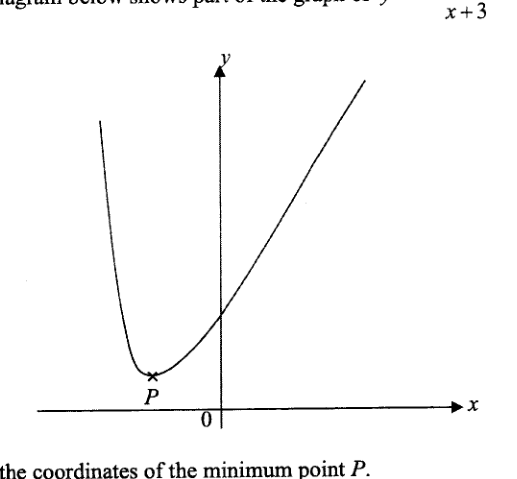
2. Set the derivative to zero to find the $x$-coordinates of the stationary points.
For a minimum point, dxdy=0. (x+3)2x2+6x+1=0 x2+6x+1=0
3. Solve the quadratic equation for $x$.
Using the quadratic formula: x=2(1)−6±62−4(1)(1) x=2−6±32 x=2−6±42 x=−3±22
4. Determine the correct $x$-coordinate for point $P$ based on the graph.
The graph has a vertical asymptote at x=−3. The point P lies on the branch of the curve that crosses the positive y-axis, which means x>−3.
Therefore, we reject x=−3−22 and accept x=−3+22.
5. Find the corresponding $y$-coordinate for point $P$.
Substitute x=−3+22 into the original equation: y=(−3+22)+3(−3+22)2+2(−3+22)+5 y=229−122+8−6+42+5 y=2216−82 y=28−42 y=282−8=42−4