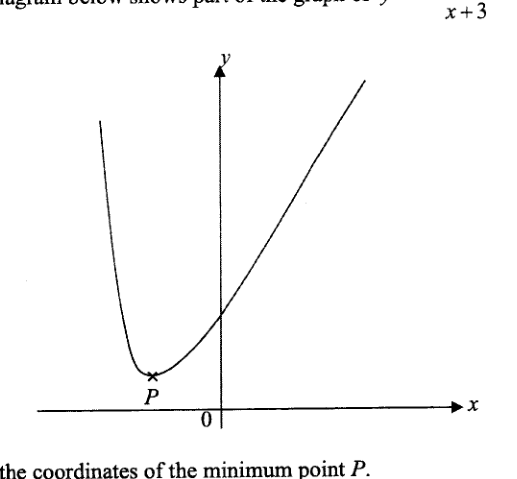
The diagram below shows part of the graph of y=x2+2x+5x+3y = \frac{x^2 + 2x + 5}{x + 3}. Find the coordinates of the minimum point PP.

Work through it with AI →

It won't just hand you the answer — it asks where you're stuck.How the checker works

Worked solution

8

1. Find the derivative $\frac{dy}{dx}$ using the quotient rule.

Let u=x2+2x+5u = x^2 + 2x + 5 and v=x+3v = x + 3.
Then dudx=2x+2\frac{du}{dx} = 2x + 2 and dvdx=1\frac{dv}{dx} = 1.

dydx=vdudx−udvdxv2\frac{dy}{dx} = \frac{v\frac{du}{dx} - u\frac{dv}{dx}}{v^2}
dydx=(x+3)(2x+2)−(x2+2x+5)(1)(x+3)2\frac{dy}{dx} = \frac{(x + 3)(2x + 2) - (x^2 + 2x + 5)(1)}{(x + 3)^2}
dydx=2x2+2x+6x+6−x2−2x−5(x+3)2\frac{dy}{dx} = \frac{2x^2 + 2x + 6x + 6 - x^2 - 2x - 5}{(x + 3)^2}
dydx=x2+6x+1(x+3)2\frac{dy}{dx} = \frac{x^2 + 6x + 1}{(x + 3)^2}

2. Set the derivative to zero to find the $x$-coordinates of the stationary points.

For a minimum point, dydx=0\frac{dy}{dx} = 0.
x2+6x+1(x+3)2=0\frac{x^2 + 6x + 1}{(x + 3)^2} = 0
x2+6x+1=0x^2 + 6x + 1 = 0

3. Solve the quadratic equation for $x$.

Using the quadratic formula:
x=−6±62−4(1)(1)2(1)x = \frac{-6 \pm \sqrt{6^2 - 4(1)(1)}}{2(1)}
x=−6±322x = \frac{-6 \pm \sqrt{32}}{2}
x=−6±422x = \frac{-6 \pm 4\sqrt{2}}{2}
x=−3±22x = -3 \pm 2\sqrt{2}

4. Determine the correct $x$-coordinate for point $P$ based on the graph.

The graph has a vertical asymptote at x=−3x = -3. The point PP lies on the branch of the curve that crosses the positive yy-axis, which means x>−3x > -3.
Therefore, we reject x=−3−22x = -3 - 2\sqrt{2} and accept x=−3+22x = -3 + 2\sqrt{2}.

5. Find the corresponding $y$-coordinate for point $P$.

Substitute x=−3+22x = -3 + 2\sqrt{2} into the original equation:
y=(−3+22)2+2(−3+22)+5(−3+22)+3y = \frac{(-3 + 2\sqrt{2})^2 + 2(-3 + 2\sqrt{2}) + 5}{(-3 + 2\sqrt{2}) + 3}
y=9−122+8−6+42+522y = \frac{9 - 12\sqrt{2} + 8 - 6 + 4\sqrt{2} + 5}{2\sqrt{2}}
y=16−8222y = \frac{16 - 8\sqrt{2}}{2\sqrt{2}}
y=8−422y = \frac{8 - 4\sqrt{2}}{\sqrt{2}}
y=82−82=42−4y = \frac{8\sqrt{2} - 8}{2} = 4\sqrt{2} - 4

The coordinates of PP are (−3+22,−4+42)(-3 + 2\sqrt{2}, -4 + 4\sqrt{2}).

Answer

(−3+22,−4+42)(-3 + 2\sqrt{2}, -4 + 4\sqrt{2})

AI analysis — may contain mistakes.

Worked this one out on paper? Snap your steps and Gigle's AI math checker will circle the step where it went wrong.

More questions on this topic

  1. 1The curve CC has equation y=x2+x+3x−2y = \frac{x^2 + x + 3}{x - 2}. Without using a calculator, find the set of values that yy…
  2. 2The diagram shows a greenhouse built on a rectangular base. 140 m2140\text{ m}^2 of polyethene is used to build the curved r…
  3. 3The equation of a curve is given by y=x+sin⁡2xy = x + \sin^2 x for 0≤x≤π0 \le x \le \pi. Write down the expression for dydx\frac{\mathrm{d}y}{\mathrm{d}x}…
  4. 4A curve has equation y=ax+(bx)2+cx3+dy = \sqrt{ax + (bx)^2} + cx^3 + d where aa, bb, cc and dd are constants. The curve cuts the x…
  5. 5A cone of height, hh and radius, rr fits exactly inside a sphere of radius 5 cm5\text{ cm} as shown below. (Volume of cone=13πr2h)\left(\text{Volume of cone} = \frac{1}{3}\pi r^2 h\right)…