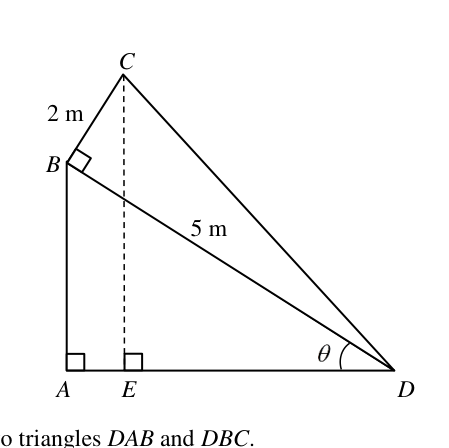
该图显示了两个三角形 DAB 和 DBC。已知 BD = 5 米且 BC = 2 米。角 DAB = 角 DBC = 角 DEC = 90∘90^{\circ}。角 ADB = θ\theta,且 θ\theta 是可以变化的。

  1. ((i))

    证明 DEDE 可以表示为 (acos⁡θ−bsin⁡θ)(a\cos\theta - b\sin\theta) 米的形式,其中 aa 和 bb 为待求常数。

  2. ((ii))

    将 DEDE 表示为 Rcos⁡(θ+α)R\cos(\theta + \alpha) 米的形式,其中 R>0R > 0 且 α\alpha 为锐角。

  3. ((iii))

    将 CECE 表示为 Rsin⁡(θ+α)R\sin(\theta + \alpha) 米的形式。

  4. ((iv))

    由此证明三角形 CDE 的面积可以表示为 psin⁡(2θ+2α) m2p\sin(2\theta + 2\alpha)\ \mathrm{m}^{2} 的形式,其中 pp 为待求常数。

先不看答案,让 AI 诊断你卡在哪里?

它不会直接告诉你答案,而是问你卡在哪一步看看 AI 是怎么陪你一步步弄懂这道题的

完整解法

8((i))

1. Find the length of $AD$ in terms of $\theta$.

In the right-angled triangle ABDABD,
cos⁡θ=ADBD\cos\theta = \frac{AD}{BD}
AD=5cos⁡θAD = 5\cos\theta

2. Find the horizontal distance from $A$ to $E$ by analysing the angles around $B$.

Draw a horizontal line through BB to the right, meeting CECE at FF.
Since ABAB is vertical and ADAD is horizontal, ∠ABD=90∘−θ\angle ABD = 90^{\circ} - \theta.
The angle between BDBD and the horizontal through BB is θ\theta.
Since ∠DBC=90∘\angle DBC = 90^{\circ}, the angle between BCBC and the horizontal is 90∘−θ90^{\circ} - \theta.
In the right-angled triangle BFCBFC, the horizontal distance BFBF (which equals AEAE) is:
BF=BCcos⁡(90∘−θ)=2sin⁡θBF = BC \cos(90^{\circ} - \theta) = 2\sin\theta
So, AE=2sin⁡θAE = 2\sin\theta.

3. Express $DE$ as the difference between $AD$ and $AE$.

From the diagram, EE lies on ADAD, so:
DE=AD−AEDE = AD - AE
DE=5cos⁡θ−2sin⁡θDE = 5\cos\theta - 2\sin\theta
This is in the form acos⁡θ−bsin⁡θa\cos\theta - b\sin\theta with a=5a = 5 and b=2b = 2.

答案

5cos⁡θ−2sin⁡θ5\cos\theta - 2\sin\theta

8((ii))

1. Equate the expression from part (i) to the R-formula form and expand

From (i), DE=5cos⁡θ−2sin⁡θDE = 5\cos\theta - 2\sin\theta.
Let 5cos⁡θ−2sin⁡θ=Rcos⁡(θ+α)5\cos\theta - 2\sin\theta = R\cos(\theta + \alpha).
5cos⁡θ−2sin⁡θ=Rcos⁡θcos⁡α−Rsin⁡θsin⁡α5\cos\theta - 2\sin\theta = R\cos\theta\cos\alpha - R\sin\theta\sin\alpha

2. Compare coefficients to find $R$ and $\alpha$

Comparing coefficients:
Rcos⁡α=5R\cos\alpha = 5
Rsin⁡α=2R\sin\alpha = 2

R=52+22=29≈5.385R = \sqrt{5^2 + 2^2} = \sqrt{29} \approx 5.385
tan⁡α=25\tan\alpha = \frac{2}{5}
α=tan⁡−1(0.4)≈21.801∘\alpha = \tan^{-1}(0.4) \approx 21.801^{\circ}

3. State the final expression

DE=29cos⁡(θ+21.8∘)DE = \sqrt{29}\cos(\theta + 21.8^{\circ})

答案

29cos⁡(θ+21.8∘)\sqrt{29}\cos(\theta + 21.8^{\circ})

8((iii))

1. Express CE in terms of trigonometric ratios of theta

Let FF be the foot of the perpendicular from BB to CECE. Then CE=CF+FECE = CF + FE. Since ABEDABED is a rectangle, FE=AB=5sin⁡θFE = AB = 5\sin\theta. In △BCF\triangle BCF, ∠CBF=θ\angle CBF = \theta (since ∠ABD=90∘−θ\angle ABD = 90^\circ - \theta and ∠DBC=90∘\angle DBC = 90^\circ). Thus CF=2cos⁡θCF = 2\cos\theta. Therefore, CE=5sin⁡θ+2cos⁡θCE = 5\sin\theta + 2\cos\theta.

2. Convert the expression for CE into the R-formula form

We want to express 5sin⁡θ+2cos⁡θ5\sin\theta + 2\cos\theta in the form Rsin⁡(θ+α)=Rsin⁡θcos⁡α+Rcos⁡θsin⁡αR\sin(\theta + \alpha) = R\sin\theta\cos\alpha + R\cos\theta\sin\alpha.
Comparing coefficients:
Rcos⁡α=5R\cos\alpha = 5
Rsin⁡α=2R\sin\alpha = 2
R=52+22=29R = \sqrt{5^2 + 2^2} = \sqrt{29}
tan⁡α=25  ⟹  α=tan⁡−1(0.4)≈21.801∘\tan\alpha = \frac{2}{5} \implies \alpha = \tan^{-1}(0.4) \approx 21.801^{\circ}
Thus, CE=29sin⁡(θ+21.8∘)CE = \sqrt{29}\sin(\theta + 21.8^{\circ}).

答案

CE=29sin⁡(θ+21.8∘)CE = \sqrt{29}\sin(\theta + 21.8^{\circ})

8((iv))

1. Write down the formula for the area of triangle CDE using the expressions for DE and CE.

Area of △CDE=12×DE×CE\triangle CDE = \frac{1}{2} \times DE \times CE
From (ii) and (iii), DE=Rcos⁡(θ+α)DE = R\cos(\theta + \alpha) and CE=Rsin⁡(θ+α)CE = R\sin(\theta + \alpha).
Area =12[Rcos⁡(θ+α)][Rsin⁡(θ+α)]= \frac{1}{2} [R\cos(\theta + \alpha)][R\sin(\theta + \alpha)]
Area =12R2sin⁡(θ+α)cos⁡(θ+α)= \frac{1}{2} R^2 \sin(\theta + \alpha) \cos(\theta + \alpha)

2. Apply the double angle identity for sine.

Using sin⁡(2A)=2sin⁡Acos⁡A\sin(2A) = 2\sin A \cos A, we have sin⁡(θ+α)cos⁡(θ+α)=12sin⁡(2θ+2α)\sin(\theta + \alpha) \cos(\theta + \alpha) = \frac{1}{2}\sin(2\theta + 2\alpha).
Area =12R2[12sin⁡(2θ+2α)]=14R2sin⁡(2θ+2α)= \frac{1}{2} R^2 \left[ \frac{1}{2}\sin(2\theta + 2\alpha) \right] = \frac{1}{4} R^2 \sin(2\theta + 2\alpha)

3. Determine the value of $R^2$ and hence $p$.

From (i) and (ii), DE=5cos⁡θ−2sin⁡θDE = 5\cos\theta - 2\sin\theta, so R=52+22=29R = \sqrt{5^2 + 2^2} = \sqrt{29}.
R2=29R^2 = 29
Area =14(29)sin⁡(2θ+2α)=294sin⁡(2θ+2α)= \frac{1}{4} (29) \sin(2\theta + 2\alpha) = \frac{29}{4} \sin(2\theta + 2\alpha)
Comparing with psin⁡(2θ+2α)p\sin(2\theta + 2\alpha), we get p=294p = \frac{29}{4}.

答案

p=294p = \frac{29}{4}

AI 分析,可能出错

用 AI 批改,圈出写错的那一步,并自动将你的薄弱点存入错题本,形成你的错因库。

同一知识点的其他题

  1. 1解方程 2cot⁡22x=1−5sin⁡2x2 \cot^2 2x = 1 - \frac{5}{\sin 2x},其中 −180∘≤x≤180∘-180^\circ \le x \le 180^\circ。
  2. 2已知sin⁡(α+π12)=55\sin (α+ \dfrac {π}{12} )= \dfrac { \sqrt {5}}{5},则sin⁡(π3−2α)=(    )\sin ( \dfrac {π}{3} -2α)= (\:\:\:\:) A. 45 \dfrac {4}{5}…
  3. 38.8.设△ABC\triangle ABC的内角AA,BB,CC所对的边分别为aa,bb,cc,若bcos⁡C+ccos⁡B=asin⁡Ab\cos C+c\cos B=a\sin A,则△ABC\triangle ABC的形状为…
  4. 4证明 sin⁡3xsec⁡2x+sin⁡x=tan⁡xsec⁡x\sin^{3} x\sec^{2} x + \sin x = \tan x\sec x。 解方程 sin⁡3xsec⁡2x+sin⁡x=5\sin^{3} x\sec^{2} x + \sin x = 5,其中 0≤x≤360∘0 \le x \le 360^\circ。
  5. 5已知 cos⁡x=−45\cos x = -\frac{4}{5} 且 tan⁡x>0\tan x > 0,求 sin⁡2x\sin 2x, cos⁡x2\cos \frac{x}{2}。