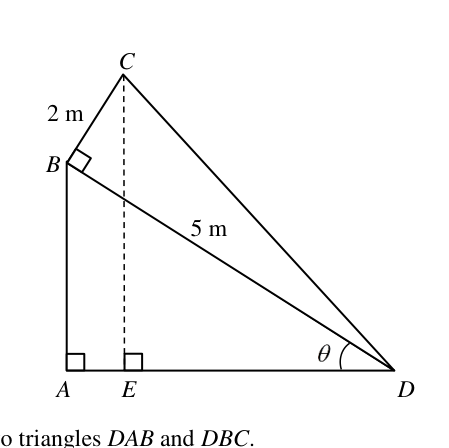
The diagram shows two triangles DAB and DBC. It is given that BD = 5 m and BC = 2 m. Angle DAB = angle DBC = angle DEC = 90∘90^{\circ}. Angle ADB = θ\theta and θ\theta can vary.

  1. ((i))

    Show that DEDE can be expressed in the form (acos⁡θ−bsin⁡θ)(a\cos\theta - b\sin\theta) metres, where aa and bb are constants to be found.

  2. ((ii))

    Express DEDE in the form Rcos⁡(θ+α)R\cos(\theta + \alpha) metres, where R>0R > 0 and α\alpha is an acute angle.

  3. ((iii))

    Express CECE in the form Rsin⁡(θ+α)R\sin(\theta + \alpha) metres.

  4. ((iv))

    Hence show that the area of triangle CDE can be expressed in the form psin⁡(2θ+2α) m2p\sin(2\theta + 2\alpha)\ \mathrm{m}^{2}, where pp is a constant to be found.

Work through it with AI →

It won't just hand you the answer — it asks where you're stuck.How the checker works

Worked solution

8((i))

1. Find the length of $AD$ in terms of $\theta$.

In the right-angled triangle ABDABD,
cos⁡θ=ADBD\cos\theta = \frac{AD}{BD}
AD=5cos⁡θAD = 5\cos\theta

2. Find the horizontal distance from $A$ to $E$ by analysing the angles around $B$.

Draw a horizontal line through BB to the right, meeting CECE at FF.
Since ABAB is vertical and ADAD is horizontal, ∠ABD=90∘−θ\angle ABD = 90^{\circ} - \theta.
The angle between BDBD and the horizontal through BB is θ\theta.
Since ∠DBC=90∘\angle DBC = 90^{\circ}, the angle between BCBC and the horizontal is 90∘−θ90^{\circ} - \theta.
In the right-angled triangle BFCBFC, the horizontal distance BFBF (which equals AEAE) is:
BF=BCcos⁡(90∘−θ)=2sin⁡θBF = BC \cos(90^{\circ} - \theta) = 2\sin\theta
So, AE=2sin⁡θAE = 2\sin\theta.

3. Express $DE$ as the difference between $AD$ and $AE$.

From the diagram, EE lies on ADAD, so:
DE=AD−AEDE = AD - AE
DE=5cos⁡θ−2sin⁡θDE = 5\cos\theta - 2\sin\theta
This is in the form acos⁡θ−bsin⁡θa\cos\theta - b\sin\theta with a=5a = 5 and b=2b = 2.

Answer

5cos⁡θ−2sin⁡θ5\cos\theta - 2\sin\theta

8((ii))

1. Equate the expression from part (i) to the R-formula form and expand

From (i), DE=5cos⁡θ−2sin⁡θDE = 5\cos\theta - 2\sin\theta.
Let 5cos⁡θ−2sin⁡θ=Rcos⁡(θ+α)5\cos\theta - 2\sin\theta = R\cos(\theta + \alpha).
5cos⁡θ−2sin⁡θ=Rcos⁡θcos⁡α−Rsin⁡θsin⁡α5\cos\theta - 2\sin\theta = R\cos\theta\cos\alpha - R\sin\theta\sin\alpha

2. Compare coefficients to find $R$ and $\alpha$

Comparing coefficients:
Rcos⁡α=5R\cos\alpha = 5
Rsin⁡α=2R\sin\alpha = 2

R=52+22=29≈5.385R = \sqrt{5^2 + 2^2} = \sqrt{29} \approx 5.385
tan⁡α=25\tan\alpha = \frac{2}{5}
α=tan⁡−1(0.4)≈21.801∘\alpha = \tan^{-1}(0.4) \approx 21.801^{\circ}

3. State the final expression

DE=29cos⁡(θ+21.8∘)DE = \sqrt{29}\cos(\theta + 21.8^{\circ})

Answer

29cos⁡(θ+21.8∘)\sqrt{29}\cos(\theta + 21.8^{\circ})

8((iii))

1. Express CE in terms of trigonometric ratios of theta

Let FF be the foot of the perpendicular from BB to CECE. Then CE=CF+FECE = CF + FE. Since ABEDABED is a rectangle, FE=AB=5sin⁡θFE = AB = 5\sin\theta. In △BCF\triangle BCF, ∠CBF=θ\angle CBF = \theta (since ∠ABD=90∘−θ\angle ABD = 90^\circ - \theta and ∠DBC=90∘\angle DBC = 90^\circ). Thus CF=2cos⁡θCF = 2\cos\theta. Therefore, CE=5sin⁡θ+2cos⁡θCE = 5\sin\theta + 2\cos\theta.

2. Convert the expression for CE into the R-formula form

We want to express 5sin⁡θ+2cos⁡θ5\sin\theta + 2\cos\theta in the form Rsin⁡(θ+α)=Rsin⁡θcos⁡α+Rcos⁡θsin⁡αR\sin(\theta + \alpha) = R\sin\theta\cos\alpha + R\cos\theta\sin\alpha.
Comparing coefficients:
Rcos⁡α=5R\cos\alpha = 5
Rsin⁡α=2R\sin\alpha = 2
R=52+22=29R = \sqrt{5^2 + 2^2} = \sqrt{29}
tan⁡α=25  ⟹  α=tan⁡−1(0.4)≈21.801∘\tan\alpha = \frac{2}{5} \implies \alpha = \tan^{-1}(0.4) \approx 21.801^{\circ}
Thus, CE=29sin⁡(θ+21.8∘)CE = \sqrt{29}\sin(\theta + 21.8^{\circ}).

Answer

CE=29sin⁡(θ+21.8∘)CE = \sqrt{29}\sin(\theta + 21.8^{\circ})

8((iv))

1. Write down the formula for the area of triangle CDE using the expressions for DE and CE.

Area of △CDE=12×DE×CE\triangle CDE = \frac{1}{2} \times DE \times CE
From (ii) and (iii), DE=Rcos⁡(θ+α)DE = R\cos(\theta + \alpha) and CE=Rsin⁡(θ+α)CE = R\sin(\theta + \alpha).
Area =12[Rcos⁡(θ+α)][Rsin⁡(θ+α)]= \frac{1}{2} [R\cos(\theta + \alpha)][R\sin(\theta + \alpha)]
Area =12R2sin⁡(θ+α)cos⁡(θ+α)= \frac{1}{2} R^2 \sin(\theta + \alpha) \cos(\theta + \alpha)

2. Apply the double angle identity for sine.

Using sin⁡(2A)=2sin⁡Acos⁡A\sin(2A) = 2\sin A \cos A, we have sin⁡(θ+α)cos⁡(θ+α)=12sin⁡(2θ+2α)\sin(\theta + \alpha) \cos(\theta + \alpha) = \frac{1}{2}\sin(2\theta + 2\alpha).
Area =12R2[12sin⁡(2θ+2α)]=14R2sin⁡(2θ+2α)= \frac{1}{2} R^2 \left[ \frac{1}{2}\sin(2\theta + 2\alpha) \right] = \frac{1}{4} R^2 \sin(2\theta + 2\alpha)

3. Determine the value of $R^2$ and hence $p$.

From (i) and (ii), DE=5cos⁡θ−2sin⁡θDE = 5\cos\theta - 2\sin\theta, so R=52+22=29R = \sqrt{5^2 + 2^2} = \sqrt{29}.
R2=29R^2 = 29
Area =14(29)sin⁡(2θ+2α)=294sin⁡(2θ+2α)= \frac{1}{4} (29) \sin(2\theta + 2\alpha) = \frac{29}{4} \sin(2\theta + 2\alpha)
Comparing with psin⁡(2θ+2α)p\sin(2\theta + 2\alpha), we get p=294p = \frac{29}{4}.

Answer

p=294p = \frac{29}{4}

AI analysis — may contain mistakes.

Worked this one out on paper? Snap your steps and Gigle's AI math checker will circle the step where it went wrong.

More questions on this topic

  1. 1Solve the equation 2cot⁡22x=1−5sin⁡2x2 \cot^2 2x = 1 - \frac{5}{\sin 2x} for −180∘≤x≤180∘-180^\circ \le x \le 180^\circ.
  2. 2已知sin⁡(α+π12)=55\sin (α+ \dfrac {π}{12} )= \dfrac { \sqrt {5}}{5},则sin⁡(π3−2α)=(    )\sin ( \dfrac {π}{3} -2α)= (\:\:\:\:) A. 45 \dfrac {4}{5}…
  3. 38.8.设△ABC\triangle ABC的内角AA,BB,CC所对的边分别为aa,bb,cc,若bcos⁡C+ccos⁡B=asin⁡Ab\cos C+c\cos B=a\sin A,则△ABC\triangle ABC的形状为…
  4. 4Prove that sin⁡3xsec⁡2x+sin⁡x=tan⁡xsec⁡x\sin^{3} x\sec^{2} x + \sin x = \tan x\sec x. Solve the equation sin⁡3xsec⁡2x+sin⁡x=5\sin^{3} x\sec^{2} x + \sin x = 5 for 0≤x≤360∘0 \le x \le 360^\circ…
  5. 5Given that cos⁡x=−45\cos x = -\frac{4}{5} and tan⁡x>0\tan x > 0, find sin⁡2x\sin 2x, cos⁡x2\cos \frac{x}{2}.