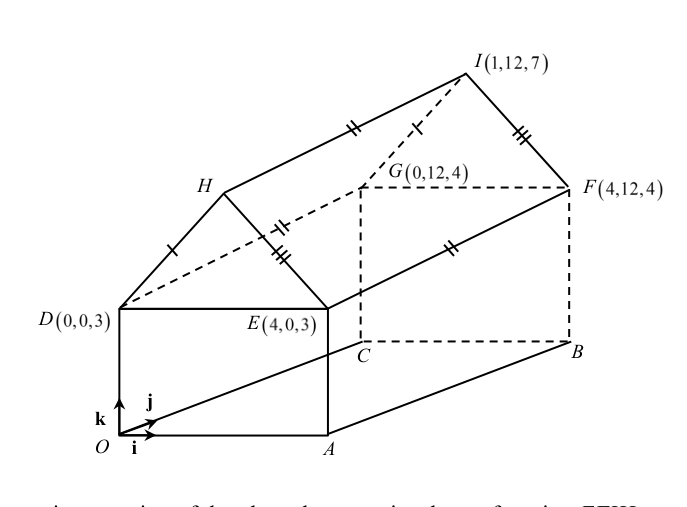
为了应对不断增加的 COVID-19 病例,建立了一个临时隔离中心。其屋顶呈三角柱体形状。点 (x,y,z)(x, y, z) 是相对于原点 OO 定义的,其中单位向量 i\mathbf{i}、j\mathbf{j} 和 k\mathbf{k} 分别沿着 OA→\overrightarrow{OA}、OC→\overrightarrow{OC} 和 OD→\overrightarrow{OD} 方向(见图)。D,E,F,GD, E, F, G 和 II 的坐标分别为 (0,0,3)(0,0,3)、(4,0,3)(4,0,3)、(4,12,4)(4,12,4)、(0,12,4)(0,12,4) 和 (1,12,7)(1,12,7)。单位以米为单位。

  1. (i)

    求包含屋顶部分 EFIHEFIH 的平面的笛卡尔方程。

  2. (ii)

    已知屋顶部分 DGIHDGIH 是方程为 36x+y−12z=−3636x + y - 12z = -36 的平面的一部分。

    求包含屋脊 HIHI 的直线的笛卡尔方程。

  3. (iii)

    钢缆用于将隔离中心固定在适当的位置。钢缆铺设在直线上,其宽度可以忽略不计。已知钢缆 1 穿过 FF 和 DD,钢缆 2 穿过 GG 和 MM,其中 MM 是 EFEF 的中点。

    施工人员需要确定两条钢缆相交的点 JJ 的位置。

    求 JJ 的坐标。

  4. (iv)

    为了加强结构,建议从 JJ 延伸另一条钢缆到屋脊 HIHI 上的最近点。施工人员还剩 3.2 米长的钢缆。

    确定剩余的钢缆是否足够长,以连接 JJ 和屋脊 HIHI。

先不看答案,让 AI 诊断你卡在哪里?

它不会直接告诉你答案,而是问你卡在哪一步看看 AI 是怎么陪你一步步弄懂这道题的

完整解法

11(i)

1. Find two non-parallel direction vectors lying on the plane $EFIH$.

Using points E(4,0,3)E(4, 0, 3), F(4,12,4)F(4, 12, 4), and I(1,12,7)I(1, 12, 7):
EF→=(4124)−(403)=(0121)\overrightarrow{EF} = \begin{pmatrix} 4 \\ 12 \\ 4 \end{pmatrix} - \begin{pmatrix} 4 \\ 0 \\ 3 \end{pmatrix} = \begin{pmatrix} 0 \\ 12 \\ 1 \end{pmatrix}
FI→=(1127)−(4124)=(−303)\overrightarrow{FI} = \begin{pmatrix} 1 \\ 12 \\ 7 \end{pmatrix} - \begin{pmatrix} 4 \\ 12 \\ 4 \end{pmatrix} = \begin{pmatrix} -3 \\ 0 \\ 3 \end{pmatrix}

2. Calculate the cross product of the two direction vectors to find a normal vector to the plane.

n=EF→×FI→=(0121)×(−303)=((12)(3)−(1)(0)(1)(−3)−(0)(3)(0)(0)−(12)(−3))=(36−336)\mathbf{n} = \overrightarrow{EF} \times \overrightarrow{FI} = \begin{pmatrix} 0 \\ 12 \\ 1 \end{pmatrix} \times \begin{pmatrix} -3 \\ 0 \\ 3 \end{pmatrix} = \begin{pmatrix} (12)(3) - (1)(0) \\ (1)(-3) - (0)(3) \\ (0)(0) - (12)(-3) \end{pmatrix} = \begin{pmatrix} 36 \\ -3 \\ 36 \end{pmatrix}
A simpler normal vector parallel to n\mathbf{n} is obtained by dividing by 33:
n1=(12−112)\mathbf{n_1} = \begin{pmatrix} 12 \\ -1 \\ 12 \end{pmatrix}

3. Form the cartesian equation of the plane using the normal vector and a point on the plane.

Let the equation of the plane be r⋅(12−112)=D\mathbf{r} \cdot \begin{pmatrix} 12 \\ -1 \\ 12 \end{pmatrix} = D.
Using point E(4,0,3)E(4, 0, 3):
D=(403)⋅(12−112)=4(12)+0(−1)+3(12)=48+0+36=84D = \begin{pmatrix} 4 \\ 0 \\ 3 \end{pmatrix} \cdot \begin{pmatrix} 12 \\ -1 \\ 12 \end{pmatrix} = 4(12) + 0(-1) + 3(12) = 48 + 0 + 36 = 84
Thus, the cartesian equation of the plane is 12x−y+12z=8412x - y + 12z = 84.

答案

12x−y+12z=8412x - y + 12z = 84

11(ii)

1. Obtain the cartesian equation of plane $EFIH$ (required from part i).

From the given coordinates, we find two direction vectors on plane EFIHEFIH:
EF→=(4124)−(403)=(0121)\overrightarrow{EF} = \begin{pmatrix} 4 \\ 12 \\ 4 \end{pmatrix} - \begin{pmatrix} 4 \\ 0 \\ 3 \end{pmatrix} = \begin{pmatrix} 0 \\ 12 \\ 1 \end{pmatrix}
EI→=(1127)−(403)=(−3124)\overrightarrow{EI} = \begin{pmatrix} 1 \\ 12 \\ 7 \end{pmatrix} - \begin{pmatrix} 4 \\ 0 \\ 3 \end{pmatrix} = \begin{pmatrix} -3 \\ 12 \\ 4 \end{pmatrix}
A normal vector to plane EFIHEFIH is:
n1=(0121)×(−3124)=(36−336)=3(12−112)\mathbf{n}_1 = \begin{pmatrix} 0 \\ 12 \\ 1 \end{pmatrix} \times \begin{pmatrix} -3 \\ 12 \\ 4 \end{pmatrix} = \begin{pmatrix} 36 \\ -3 \\ 36 \end{pmatrix} = 3\begin{pmatrix} 12 \\ -1 \\ 12 \end{pmatrix}
Using point E(4,0,3)E(4, 0, 3), the equation of plane EFIHEFIH is:
r⋅(12−112)=(403)⋅(12−112)=48−0+36=84\mathbf{r} \cdot \begin{pmatrix} 12 \\ -1 \\ 12 \end{pmatrix} = \begin{pmatrix} 4 \\ 0 \\ 3 \end{pmatrix} \cdot \begin{pmatrix} 12 \\ -1 \\ 12 \end{pmatrix} = 48 - 0 + 36 = 84
  ⟹  12x−y+12z=84\implies 12x - y + 12z = 84

2. Solve the equations of the two planes simultaneously to find the line of intersection $HI$.

The line HIHI lies on both planes. We solve their equations simultaneously:
Plane EFIHEFIH: 12x−y+12z=8412x - y + 12z = 84 --- (1)
Plane DGIHDGIH: 36x+y−12z=−3636x + y - 12z = -36 --- (2)

Adding equations (1) and (2):
(12x−y+12z)+(36x+y−12z)=84−36(12x - y + 12z) + (36x + y - 12z) = 84 - 36
48x=48  ⟹  x=148x = 48 \implies x = 1

3. Formulate the cartesian equation of the line.

Substitute x=1x = 1 into equation (1):
12(1)−y+12z=84  ⟹  y−12z=−7212(1) - y + 12z = 84 \implies y - 12z = -72
Rearranging to form a standard line equation:
y+72=12z  ⟹  y+7212=zy + 72 = 12z \implies \frac{y+72}{12} = z
Since we know the point I(1,12,7)I(1, 12, 7) lies on this line, we can re-centre the equation around it to match standard format:
y−1212=z−7\frac{y-12}{12} = z - 7
The cartesian equation is therefore x=1x = 1, y−1212=z−7\frac{y-12}{12} = z - 7.

答案

x=1,y−1212=z−7x = 1, \frac{y-12}{12} = z - 7

11(iii)

1. Find the coordinates of $M$, the midpoint of $EF$.

OM→=OE→+OF→2\overrightarrow{OM} = \frac{\overrightarrow{OE} + \overrightarrow{OF}}{2}
OM→=12[(403)+(4124)]=(463.5)\overrightarrow{OM} = \frac{1}{2} \left[ \begin{pmatrix} 4 \\ 0 \\ 3 \end{pmatrix} + \begin{pmatrix} 4 \\ 12 \\ 4 \end{pmatrix} \right] = \begin{pmatrix} 4 \\ 6 \\ 3.5 \end{pmatrix}

2. Formulate the vector equations of the lines representing the two cables.

For cable 1 (line FDFD):
DF→=(4124)−(003)=(4121)\overrightarrow{DF} = \begin{pmatrix} 4 \\ 12 \\ 4 \end{pmatrix} - \begin{pmatrix} 0 \\ 0 \\ 3 \end{pmatrix} = \begin{pmatrix} 4 \\ 12 \\ 1 \end{pmatrix}
l1:r=(003)+λ(4121),λ∈Rl_1: \mathbf{r} = \begin{pmatrix} 0 \\ 0 \\ 3 \end{pmatrix} + \lambda \begin{pmatrix} 4 \\ 12 \\ 1 \end{pmatrix}, \quad \lambda \in \mathbb{R}

For cable 2 (line GMGM):
GM→=(463.5)−(0124)=(4−6−0.5)\overrightarrow{GM} = \begin{pmatrix} 4 \\ 6 \\ 3.5 \end{pmatrix} - \begin{pmatrix} 0 \\ 12 \\ 4 \end{pmatrix} = \begin{pmatrix} 4 \\ -6 \\ -0.5 \end{pmatrix}
Scaling the direction vector by 2 yields (8−12−1)\begin{pmatrix} 8 \\ -12 \\ -1 \end{pmatrix}:
l2:r=(0124)+μ(8−12−1),μ∈Rl_2: \mathbf{r} = \begin{pmatrix} 0 \\ 12 \\ 4 \end{pmatrix} + \mu \begin{pmatrix} 8 \\ -12 \\ -1 \end{pmatrix}, \quad \mu \in \mathbb{R}

3. Set up a system of equations to find the parameter values at the intersection point.

Equating the xx and yy components of l1l_1 and l2l_2:
4λ=8μ  ⟹  λ=2μ— (1)4\lambda = 8\mu \implies \lambda = 2\mu \quad \text{--- (1)}
12λ=12−12μ— (2)12\lambda = 12 - 12\mu \quad \text{--- (2)}
Substitute (1) into (2):
12(2μ)=12−12μ12(2\mu) = 12 - 12\mu
24μ+12μ=12  ⟹  36μ=12  ⟹  μ=1324\mu + 12\mu = 12 \implies 36\mu = 12 \implies \mu = \frac{1}{3}
Thus, λ=2(13)=23\lambda = 2\left(\frac{1}{3}\right) = \frac{2}{3}.

(Checking with the zz-component: 3+23=1133 + \frac{2}{3} = \frac{11}{3} and 4−13=1134 - \frac{1}{3} = \frac{11}{3}, which are consistent)

4. Evaluate the coordinates of intersection point $J$.

Substitute λ=23\lambda = \frac{2}{3} into l1l_1:
OJ→=(003)+23(4121)=(8/3811/3)\overrightarrow{OJ} = \begin{pmatrix} 0 \\ 0 \\ 3 \end{pmatrix} + \frac{2}{3} \begin{pmatrix} 4 \\ 12 \\ 1 \end{pmatrix} = \begin{pmatrix} 8/3 \\ 8 \\ 11/3 \end{pmatrix}

答案

(83,8,113)(\frac{8}{3}, 8, \frac{11}{3})

11(iv)

1. State the vector equation of the roof ridge $HI$ (derivable from earlier parts).

From earlier parts, the roof ridge HIHI is parallel to the base edge DGDG, so its direction vector is DG→=(0124)−(003)=(0121)\overrightarrow{DG} = \begin{pmatrix} 0 \\ 12 \\ 4 \end{pmatrix} - \begin{pmatrix} 0 \\ 0 \\ 3 \end{pmatrix} = \begin{pmatrix} 0 \\ 12 \\ 1 \end{pmatrix}.
Passing through I(1,12,7)I(1, 12, 7), the vector equation of the line containing HIHI is:
r=(1127)+λ(0121)\mathbf{r} = \begin{pmatrix} 1 \\ 12 \\ 7 \end{pmatrix} + \lambda \begin{pmatrix} 0 \\ 12 \\ 1 \end{pmatrix}

2. State the coordinates of the cable intersection point $J$ (calculated from part iii).

Cable 1 passes through F(4,12,4)F(4,12,4) and D(0,0,3)D(0,0,3). Cable 2 passes through G(0,12,4)G(0,12,4) and the midpoint of EFEF, M(4,6,3.5)M(4,6,3.5).
Equating their respective line equations gives:
(003)+s(4121)=(0124)+t(4−6−0.5)\begin{pmatrix} 0 \\ 0 \\ 3 \end{pmatrix} + s\begin{pmatrix} 4 \\ 12 \\ 1 \end{pmatrix} = \begin{pmatrix} 0 \\ 12 \\ 4 \end{pmatrix} + t\begin{pmatrix} 4 \\ -6 \\ -0.5 \end{pmatrix}
Solving yields s=t=23s = t = \frac{2}{3}. Substituting s=23s = \frac{2}{3} into the first line gives the coordinates of intersection JJ:
J(83,8,113)J\left(\frac{8}{3}, 8, \frac{11}{3}\right)

3. Express the displacement vector $\overrightarrow{JP}$ from $J$ to a general point $P$ on $HI$.

Let PP be a point on the line HIHI.
JP→=OP→−OJ→=(112+12λ7+λ)−(8/3811/3)=(−5/34+12λ10/3+λ)\overrightarrow{JP} = \overrightarrow{OP} - \overrightarrow{OJ} = \begin{pmatrix} 1 \\ 12 + 12\lambda \\ 7 + \lambda \end{pmatrix} - \begin{pmatrix} 8/3 \\ 8 \\ 11/3 \end{pmatrix} = \begin{pmatrix} -5/3 \\ 4 + 12\lambda \\ 10/3 + \lambda \end{pmatrix}

4. Use the dot product to locate the foot of the perpendicular from $J$ to $HI$.

For the shortest distance, JP→\overrightarrow{JP} must be perpendicular to the direction vector of HIHI:
(−5/34+12λ10/3+λ)⋅(0121)=0\begin{pmatrix} -5/3 \\ 4 + 12\lambda \\ 10/3 + \lambda \end{pmatrix} \cdot \begin{pmatrix} 0 \\ 12 \\ 1 \end{pmatrix} = 0
0+12(4+12λ)+1(103+λ)=00 + 12(4 + 12\lambda) + 1\left(\frac{10}{3} + \lambda\right) = 0
48+144λ+103+λ=0  ⟹  145λ=−1543  ⟹  λ=−154435≈−0.35448 + 144\lambda + \frac{10}{3} + \lambda = 0 \implies 145\lambda = -\frac{154}{3} \implies \lambda = -\frac{154}{435} \approx -0.354
(Note: The segment HIHI spans from y=0y=0 at λ=−1\lambda=-1 to y=12y=12 at λ=0\lambda=0. Since −1<−0.354<0-1 < -0.354 < 0, the closest point lies strictly on the roof ridge segment itself, rather than beyond its ends.)

5. Calculate the required length of cable and conclude.

Substitute λ=−154435\lambda = -\frac{154}{435} back into JP→\overrightarrow{JP}:
JP→=(−5/34−1848435103−154435)=(−5/3−36/145432/145)\overrightarrow{JP} = \begin{pmatrix} -5/3 \\ 4 - \frac{1848}{435} \\ \frac{10}{3} - \frac{154}{435} \end{pmatrix} = \begin{pmatrix} -5/3 \\ -36/145 \\ 432/145 \end{pmatrix}
The shortest distance is the magnitude ∣JP→∣|\overrightarrow{JP}|:
∣JP→∣=(−53)2+(−36145)2+(432145)2=152891305≈3.42 m|\overrightarrow{JP}| = \sqrt{ \left(-\frac{5}{3}\right)^2 + \left(-\frac{36}{145}\right)^2 + \left(\frac{432}{145}\right)^2 } = \sqrt{\frac{15289}{1305}} \approx 3.42 \text{ m}
Since 3.42 m>3.2 m3.42 \text{ m} > 3.2 \text{ m}, the remaining steel cable is not long enough.

答案

The shortest distance from JJ to the roof ridge HIHI is approximately 3.42 m3.42 \text{ m}. Since 3.42 m>3.2 m3.42 \text{ m} > 3.2 \text{ m}, the remaining steel cable is not long enough.

AI 分析,可能出错

用 AI 批改,圈出写错的那一步,并自动将你的薄弱点存入错题本,形成你的错因库。

同一知识点的其他题

  1. 1直线 l1l_1 和 l2l_2 的方程分别为 r=(4110)+λ(1−1−6),λ∈R\mathbf{r} = \begin{pmatrix} 4 \\ 1 \\ 10 \end{pmatrix} + \lambda \begin{pmatrix} 1 \\ -1 \\ -6 \end{pmatrix}, \lambda \in \mathbb{R}…
  2. 2一家钻探公司计划在山中铺设一条直管道 ABAB。点 (x,y,z)(x, y, z) 是相对于山脚下坐标为 (0,0,0)(0, 0, 0) 的主控制中心定义的,其中单位为米。xx 轴指向东,yy 轴指向北,zz 轴垂直向上。点 AA 的坐标为 (−200,150,10)(-200, 150, 10)…
  3. 3平面 Π1\Pi_1 的方程为 x+y+z=3x + y + z = 3。一条直线穿过点 PP 和 QQ,它们的位置向量分别为 i+j+2k\mathbf{i} + \mathbf{j} + 2\mathbf{k} 和 4i+2j−k4\mathbf{i} + 2\mathbf{j} - \mathbf{k}…
  4. 4平面 Π1\Pi_1 和 Π2\Pi_2 的向量方程分别为 r=λ1(i+j−k)+μ1(2i−j+k)andr=λ2(i+2j+k)+μ2(3i+j−k)\mathbf{r} = \lambda_1(\mathbf{i} + \mathbf{j} - \mathbf{k}) + \mu_1(2\mathbf{i} - \mathbf{j} + \mathbf{k}) \quad \text{and} \quad \mathbf{r} = \lambda_2(\mathbf{i} + 2\mathbf{j} + \mathbf{k}) + \mu_2(3\mathbf{i} + \mathbf{j} - \mathbf{k})…
  5. 5一位室内设计师正计划设计一个下拉式衣柜升降机。为了测试他的设想,设计师制作了一个它的微缩模型。在这个模型中,点 (x,y,z)(x, y, z) 是相对于模型的一个拐角 O(0,0,0)O(0, 0, 0) 来定义的。模型中使用的杆可以用直线方程来建模。 主杆可…