A temporary isolation centre is built to manage the increasing number of COVID-19 cases. The roof takes the shape of a triangular prism. Points (x,y,z)(x, y, z) are defined relative to an origin, OO, with unit vectors i\mathbf{i} along OA→\overrightarrow{OA}, j\mathbf{j} along OC→\overrightarrow{OC}, and k\mathbf{k} along OD→\overrightarrow{OD} (see diagram). The coordinates of D,E,F,GD, E, F, G and II are (0,0,3)(0,0,3), (4,0,3)(4,0,3), (4,12,4)(4,12,4), (0,12,4)(0,12,4) and (1,12,7)(1,12,7) respectively. The units are measured in metres.
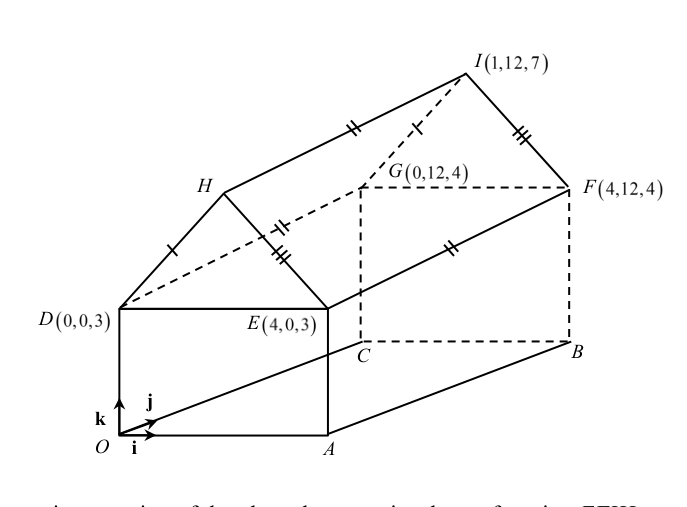
  1. (i)

    Find a cartesian equation of the plane that contains the roof section EFIHEFIH.

  2. (ii)

    It is given that the roof section DGIHDGIH is part of the plane with equation 36x+y−12z=−3636x + y - 12z = -36.

    Find a cartesian equation of the line that contains the roof ridge HIHI.

  3. (iii)

    Steel cables are used to hold the isolation centre in place. Cables are laid in straight lines and the widths of cables can be neglected. It is given that cable 1 passes through FF and DD and cable 2 passes through GG and MM, where MM is the mid point of EFEF.

    A builder needs to locate the point JJ where both cables meet.

    Find the coordinates of JJ.

  4. (iv)

    To strengthen the structure, it is recommended that another steel cable should be extended from JJ to the closest point on the roof ridge HIHI. The builder is left with 3.2 metres of steel cable.

    Determine whether the remaining steel cable is long enough to connect JJ to the roof ridge HIHI.

Work through it with AI →

It won't just hand you the answer — it asks where you're stuck.How the checker works

Worked solution

11(i)

1. Find two non-parallel direction vectors lying on the plane $EFIH$.

Using points E(4,0,3)E(4, 0, 3), F(4,12,4)F(4, 12, 4), and I(1,12,7)I(1, 12, 7):
EF→=(4124)−(403)=(0121)\overrightarrow{EF} = \begin{pmatrix} 4 \\ 12 \\ 4 \end{pmatrix} - \begin{pmatrix} 4 \\ 0 \\ 3 \end{pmatrix} = \begin{pmatrix} 0 \\ 12 \\ 1 \end{pmatrix}
FI→=(1127)−(4124)=(−303)\overrightarrow{FI} = \begin{pmatrix} 1 \\ 12 \\ 7 \end{pmatrix} - \begin{pmatrix} 4 \\ 12 \\ 4 \end{pmatrix} = \begin{pmatrix} -3 \\ 0 \\ 3 \end{pmatrix}

2. Calculate the cross product of the two direction vectors to find a normal vector to the plane.

n=EF→×FI→=(0121)×(−303)=((12)(3)−(1)(0)(1)(−3)−(0)(3)(0)(0)−(12)(−3))=(36−336)\mathbf{n} = \overrightarrow{EF} \times \overrightarrow{FI} = \begin{pmatrix} 0 \\ 12 \\ 1 \end{pmatrix} \times \begin{pmatrix} -3 \\ 0 \\ 3 \end{pmatrix} = \begin{pmatrix} (12)(3) - (1)(0) \\ (1)(-3) - (0)(3) \\ (0)(0) - (12)(-3) \end{pmatrix} = \begin{pmatrix} 36 \\ -3 \\ 36 \end{pmatrix}
A simpler normal vector parallel to n\mathbf{n} is obtained by dividing by 33:
n1=(12−112)\mathbf{n_1} = \begin{pmatrix} 12 \\ -1 \\ 12 \end{pmatrix}

3. Form the cartesian equation of the plane using the normal vector and a point on the plane.

Let the equation of the plane be r⋅(12−112)=D\mathbf{r} \cdot \begin{pmatrix} 12 \\ -1 \\ 12 \end{pmatrix} = D.
Using point E(4,0,3)E(4, 0, 3):
D=(403)⋅(12−112)=4(12)+0(−1)+3(12)=48+0+36=84D = \begin{pmatrix} 4 \\ 0 \\ 3 \end{pmatrix} \cdot \begin{pmatrix} 12 \\ -1 \\ 12 \end{pmatrix} = 4(12) + 0(-1) + 3(12) = 48 + 0 + 36 = 84
Thus, the cartesian equation of the plane is 12x−y+12z=8412x - y + 12z = 84.

Answer

12x−y+12z=8412x - y + 12z = 84

11(ii)

1. Obtain the cartesian equation of plane $EFIH$ (required from part i).

From the given coordinates, we find two direction vectors on plane EFIHEFIH:
EF→=(4124)−(403)=(0121)\overrightarrow{EF} = \begin{pmatrix} 4 \\ 12 \\ 4 \end{pmatrix} - \begin{pmatrix} 4 \\ 0 \\ 3 \end{pmatrix} = \begin{pmatrix} 0 \\ 12 \\ 1 \end{pmatrix}
EI→=(1127)−(403)=(−3124)\overrightarrow{EI} = \begin{pmatrix} 1 \\ 12 \\ 7 \end{pmatrix} - \begin{pmatrix} 4 \\ 0 \\ 3 \end{pmatrix} = \begin{pmatrix} -3 \\ 12 \\ 4 \end{pmatrix}
A normal vector to plane EFIHEFIH is:
n1=(0121)×(−3124)=(36−336)=3(12−112)\mathbf{n}_1 = \begin{pmatrix} 0 \\ 12 \\ 1 \end{pmatrix} \times \begin{pmatrix} -3 \\ 12 \\ 4 \end{pmatrix} = \begin{pmatrix} 36 \\ -3 \\ 36 \end{pmatrix} = 3\begin{pmatrix} 12 \\ -1 \\ 12 \end{pmatrix}
Using point E(4,0,3)E(4, 0, 3), the equation of plane EFIHEFIH is:
r⋅(12−112)=(403)⋅(12−112)=48−0+36=84\mathbf{r} \cdot \begin{pmatrix} 12 \\ -1 \\ 12 \end{pmatrix} = \begin{pmatrix} 4 \\ 0 \\ 3 \end{pmatrix} \cdot \begin{pmatrix} 12 \\ -1 \\ 12 \end{pmatrix} = 48 - 0 + 36 = 84
  ⟹  12x−y+12z=84\implies 12x - y + 12z = 84

2. Solve the equations of the two planes simultaneously to find the line of intersection $HI$.

The line HIHI lies on both planes. We solve their equations simultaneously:
Plane EFIHEFIH: 12x−y+12z=8412x - y + 12z = 84 --- (1)
Plane DGIHDGIH: 36x+y−12z=−3636x + y - 12z = -36 --- (2)

Adding equations (1) and (2):
(12x−y+12z)+(36x+y−12z)=84−36(12x - y + 12z) + (36x + y - 12z) = 84 - 36
48x=48  ⟹  x=148x = 48 \implies x = 1

3. Formulate the cartesian equation of the line.

Substitute x=1x = 1 into equation (1):
12(1)−y+12z=84  ⟹  y−12z=−7212(1) - y + 12z = 84 \implies y - 12z = -72
Rearranging to form a standard line equation:
y+72=12z  ⟹  y+7212=zy + 72 = 12z \implies \frac{y+72}{12} = z
Since we know the point I(1,12,7)I(1, 12, 7) lies on this line, we can re-centre the equation around it to match standard format:
y−1212=z−7\frac{y-12}{12} = z - 7
The cartesian equation is therefore x=1x = 1, y−1212=z−7\frac{y-12}{12} = z - 7.

Answer

x=1,y−1212=z−7x = 1, \frac{y-12}{12} = z - 7

11(iii)

1. Find the coordinates of $M$, the midpoint of $EF$.

OM→=OE→+OF→2\overrightarrow{OM} = \frac{\overrightarrow{OE} + \overrightarrow{OF}}{2}
OM→=12[(403)+(4124)]=(463.5)\overrightarrow{OM} = \frac{1}{2} \left[ \begin{pmatrix} 4 \\ 0 \\ 3 \end{pmatrix} + \begin{pmatrix} 4 \\ 12 \\ 4 \end{pmatrix} \right] = \begin{pmatrix} 4 \\ 6 \\ 3.5 \end{pmatrix}

2. Formulate the vector equations of the lines representing the two cables.

For cable 1 (line FDFD):
DF→=(4124)−(003)=(4121)\overrightarrow{DF} = \begin{pmatrix} 4 \\ 12 \\ 4 \end{pmatrix} - \begin{pmatrix} 0 \\ 0 \\ 3 \end{pmatrix} = \begin{pmatrix} 4 \\ 12 \\ 1 \end{pmatrix}
l1:r=(003)+λ(4121),λ∈Rl_1: \mathbf{r} = \begin{pmatrix} 0 \\ 0 \\ 3 \end{pmatrix} + \lambda \begin{pmatrix} 4 \\ 12 \\ 1 \end{pmatrix}, \quad \lambda \in \mathbb{R}

For cable 2 (line GMGM):
GM→=(463.5)−(0124)=(4−6−0.5)\overrightarrow{GM} = \begin{pmatrix} 4 \\ 6 \\ 3.5 \end{pmatrix} - \begin{pmatrix} 0 \\ 12 \\ 4 \end{pmatrix} = \begin{pmatrix} 4 \\ -6 \\ -0.5 \end{pmatrix}
Scaling the direction vector by 2 yields (8−12−1)\begin{pmatrix} 8 \\ -12 \\ -1 \end{pmatrix}:
l2:r=(0124)+μ(8−12−1),μ∈Rl_2: \mathbf{r} = \begin{pmatrix} 0 \\ 12 \\ 4 \end{pmatrix} + \mu \begin{pmatrix} 8 \\ -12 \\ -1 \end{pmatrix}, \quad \mu \in \mathbb{R}

3. Set up a system of equations to find the parameter values at the intersection point.

Equating the xx and yy components of l1l_1 and l2l_2:
4λ=8μ  ⟹  λ=2μ— (1)4\lambda = 8\mu \implies \lambda = 2\mu \quad \text{--- (1)}
12λ=12−12μ— (2)12\lambda = 12 - 12\mu \quad \text{--- (2)}
Substitute (1) into (2):
12(2μ)=12−12μ12(2\mu) = 12 - 12\mu
24μ+12μ=12  ⟹  36μ=12  ⟹  μ=1324\mu + 12\mu = 12 \implies 36\mu = 12 \implies \mu = \frac{1}{3}
Thus, λ=2(13)=23\lambda = 2\left(\frac{1}{3}\right) = \frac{2}{3}.

(Checking with the zz-component: 3+23=1133 + \frac{2}{3} = \frac{11}{3} and 4−13=1134 - \frac{1}{3} = \frac{11}{3}, which are consistent)

4. Evaluate the coordinates of intersection point $J$.

Substitute λ=23\lambda = \frac{2}{3} into l1l_1:
OJ→=(003)+23(4121)=(8/3811/3)\overrightarrow{OJ} = \begin{pmatrix} 0 \\ 0 \\ 3 \end{pmatrix} + \frac{2}{3} \begin{pmatrix} 4 \\ 12 \\ 1 \end{pmatrix} = \begin{pmatrix} 8/3 \\ 8 \\ 11/3 \end{pmatrix}

Answer

(83,8,113)(\frac{8}{3}, 8, \frac{11}{3})

11(iv)

1. State the vector equation of the roof ridge $HI$ (derivable from earlier parts).

From earlier parts, the roof ridge HIHI is parallel to the base edge DGDG, so its direction vector is DG→=(0124)−(003)=(0121)\overrightarrow{DG} = \begin{pmatrix} 0 \\ 12 \\ 4 \end{pmatrix} - \begin{pmatrix} 0 \\ 0 \\ 3 \end{pmatrix} = \begin{pmatrix} 0 \\ 12 \\ 1 \end{pmatrix}.
Passing through I(1,12,7)I(1, 12, 7), the vector equation of the line containing HIHI is:
r=(1127)+λ(0121)\mathbf{r} = \begin{pmatrix} 1 \\ 12 \\ 7 \end{pmatrix} + \lambda \begin{pmatrix} 0 \\ 12 \\ 1 \end{pmatrix}

2. State the coordinates of the cable intersection point $J$ (calculated from part iii).

Cable 1 passes through F(4,12,4)F(4,12,4) and D(0,0,3)D(0,0,3). Cable 2 passes through G(0,12,4)G(0,12,4) and the midpoint of EFEF, M(4,6,3.5)M(4,6,3.5).
Equating their respective line equations gives:
(003)+s(4121)=(0124)+t(4−6−0.5)\begin{pmatrix} 0 \\ 0 \\ 3 \end{pmatrix} + s\begin{pmatrix} 4 \\ 12 \\ 1 \end{pmatrix} = \begin{pmatrix} 0 \\ 12 \\ 4 \end{pmatrix} + t\begin{pmatrix} 4 \\ -6 \\ -0.5 \end{pmatrix}
Solving yields s=t=23s = t = \frac{2}{3}. Substituting s=23s = \frac{2}{3} into the first line gives the coordinates of intersection JJ:
J(83,8,113)J\left(\frac{8}{3}, 8, \frac{11}{3}\right)

3. Express the displacement vector $\overrightarrow{JP}$ from $J$ to a general point $P$ on $HI$.

Let PP be a point on the line HIHI.
JP→=OP→−OJ→=(112+12λ7+λ)−(8/3811/3)=(−5/34+12λ10/3+λ)\overrightarrow{JP} = \overrightarrow{OP} - \overrightarrow{OJ} = \begin{pmatrix} 1 \\ 12 + 12\lambda \\ 7 + \lambda \end{pmatrix} - \begin{pmatrix} 8/3 \\ 8 \\ 11/3 \end{pmatrix} = \begin{pmatrix} -5/3 \\ 4 + 12\lambda \\ 10/3 + \lambda \end{pmatrix}

4. Use the dot product to locate the foot of the perpendicular from $J$ to $HI$.

For the shortest distance, JP→\overrightarrow{JP} must be perpendicular to the direction vector of HIHI:
(−5/34+12λ10/3+λ)⋅(0121)=0\begin{pmatrix} -5/3 \\ 4 + 12\lambda \\ 10/3 + \lambda \end{pmatrix} \cdot \begin{pmatrix} 0 \\ 12 \\ 1 \end{pmatrix} = 0
0+12(4+12λ)+1(103+λ)=00 + 12(4 + 12\lambda) + 1\left(\frac{10}{3} + \lambda\right) = 0
48+144λ+103+λ=0  ⟹  145λ=−1543  ⟹  λ=−154435≈−0.35448 + 144\lambda + \frac{10}{3} + \lambda = 0 \implies 145\lambda = -\frac{154}{3} \implies \lambda = -\frac{154}{435} \approx -0.354
(Note: The segment HIHI spans from y=0y=0 at λ=−1\lambda=-1 to y=12y=12 at λ=0\lambda=0. Since −1<−0.354<0-1 < -0.354 < 0, the closest point lies strictly on the roof ridge segment itself, rather than beyond its ends.)

5. Calculate the required length of cable and conclude.

Substitute λ=−154435\lambda = -\frac{154}{435} back into JP→\overrightarrow{JP}:
JP→=(−5/34−1848435103−154435)=(−5/3−36/145432/145)\overrightarrow{JP} = \begin{pmatrix} -5/3 \\ 4 - \frac{1848}{435} \\ \frac{10}{3} - \frac{154}{435} \end{pmatrix} = \begin{pmatrix} -5/3 \\ -36/145 \\ 432/145 \end{pmatrix}
The shortest distance is the magnitude ∣JP→∣|\overrightarrow{JP}|:
∣JP→∣=(−53)2+(−36145)2+(432145)2=152891305≈3.42 m|\overrightarrow{JP}| = \sqrt{ \left(-\frac{5}{3}\right)^2 + \left(-\frac{36}{145}\right)^2 + \left(\frac{432}{145}\right)^2 } = \sqrt{\frac{15289}{1305}} \approx 3.42 \text{ m}
Since 3.42 m>3.2 m3.42 \text{ m} > 3.2 \text{ m}, the remaining steel cable is not long enough.

Answer

The shortest distance from JJ to the roof ridge HIHI is approximately 3.42 m3.42 \text{ m}. Since 3.42 m>3.2 m3.42 \text{ m} > 3.2 \text{ m}, the remaining steel cable is not long enough.

AI analysis — may contain mistakes.

Worked this one out on paper? Snap your steps and Gigle's AI math checker will circle the step where it went wrong.

More questions on this topic

  1. 1The lines l1l_1 and l2l_2 have equations r=(4110)+λ(1−1−6),λ∈R\mathbf{r} = \begin{pmatrix} 4 \\ 1 \\ 10 \end{pmatrix} + \lambda \begin{pmatrix} 1 \\ -1 \\ -6 \end{pmatrix}, \lambda \in \mathbb{R}…
  2. 2A drilling company plans to install a straight pipeline ABAB through a mountain. Points (x,y,z)(x, y, z) are defined relative…
  3. 3A plane Π1\Pi_1 has equation x+y+z=3x + y + z = 3. A line passes through the points PP and QQ with position vectors i+j+2k\mathbf{i} + \mathbf{j} + 2\mathbf{k}…
  4. 4The planes Π1\Pi_1 and Π2\Pi_2 have vector equations r=λ1(i+j−k)+μ1(2i−j+k)andr=λ2(i+2j+k)+μ2(3i+j−k)\mathbf{r} = \lambda_1(\mathbf{i} + \mathbf{j} - \mathbf{k}) + \mu_1(2\mathbf{i} - \mathbf{j} + \mathbf{k}) \quad \text{and} \quad \mathbf{r} = \lambda_2(\mathbf{i} + 2\mathbf{j} + \mathbf{k}) + \mu_2(3\mathbf{i} + \mathbf{j} - \mathbf{k})…
  5. 5A home interior designer is looking to design a pull-down wardrobe lift. To test his concept, the designer built a small…