In the diagram, A is the point , and C is the point . AB is a vertical line. The line BC has gradient .
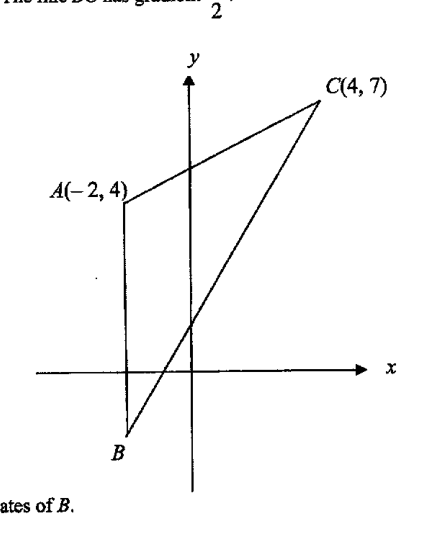
- ((a))
Find the coordinates of B.
- ((b))
Find the shortest distance from A to BC.
- ((c))
The equation of line L is
Show how you can tell that the line does not intersect the line AC.
- ((d))
Another triangle PQR is formed by reflecting triangle ABC about the y-axis. Calculate the overlapping area between triangle ABC and triangle PQR.
It won't just hand you the answer — it asks where you're stuck.How the checker works
Worked solution
7((a))
1. Use the vertical line $AB$ to determine the $x$-coordinate of $B$.
Since is vertical and passes through , every point on has .
So let .
2. Apply the gradient formula to line $BC$ to find the unknown $y$-coordinate.
Using and ,
3. State the coordinates of $B$.
Therefore,
7((b))
1. Find the equation of line $BC$ using its gradient and point $C$.
Line has gradient and passes through .
2. Apply the perpendicular distance formula from point $A$ to line $BC$.
For a line , the perpendicular distance from to the line is
Here, line is and .
3. Calculate and state the shortest distance.
However, since lies on and is vertical, the perpendicular distance is not along unless is horizontal. Checking by the formula gives the shortest distance:
units units
7((c))
1. Find the gradient of line $AC$ using the coordinates of $A$ and $C$.
For and ,
2. Rewrite the equation of line $L$ to identify its gradient and compare it with line $AC$.
For line ,
Multiply by :
So the gradient of is .
Since , the lines are parallel. Hence line does not intersect line .
Gradient of and gradient of . Since the gradients are equal, the two lines are parallel, so line does not intersect line .
7((d))
1. Find the vertices of the reflected triangle and the relevant boundary lines.
Reflecting triangle about the -axis changes each -coordinate to its opposite.
For triangle :
For the reflected triangle :
2. Identify the vertices of the overlapping region.
The overlapping region is bounded above by and , and below by and .
Top intersection:
So the top vertex is .
Bottom intersection:
So the bottom vertex is .
The left and right vertices are the touching points on the vertical sides:
Hence the overlapping region has vertices
3. Calculate the area of the overlapping region.
The overlapping region is a kite with perpendicular diagonals.
Horizontal diagonal:
Vertical diagonal:
Area of kite:
square units
AI analysis — may contain mistakes.
Worked this one out on paper? Snap your steps and Gigle's AI math checker will circle the step where it went wrong.
More questions on this topic
- 1The sketch shows the graph of . The points A(-2, -0.75) and B(0, -3) lie on the graph. Find the values of …
- 2过双曲线:的左焦点且斜率为的直线与双曲线…
- 3Solutions to this question by accurate drawing will not be accepted. The diagram below shows a triangle ABC, with …
- 4若直线为参数与直线平行,则常数 A. B. …
- 5已知圆心为的圆过点和,且圆心在直线:上. (1)求圆心为的圆的标准方程; (2)过点作圆的切线,求切线方程.