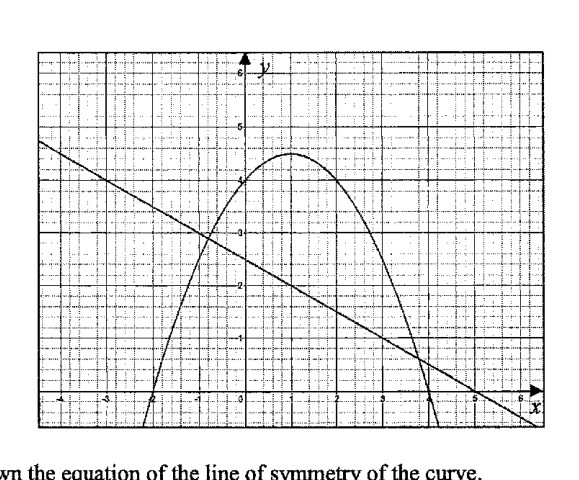
The graphs of and are drawn on the grid.
- (a)
Write down the equation of the line of symmetry of the curve.
Answer ...
- (b)
Show that the value of .
Answer ...
- (c)
Explain why the equation does not have solutions for some values of .
Answer ...
- (d)
The points of intersection of the curve and the straight line give the solutions of a quadratic equation. Find the quadratic equation, giving your answer in the form .
Answer ...
It won't just hand you the answer — it asks where you're stuck.How the checker works
Worked solution
20(a)
1. Identify the x-intercepts from the factorised quadratic and find their midpoint.
For , the x-intercepts are given by
So or .
The line of symmetry is halfway between the roots:
20(c)
1. Relate the equation to intersections between the parabola and the horizontal line $y=k$, then use the range of the quadratic graph.
The equation represents the intersections of the curve with the horizontal line .
Since in and has a negative coefficient of , the curve is a downward-opening parabola. It has a maximum value, so horizontal lines above this maximum do not meet the curve. Therefore, for some values of , there are no solutions.
The curve has a maximum value, so some horizontal lines do not cut the curve. Hence has no solutions for values of above the maximum value of the curve.
20(d)
1. Equate the two graph equations and substitute $a=\frac12$.
At the points of intersection,
Using ,
2. Clear fractions, expand and rearrange into $x^2+px+q=0$.
Multiply by :
Expand:
Rearrange:
Correctly collecting all terms:
Multiply by :
AI analysis — may contain mistakes.
Worked this one out on paper? Snap your steps and Gigle's AI math checker will circle the step where it went wrong.