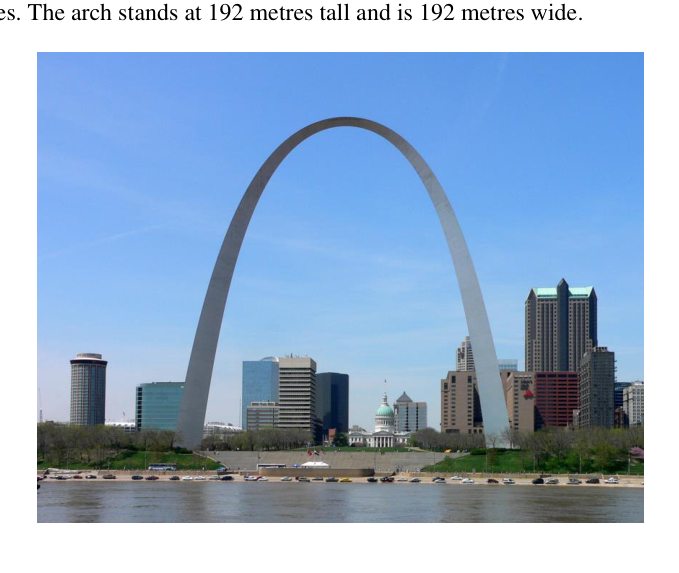
下图展示了美国密苏里州圣路易斯市的纪念碑——大拱门(Gateway Arch)。该拱门高 192 米,宽 192 米。 拱门可以用下图所示的一部分曲线来建模。 该曲线的最高点位于 yy 轴上,且曲线关于 yy 轴对称。两个端点均位于 xx 轴上。已知该曲线满足微分方程
d2ydx2=ak1+(1kdydx)2\frac{\mathrm{d}^2 y}{\mathrm{d}x^2} = ak \sqrt{1 + \left(\frac{1}{k}\frac{\mathrm{d}y}{\mathrm{d}x}\right)^2}
其中 aa 和 kk 为常数。

  1. (i)

    证明通过换元 p=1kdydxp = \frac{1}{k}\frac{\mathrm{d}y}{\mathrm{d}x} 可以将该微分方程简化为
    dpdx=a1+p2.\frac{\mathrm{d}p}{\mathrm{d}x} = a\sqrt{1 + p^2}.

  2. (ii)

    利用换元 p=tan⁡up = \tan u(其中 −π2<u<π2-\frac{\pi}{2} < u < \frac{\pi}{2})来求解第 (i) 部分中简化后的微分方程,从而证明
    p=eax−e−ax2.p = \frac{\mathrm{e}^{ax} - \mathrm{e}^{-ax}}{2}.

  3. (iii)

    已知 a=−0.0329a = -0.0329 且 k=0.701k = 0.701,求出 yy 关于 xx 的表达式。

先不看答案,让 AI 诊断你卡在哪里?

它不会直接告诉你答案,而是问你卡在哪一步看看 AI 是怎么陪你一步步弄懂这道题的

完整解法

11(i)

1. Find an expression for the second derivative $\frac{\mathrm{d}^2y}{\mathrm{d}x^2}$ in terms of $p$.

Given the substitution p=1kdydxp = \frac{1}{k}\frac{\mathrm{d}y}{\mathrm{d}x}, we differentiate both sides with respect to xx:
dpdx=1kd2ydx2\frac{\mathrm{d}p}{\mathrm{d}x} = \frac{1}{k}\frac{\mathrm{d}^2y}{\mathrm{d}x^2}
Multiplying by kk gives:
d2ydx2=kdpdx\frac{\mathrm{d}^2y}{\mathrm{d}x^2} = k\frac{\mathrm{d}p}{\mathrm{d}x}

2. Substitute the expressions back into the original differential equation to yield the required reduced form.

Substitute pp and d2ydx2\frac{\mathrm{d}^2y}{\mathrm{d}x^2} into the original differential equation d2ydx2=ak1+(1kdydx)2\frac{\mathrm{d}^2 y}{\mathrm{d}x^2} = ak \sqrt{1 + \left(\frac{1}{k}\frac{\mathrm{d}y}{\mathrm{d}x}\right)^2}:
kdpdx=ak1+p2k\frac{\mathrm{d}p}{\mathrm{d}x} = ak \sqrt{1 + p^2}
Dividing both sides by the constant kk:
dpdx=a1+p2\frac{\mathrm{d}p}{\mathrm{d}x} = a\sqrt{1 + p^2}

答案

dpdx=a1+p2 (shown)\frac{\mathrm{d}p}{\mathrm{d}x} = a\sqrt{1 + p^2} \text{ (shown)}

11(ii)

1. Separate the variables of the differential equation and apply the substitution $p = \tan u$.

From part (i), we have the reduced differential equation dpdx=a1+p2\frac{\mathrm{d}p}{\mathrm{d}x} = a\sqrt{1 + p^2}. Separating the variables:
∫11+p2 dp=∫a dx\int \frac{1}{\sqrt{1 + p^2}} \, \mathrm{d}p = \int a \, \mathrm{d}x
Using the given substitution p=tan⁡up = \tan u, we differentiate to get dpdu=sec⁡2u  ⟹  dp=sec⁡2u du\frac{\mathrm{d}p}{\mathrm{d}u} = \sec^2 u \implies \mathrm{d}p = \sec^2 u \, \mathrm{d}u.
Substitute this into the integral:
∫sec⁡2u1+tan⁡2u du=∫a dx\int \frac{\sec^2 u}{\sqrt{1 + \tan^2 u}} \, \mathrm{d}u = \int a \, \mathrm{d}x

2. Simplify the integrand using trigonometric identities and integrate both sides.

Using the identity 1+tan⁡2u=sec⁡2u1 + \tan^2 u = \sec^2 u, the denominator is sec⁡2u\sqrt{\sec^2 u}. Since −π2<u<π2-\frac{\pi}{2} < u < \frac{\pi}{2}, sec⁡u>0\sec u > 0, so sec⁡2u=sec⁡u\sqrt{\sec^2 u} = \sec u.
The integral simplifies to:
∫sec⁡2usec⁡u du=∫a dx\int \frac{\sec^2 u}{\sec u} \, \mathrm{d}u = \int a \, \mathrm{d}x
∫sec⁡u du=∫a dx\int \sec u \, \mathrm{d}u = \int a \, \mathrm{d}x
Using the standard result for integrating sec⁡u\sec u:
ln⁡(sec⁡u+tan⁡u)=ax+C\ln (\sec u + \tan u) = ax + C
(Note: The absolute value is omitted since sec⁡u+tan⁡u>0\sec u + \tan u > 0 for the given domain of uu.)

3. Determine the initial condition from the physical context of the arch.

The problem states that the highest point of the arch lies on the yy-axis. At this maximum turning point (x=0x = 0), the tangent is horizontal, so dydx=0\frac{\mathrm{d}y}{\mathrm{d}x} = 0.
Given the substitution p=1kdydxp = \frac{1}{k}\frac{\mathrm{d}y}{\mathrm{d}x}, we have:
At x=0,p=1k(0)=0\text{At } x = 0, \quad p = \frac{1}{k}(0) = 0
When p=0p = 0, 0=tan⁡u  ⟹  u=00 = \tan u \implies u = 0.

4. Substitute the initial condition to find the constant of integration $C$.

Substitute x=0x = 0 and u=0u = 0 into the integrated equation:
ln⁡(sec⁡0+tan⁡0)=a(0)+C\ln (\sec 0 + \tan 0) = a(0) + C
ln⁡(1+0)=C  ⟹  C=0\ln (1 + 0) = C \implies C = 0
Thus, the equation simplifies to:
ln⁡(sec⁡u+tan⁡u)=ax\ln (\sec u + \tan u) = ax
sec⁡u+tan⁡u=eax\sec u + \tan u = \mathrm{e}^{ax}

5. Use trigonometric identities to isolate $\tan u$ and solve for $p$.

Using the Pythagorean identity sec⁡2u−tan⁡2u=1\sec^2 u - \tan^2 u = 1, we can factorise it as:
(sec⁡u+tan⁡u)(sec⁡u−tan⁡u)=1(\sec u + \tan u)(\sec u - \tan u) = 1
Substitute sec⁡u+tan⁡u=eax\sec u + \tan u = \mathrm{e}^{ax} into the identity:
eax(sec⁡u−tan⁡u)=1  ⟹  sec⁡u−tan⁡u=e−ax\mathrm{e}^{ax} (\sec u - \tan u) = 1 \implies \sec u - \tan u = \mathrm{e}^{-ax}
Subtracting this from our earlier equation (sec⁡u+tan⁡u=eax\sec u + \tan u = \mathrm{e}^{ax}) gives:
(sec⁡u+tan⁡u)−(sec⁡u−tan⁡u)=eax−e−ax(\sec u + \tan u) - (\sec u - \tan u) = \mathrm{e}^{ax} - \mathrm{e}^{-ax}
2tan⁡u=eax−e−ax2\tan u = \mathrm{e}^{ax} - \mathrm{e}^{-ax}
Since p=tan⁡up = \tan u:
2p=eax−e−ax2p = \mathrm{e}^{ax} - \mathrm{e}^{-ax}
p=eax−e−ax2(shown)p = \frac{\mathrm{e}^{ax} - \mathrm{e}^{-ax}}{2} \quad \text{(shown)}

答案

p=eax−e−ax2p = \frac{\mathrm{e}^{ax} - \mathrm{e}^{-ax}}{2}

11(iii)

1. Rearrange the expression from (ii) to find $\frac{\mathrm{d}y}{\mathrm{d}x}$ and substitute the given constants $a$ and $k$.

From parts (i) and (ii), we know that p=1kdydxp = \frac{1}{k}\frac{\mathrm{d}y}{\mathrm{d}x} and p=eax−e−ax2p = \frac{\mathrm{e}^{ax} - \mathrm{e}^{-ax}}{2}.
Equating these expressions:
1kdydx=eax−e−ax2\frac{1}{k}\frac{\mathrm{d}y}{\mathrm{d}x} = \frac{\mathrm{e}^{ax} - \mathrm{e}^{-ax}}{2}
dydx=k2(eax−e−ax)\frac{\mathrm{d}y}{\mathrm{d}x} = \frac{k}{2} (\mathrm{e}^{ax} - \mathrm{e}^{-ax})
Substitute a=−0.0329a = -0.0329 and k=0.701k = 0.701:
dydx=0.7012(e−0.0329x−e0.0329x)=0.3505(e−0.0329x−e0.0329x)\frac{\mathrm{d}y}{\mathrm{d}x} = \frac{0.701}{2} (\mathrm{e}^{-0.0329x} - \mathrm{e}^{0.0329x}) = 0.3505 (\mathrm{e}^{-0.0329x} - \mathrm{e}^{0.0329x})

2. Integrate with respect to $x$ to find the general solution for $y$.

y=∫0.3505(e−0.0329x−e0.0329x) dxy = \int 0.3505 (\mathrm{e}^{-0.0329x} - \mathrm{e}^{0.0329x}) \, \mathrm{d}x
y=0.3505(e−0.0329x−0.0329−e0.0329x0.0329)+Cy = 0.3505 \left( \frac{\mathrm{e}^{-0.0329x}}{-0.0329} - \frac{\mathrm{e}^{0.0329x}}{0.0329} \right) + C
y=−10.653(e−0.0329x+e0.0329x)+Cy = -10.653 (\mathrm{e}^{-0.0329x} + \mathrm{e}^{0.0329x}) + C

3. Apply the boundary condition at the highest point to find the constant of integration $C$ and write the final equation.

The arch is 192 m192\text{ m} tall, and its highest point lies on the yy-axis. This gives the boundary condition x=0x = 0 when y=192y = 192.
192=−10.653(e0+e0)+C192 = -10.653 (\mathrm{e}^{0} + \mathrm{e}^{0}) + C
192=−21.307+C  ⟹  C=213.307192 = -21.307 + C \implies C = 213.307
Substituting CC back and rounding to 3 significant figures:
y=−10.7(e−0.0329x+e0.0329x)+213y = -10.7 (\mathrm{e}^{-0.0329x} + \mathrm{e}^{0.0329x}) + 213

答案

y=213−10.7(e−0.0329x+e0.0329x)y = 213 - 10.7 (\mathrm{e}^{-0.0329x} + \mathrm{e}^{0.0329x})

AI 分析,可能出错

用 AI 批改,圈出写错的那一步,并自动将你的薄弱点存入错题本,形成你的错因库。

同一知识点的其他题

  1. 1曲线上的点 (x,y)(x,y) 满足方程 x=12t2−2tx = \tfrac{1}{2}t^2 - 2t 和 dydx=12t−1\dfrac{dy}{dx} = \dfrac{1}{2t - 1} 其中 tt 为参数,t>2t > 2。 已知当 t=4t = 4…
  2. 2在一个大城镇中,首次发现某种病毒 tt 天后感染该病毒的人数为 xx。假设感染率与 xx 成正比。起初有 5 人感染该病毒,而在首次发现病毒 30 天后,有 5120 人感染该病毒。 在发现病毒 30 天后,人们发现了该病毒的治疗方法…
  3. 3考虑二阶微分方程 d2xdt2+adxdt=b,\frac{d^{2}x}{dt^{2}} + a\frac{dx}{dt} = b, where aa and bb are non-zero constants and dxdt≠ba\frac{dx}{dt} \ne \dfrac{b}{a}…
  4. 4一杯刚泡好的茶,初始温度为 85∘C85^\circ\text{C},被放在一间室温为 25∘C25^\circ\text{C} 的房间里冷却。20分钟后,茶的温度为 55∘C55^\circ\text{C}。已知茶温的变化率与茶温与室温之差成正比。…
  5. 5在一个大城镇中,在首次发现某种病毒 tt 天后,感染该病毒的人数为 xx。假设感染率与 xx 成正比。起初有 5 人感染该病毒,在首次发现该病毒 30 天后,有 5120 人感染。 证明 x=5(2)t3x = 5(2)^{\frac{t}{3}}…