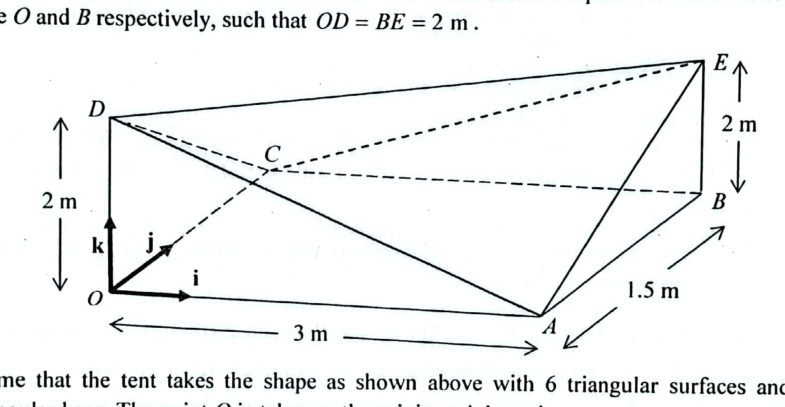
一群男孩想搭建一个露营帐篷。他们在水平地面上铺了一块矩形防水布 OABCOABC,其中 OA=3 mOA = 3\text{ m} 且 AB=1.5 mAB = 1.5\text{ m},并将点 DD 和 EE 分别固定在 OO 和 BB 的正上方,使得 OD=BE=2 mOD = BE = 2\text{ m}。 假设帐篷的形状如上图所示,具有 6 个三角形面和一个矩形底面。设点 OO 为原点,单位向量 i\mathbf{i}、j\mathbf{j} 和 k\mathbf{k} 分别取在 OA→\overrightarrow{OA}、OC→\overrightarrow{OC} 和 OD→\overrightarrow{OD} 的方向上。

  1. (i)

    证明直线 DEDE 可以表示为 r=2k+λ(2i+j)\mathbf{r} = 2\mathbf{k} + \lambda(2\mathbf{i} + \mathbf{j}),λ∈R\lambda \in \mathbb{R}。

  2. (ii)

    求平面 ADEADE 的笛卡尔方程。

  3. (iii)

    求平面 ADEADE 与 OABCOABC 之间的锐角。由此或用其他方法,求平面 ADEADE 与 CDECDE 之间的锐角。

先不看答案,让 AI 诊断你卡在哪里?

它不会直接告诉你答案,而是问你卡在哪一步看看 AI 是怎么陪你一步步弄懂这道题的

完整解法

6(i)

1. Determine the position vectors of points D and E from the given coordinates and lengths.

Given OO is the origin, OAOA is along the xx-axis (i\mathbf{i}), OCOC is along the yy-axis (j\mathbf{j}), and ODOD is along the zz-axis (k\mathbf{k}).
Since OA=3OA = 3 and AB=1.5AB = 1.5 for the rectangular base, the position vector of BB is 3i+1.5j3\mathbf{i} + 1.5\mathbf{j}.
Since DD and EE are vertically above OO and BB respectively by 2 m2\text{ m}, we have:
OD→=2k\overrightarrow{OD} = 2\mathbf{k}
OE→=3i+1.5j+2k\overrightarrow{OE} = 3\mathbf{i} + 1.5\mathbf{j} + 2\mathbf{k}

2. Find the direction vector of the line passing through D and E.

The displacement vector DE→\overrightarrow{DE} is:
DE→=OE→−OD→\overrightarrow{DE} = \overrightarrow{OE} - \overrightarrow{OD}
DE→=(3i+1.5j+2k)−2k\overrightarrow{DE} = (3\mathbf{i} + 1.5\mathbf{j} + 2\mathbf{k}) - 2\mathbf{k}
DE→=3i+1.5j\overrightarrow{DE} = 3\mathbf{i} + 1.5\mathbf{j}

3. Form the vector equation of the line DE.

The direction vector can be scaled by taking out a factor of 1.51.5 to match the required form:
DE→=1.5(2i+j)\overrightarrow{DE} = 1.5(2\mathbf{i} + \mathbf{j})
Taking 2i+j2\mathbf{i} + \mathbf{j} as the direction vector and the point DD (with position vector 2k2\mathbf{k}) as the starting point, the vector equation of the line is:
r=OD→+λ(2i+j)\mathbf{r} = \overrightarrow{OD} + \lambda(2\mathbf{i} + \mathbf{j})
r=2k+λ(2i+j),λ∈R (Shown)\mathbf{r} = 2\mathbf{k} + \lambda(2\mathbf{i} + \mathbf{j}), \lambda \in \mathbb{R}\text{ (Shown)}

答案

r=2k+λ(2i+j),λ∈R\mathbf{r} = 2\mathbf{k} + \lambda(2\mathbf{i} + \mathbf{j}), \lambda \in \mathbb{R}

6(ii)

1. Find two non-parallel vectors parallel to the plane $ADE$.

From the given dimensions and coordinate system, the coordinates of AA and DD are A(3,0,0)A(3, 0, 0) and D(0,0,2)D(0, 0, 2).
DA→=(300)−(002)=(30−2)\overrightarrow{DA} = \begin{pmatrix} 3 \\ 0 \\ 0 \end{pmatrix} - \begin{pmatrix} 0 \\ 0 \\ 2 \end{pmatrix} = \begin{pmatrix} 3 \\ 0 \\ -2 \end{pmatrix}
From part (i), the direction vector of line DEDE is:
dDE=(210)\mathbf{d}_{DE} = \begin{pmatrix} 2 \\ 1 \\ 0 \end{pmatrix}

2. Find a normal vector to the plane $ADE$ using the cross product.

A normal vector n\mathbf{n} can be found by evaluating the cross product of DA→\overrightarrow{DA} and dDE\mathbf{d}_{DE}:
n=(30−2)×(210)=((0)(0)−(−2)(1)(−2)(2)−(3)(0)(3)(1)−(0)(2))=(2−43)\mathbf{n} = \begin{pmatrix} 3 \\ 0 \\ -2 \end{pmatrix} \times \begin{pmatrix} 2 \\ 1 \\ 0 \end{pmatrix} = \begin{pmatrix} (0)(0) - (-2)(1) \\ (-2)(2) - (3)(0) \\ (3)(1) - (0)(2) \end{pmatrix} = \begin{pmatrix} 2 \\ -4 \\ 3 \end{pmatrix}

3. Determine the Cartesian equation of the plane $ADE$.

Using point D(0,0,2)D(0, 0, 2) and the normal vector n\mathbf{n}:
r⋅n=d⋅n\mathbf{r} \cdot \mathbf{n} = \mathbf{d} \cdot \mathbf{n}
r⋅(2−43)=(002)⋅(2−43)=6\mathbf{r} \cdot \begin{pmatrix} 2 \\ -4 \\ 3 \end{pmatrix} = \begin{pmatrix} 0 \\ 0 \\ 2 \end{pmatrix} \cdot \begin{pmatrix} 2 \\ -4 \\ 3 \end{pmatrix} = 6
Thus, replacing r\mathbf{r} with (xyz)\begin{pmatrix} x \\ y \\ z \end{pmatrix}, the Cartesian equation of the plane is:
2x−4y+3z=62x - 4y + 3z = 6

答案

2x−4y+3z=62x - 4y + 3z = 6

6(iii)

1. Determine the normal vector to the plane $ADE$ and calculate the acute angle it makes with the plane $OABC$.

Let n1\mathbf{n}_1 be the normal to the plane ADEADE. Deriving from the coordinates A(3,0,0)A(3, 0, 0), D(0,0,2)D(0, 0, 2) and E(3,1.5,2)E(3, 1.5, 2) (as expected in part (ii)):
AD→=(−302),AE→=(01.52)\overrightarrow{AD} = \begin{pmatrix} -3 \\ 0 \\ 2 \end{pmatrix}, \quad \overrightarrow{AE} = \begin{pmatrix} 0 \\ 1.5 \\ 2 \end{pmatrix}
n1=AD→×AE→=(−302)×(01.52)=(−36−4.5)\mathbf{n}_1 = \overrightarrow{AD} \times \overrightarrow{AE} = \begin{pmatrix} -3 \\ 0 \\ 2 \end{pmatrix} \times \begin{pmatrix} 0 \\ 1.5 \\ 2 \end{pmatrix} = \begin{pmatrix} -3 \\ 6 \\ -4.5 \end{pmatrix}
Taking a simpler scalar multiple, let n1=(2−43)\mathbf{n}_1 = \begin{pmatrix} 2 \\ -4 \\ 3 \end{pmatrix}.
The plane OABCOABC lies flat on the xyxy-plane, so its normal is n2=k=(001)\mathbf{n}_2 = \mathbf{k} = \begin{pmatrix} 0 \\ 0 \\ 1 \end{pmatrix}.
Let θ\theta be the acute angle between the planes ADEADE and OABCOABC:
cos⁡θ=∣n1⋅n2∣∣n1∣∣n2∣=∣(2−43)⋅(001)∣22+(−4)2+3212=329\cos \theta = \frac{|\mathbf{n}_1 \cdot \mathbf{n}_2|}{|\mathbf{n}_1||\mathbf{n}_2|} = \frac{\left| \begin{pmatrix} 2 \\ -4 \\ 3 \end{pmatrix} \cdot \begin{pmatrix} 0 \\ 0 \\ 1 \end{pmatrix} \right|}{\sqrt{2^2 + (-4)^2 + 3^2}\sqrt{1^2}} = \frac{3}{\sqrt{29}}
θ=cos⁡−1(329)≈56.145∘≈56.1∘\theta = \cos^{-1}\left(\frac{3}{\sqrt{29}}\right) \approx 56.145^\circ \approx 56.1^\circ

2. Find the normal vector to the plane $CDE$ and use the dot product to find the acute angle between $ADE$ and $CDE$.

To find the angle between planes ADEADE and CDECDE, we first find the normal to the plane CDECDE, n3\mathbf{n}_3. Using C(0,1.5,0)C(0, 1.5, 0):
CD→=(0−1.52),CE→=(302)\overrightarrow{CD} = \begin{pmatrix} 0 \\ -1.5 \\ 2 \end{pmatrix}, \quad \overrightarrow{CE} = \begin{pmatrix} 3 \\ 0 \\ 2 \end{pmatrix}
n3=CD→×CE→=(0−1.52)×(302)=(−364.5)\mathbf{n}_3 = \overrightarrow{CD} \times \overrightarrow{CE} = \begin{pmatrix} 0 \\ -1.5 \\ 2 \end{pmatrix} \times \begin{pmatrix} 3 \\ 0 \\ 2 \end{pmatrix} = \begin{pmatrix} -3 \\ 6 \\ 4.5 \end{pmatrix}
Taking a scalar multiple, we use n3=(2−4−3)\mathbf{n}_3 = \begin{pmatrix} 2 \\ -4 \\ -3 \end{pmatrix}.
Let ϕ\phi be the acute angle between the planes ADEADE and CDECDE:
cos⁡ϕ=∣n1⋅n3∣∣n1∣∣n3∣=∣(2−43)⋅(2−4−3)∣2929=∣4+16−9∣29=1129\cos \phi = \frac{|\mathbf{n}_1 \cdot \mathbf{n}_3|}{|\mathbf{n}_1||\mathbf{n}_3|} = \frac{\left| \begin{pmatrix} 2 \\ -4 \\ 3 \end{pmatrix} \cdot \begin{pmatrix} 2 \\ -4 \\ -3 \end{pmatrix} \right|}{\sqrt{29}\sqrt{29}} = \frac{|4 + 16 - 9|}{29} = \frac{11}{29}
ϕ=cos⁡−1(1129)≈67.706∘≈67.7∘\phi = \cos^{-1}\left(\frac{11}{29}\right) \approx 67.706^\circ \approx 67.7^\circ
(Note for "Hence" method: Since n3\mathbf{n}_3 is a reflection of n1\mathbf{n}_1 across the xyxy-plane, the angle between them is identically 180∘−2θ=180∘−2(56.145∘)=67.7∘180^\circ - 2\theta = 180^\circ - 2(56.145^\circ) = 67.7^\circ.)

答案

Angle between planes ADEADE and OABC=56.1∘OABC = 56.1^\circ
Angle between planes ADEADE and CDE=67.7∘CDE = 67.7^\circ

AI 分析,可能出错

用 AI 批改,圈出写错的那一步,并自动将你的薄弱点存入错题本,形成你的错因库。

同一知识点的其他题

  1. 1直线 l1l_1 和 l2l_2 的方程分别为 r=(4110)+λ(1−1−6),λ∈R\mathbf{r} = \begin{pmatrix} 4 \\ 1 \\ 10 \end{pmatrix} + \lambda \begin{pmatrix} 1 \\ -1 \\ -6 \end{pmatrix}, \lambda \in \mathbb{R}…
  2. 2一家钻探公司计划在山中铺设一条直管道 ABAB。点 (x,y,z)(x, y, z) 是相对于山脚下坐标为 (0,0,0)(0, 0, 0) 的主控制中心定义的,其中单位为米。xx 轴指向东,yy 轴指向北,zz 轴垂直向上。点 AA 的坐标为 (−200,150,10)(-200, 150, 10)…
  3. 3平面 Π1\Pi_1 的方程为 x+y+z=3x + y + z = 3。一条直线穿过点 PP 和 QQ,它们的位置向量分别为 i+j+2k\mathbf{i} + \mathbf{j} + 2\mathbf{k} 和 4i+2j−k4\mathbf{i} + 2\mathbf{j} - \mathbf{k}…
  4. 4平面 Π1\Pi_1 和 Π2\Pi_2 的向量方程分别为 r=λ1(i+j−k)+μ1(2i−j+k)andr=λ2(i+2j+k)+μ2(3i+j−k)\mathbf{r} = \lambda_1(\mathbf{i} + \mathbf{j} - \mathbf{k}) + \mu_1(2\mathbf{i} - \mathbf{j} + \mathbf{k}) \quad \text{and} \quad \mathbf{r} = \lambda_2(\mathbf{i} + 2\mathbf{j} + \mathbf{k}) + \mu_2(3\mathbf{i} + \mathbf{j} - \mathbf{k})…
  5. 5一位室内设计师正计划设计一个下拉式衣柜升降机。为了测试他的设想,设计师制作了一个它的微缩模型。在这个模型中,点 (x,y,z)(x, y, z) 是相对于模型的一个拐角 O(0,0,0)O(0, 0, 0) 来定义的。模型中使用的杆可以用直线方程来建模。 主杆可…