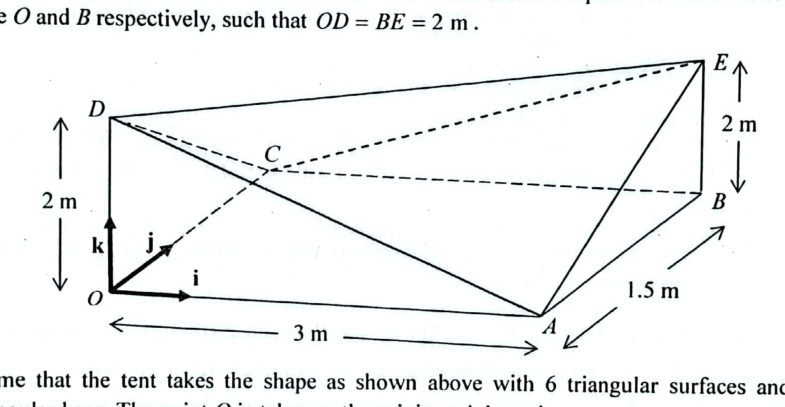
A group of boys want to set up a camping tent. They lay down a rectangular tarp OABCOABC on the horizontal ground with OA=3 mOA = 3\text{ m} and AB=1.5 mAB = 1.5\text{ m} and secure the points DD and EE vertically above OO and BB respectively, such that OD=BE=2 mOD = BE = 2\text{ m}. Assume that the tent takes the shape as shown above with 6 triangular surfaces and a rectangular base. The point OO is taken as the origin and the unit vectors i\mathbf{i}, j\mathbf{j} and k\mathbf{k} are taken to be in the direction of OA→\overrightarrow{OA}, OC→\overrightarrow{OC} and OD→\overrightarrow{OD} respectively.

  1. (i)

    Show that the line DEDE can be expressed as r=2k+λ(2i+j)\mathbf{r} = 2\mathbf{k} + \lambda(2\mathbf{i} + \mathbf{j}), λ∈R\lambda \in \mathbb{R}.

  2. (ii)

    Find the Cartesian equation of the plane ADEADE.

  3. (iii)

    Determine the acute angle between the planes ADEADE and OABCOABC. Hence, or otherwise, find the acute angle between the planes ADEADE and CDECDE.

Work through it with AI →

It won't just hand you the answer — it asks where you're stuck.How the checker works

Worked solution

6(i)

1. Determine the position vectors of points D and E from the given coordinates and lengths.

Given OO is the origin, OAOA is along the xx-axis (i\mathbf{i}), OCOC is along the yy-axis (j\mathbf{j}), and ODOD is along the zz-axis (k\mathbf{k}).
Since OA=3OA = 3 and AB=1.5AB = 1.5 for the rectangular base, the position vector of BB is 3i+1.5j3\mathbf{i} + 1.5\mathbf{j}.
Since DD and EE are vertically above OO and BB respectively by 2 m2\text{ m}, we have:
OD→=2k\overrightarrow{OD} = 2\mathbf{k}
OE→=3i+1.5j+2k\overrightarrow{OE} = 3\mathbf{i} + 1.5\mathbf{j} + 2\mathbf{k}

2. Find the direction vector of the line passing through D and E.

The displacement vector DE→\overrightarrow{DE} is:
DE→=OE→−OD→\overrightarrow{DE} = \overrightarrow{OE} - \overrightarrow{OD}
DE→=(3i+1.5j+2k)−2k\overrightarrow{DE} = (3\mathbf{i} + 1.5\mathbf{j} + 2\mathbf{k}) - 2\mathbf{k}
DE→=3i+1.5j\overrightarrow{DE} = 3\mathbf{i} + 1.5\mathbf{j}

3. Form the vector equation of the line DE.

The direction vector can be scaled by taking out a factor of 1.51.5 to match the required form:
DE→=1.5(2i+j)\overrightarrow{DE} = 1.5(2\mathbf{i} + \mathbf{j})
Taking 2i+j2\mathbf{i} + \mathbf{j} as the direction vector and the point DD (with position vector 2k2\mathbf{k}) as the starting point, the vector equation of the line is:
r=OD→+λ(2i+j)\mathbf{r} = \overrightarrow{OD} + \lambda(2\mathbf{i} + \mathbf{j})
r=2k+λ(2i+j),λ∈R (Shown)\mathbf{r} = 2\mathbf{k} + \lambda(2\mathbf{i} + \mathbf{j}), \lambda \in \mathbb{R}\text{ (Shown)}

Answer

r=2k+λ(2i+j),λ∈R\mathbf{r} = 2\mathbf{k} + \lambda(2\mathbf{i} + \mathbf{j}), \lambda \in \mathbb{R}

6(ii)

1. Find two non-parallel vectors parallel to the plane $ADE$.

From the given dimensions and coordinate system, the coordinates of AA and DD are A(3,0,0)A(3, 0, 0) and D(0,0,2)D(0, 0, 2).
DA→=(300)−(002)=(30−2)\overrightarrow{DA} = \begin{pmatrix} 3 \\ 0 \\ 0 \end{pmatrix} - \begin{pmatrix} 0 \\ 0 \\ 2 \end{pmatrix} = \begin{pmatrix} 3 \\ 0 \\ -2 \end{pmatrix}
From part (i), the direction vector of line DEDE is:
dDE=(210)\mathbf{d}_{DE} = \begin{pmatrix} 2 \\ 1 \\ 0 \end{pmatrix}

2. Find a normal vector to the plane $ADE$ using the cross product.

A normal vector n\mathbf{n} can be found by evaluating the cross product of DA→\overrightarrow{DA} and dDE\mathbf{d}_{DE}:
n=(30−2)×(210)=((0)(0)−(−2)(1)(−2)(2)−(3)(0)(3)(1)−(0)(2))=(2−43)\mathbf{n} = \begin{pmatrix} 3 \\ 0 \\ -2 \end{pmatrix} \times \begin{pmatrix} 2 \\ 1 \\ 0 \end{pmatrix} = \begin{pmatrix} (0)(0) - (-2)(1) \\ (-2)(2) - (3)(0) \\ (3)(1) - (0)(2) \end{pmatrix} = \begin{pmatrix} 2 \\ -4 \\ 3 \end{pmatrix}

3. Determine the Cartesian equation of the plane $ADE$.

Using point D(0,0,2)D(0, 0, 2) and the normal vector n\mathbf{n}:
r⋅n=d⋅n\mathbf{r} \cdot \mathbf{n} = \mathbf{d} \cdot \mathbf{n}
r⋅(2−43)=(002)⋅(2−43)=6\mathbf{r} \cdot \begin{pmatrix} 2 \\ -4 \\ 3 \end{pmatrix} = \begin{pmatrix} 0 \\ 0 \\ 2 \end{pmatrix} \cdot \begin{pmatrix} 2 \\ -4 \\ 3 \end{pmatrix} = 6
Thus, replacing r\mathbf{r} with (xyz)\begin{pmatrix} x \\ y \\ z \end{pmatrix}, the Cartesian equation of the plane is:
2x−4y+3z=62x - 4y + 3z = 6

Answer

2x−4y+3z=62x - 4y + 3z = 6

6(iii)

1. Determine the normal vector to the plane $ADE$ and calculate the acute angle it makes with the plane $OABC$.

Let n1\mathbf{n}_1 be the normal to the plane ADEADE. Deriving from the coordinates A(3,0,0)A(3, 0, 0), D(0,0,2)D(0, 0, 2) and E(3,1.5,2)E(3, 1.5, 2) (as expected in part (ii)):
AD→=(−302),AE→=(01.52)\overrightarrow{AD} = \begin{pmatrix} -3 \\ 0 \\ 2 \end{pmatrix}, \quad \overrightarrow{AE} = \begin{pmatrix} 0 \\ 1.5 \\ 2 \end{pmatrix}
n1=AD→×AE→=(−302)×(01.52)=(−36−4.5)\mathbf{n}_1 = \overrightarrow{AD} \times \overrightarrow{AE} = \begin{pmatrix} -3 \\ 0 \\ 2 \end{pmatrix} \times \begin{pmatrix} 0 \\ 1.5 \\ 2 \end{pmatrix} = \begin{pmatrix} -3 \\ 6 \\ -4.5 \end{pmatrix}
Taking a simpler scalar multiple, let n1=(2−43)\mathbf{n}_1 = \begin{pmatrix} 2 \\ -4 \\ 3 \end{pmatrix}.
The plane OABCOABC lies flat on the xyxy-plane, so its normal is n2=k=(001)\mathbf{n}_2 = \mathbf{k} = \begin{pmatrix} 0 \\ 0 \\ 1 \end{pmatrix}.
Let θ\theta be the acute angle between the planes ADEADE and OABCOABC:
cos⁡θ=∣n1⋅n2∣∣n1∣∣n2∣=∣(2−43)⋅(001)∣22+(−4)2+3212=329\cos \theta = \frac{|\mathbf{n}_1 \cdot \mathbf{n}_2|}{|\mathbf{n}_1||\mathbf{n}_2|} = \frac{\left| \begin{pmatrix} 2 \\ -4 \\ 3 \end{pmatrix} \cdot \begin{pmatrix} 0 \\ 0 \\ 1 \end{pmatrix} \right|}{\sqrt{2^2 + (-4)^2 + 3^2}\sqrt{1^2}} = \frac{3}{\sqrt{29}}
θ=cos⁡−1(329)≈56.145∘≈56.1∘\theta = \cos^{-1}\left(\frac{3}{\sqrt{29}}\right) \approx 56.145^\circ \approx 56.1^\circ

2. Find the normal vector to the plane $CDE$ and use the dot product to find the acute angle between $ADE$ and $CDE$.

To find the angle between planes ADEADE and CDECDE, we first find the normal to the plane CDECDE, n3\mathbf{n}_3. Using C(0,1.5,0)C(0, 1.5, 0):
CD→=(0−1.52),CE→=(302)\overrightarrow{CD} = \begin{pmatrix} 0 \\ -1.5 \\ 2 \end{pmatrix}, \quad \overrightarrow{CE} = \begin{pmatrix} 3 \\ 0 \\ 2 \end{pmatrix}
n3=CD→×CE→=(0−1.52)×(302)=(−364.5)\mathbf{n}_3 = \overrightarrow{CD} \times \overrightarrow{CE} = \begin{pmatrix} 0 \\ -1.5 \\ 2 \end{pmatrix} \times \begin{pmatrix} 3 \\ 0 \\ 2 \end{pmatrix} = \begin{pmatrix} -3 \\ 6 \\ 4.5 \end{pmatrix}
Taking a scalar multiple, we use n3=(2−4−3)\mathbf{n}_3 = \begin{pmatrix} 2 \\ -4 \\ -3 \end{pmatrix}.
Let ϕ\phi be the acute angle between the planes ADEADE and CDECDE:
cos⁡ϕ=∣n1⋅n3∣∣n1∣∣n3∣=∣(2−43)⋅(2−4−3)∣2929=∣4+16−9∣29=1129\cos \phi = \frac{|\mathbf{n}_1 \cdot \mathbf{n}_3|}{|\mathbf{n}_1||\mathbf{n}_3|} = \frac{\left| \begin{pmatrix} 2 \\ -4 \\ 3 \end{pmatrix} \cdot \begin{pmatrix} 2 \\ -4 \\ -3 \end{pmatrix} \right|}{\sqrt{29}\sqrt{29}} = \frac{|4 + 16 - 9|}{29} = \frac{11}{29}
ϕ=cos⁡−1(1129)≈67.706∘≈67.7∘\phi = \cos^{-1}\left(\frac{11}{29}\right) \approx 67.706^\circ \approx 67.7^\circ
(Note for "Hence" method: Since n3\mathbf{n}_3 is a reflection of n1\mathbf{n}_1 across the xyxy-plane, the angle between them is identically 180∘−2θ=180∘−2(56.145∘)=67.7∘180^\circ - 2\theta = 180^\circ - 2(56.145^\circ) = 67.7^\circ.)

Answer

Angle between planes ADEADE and OABC=56.1∘OABC = 56.1^\circ
Angle between planes ADEADE and CDE=67.7∘CDE = 67.7^\circ

AI analysis — may contain mistakes.

Worked this one out on paper? Snap your steps and Gigle's AI math checker will circle the step where it went wrong.

More questions on this topic

  1. 1The lines l1l_1 and l2l_2 have equations r=(4110)+λ(1−1−6),λ∈R\mathbf{r} = \begin{pmatrix} 4 \\ 1 \\ 10 \end{pmatrix} + \lambda \begin{pmatrix} 1 \\ -1 \\ -6 \end{pmatrix}, \lambda \in \mathbb{R}…
  2. 2A drilling company plans to install a straight pipeline ABAB through a mountain. Points (x,y,z)(x, y, z) are defined relative…
  3. 3A plane Π1\Pi_1 has equation x+y+z=3x + y + z = 3. A line passes through the points PP and QQ with position vectors i+j+2k\mathbf{i} + \mathbf{j} + 2\mathbf{k}…
  4. 4The planes Π1\Pi_1 and Π2\Pi_2 have vector equations r=λ1(i+j−k)+μ1(2i−j+k)andr=λ2(i+2j+k)+μ2(3i+j−k)\mathbf{r} = \lambda_1(\mathbf{i} + \mathbf{j} - \mathbf{k}) + \mu_1(2\mathbf{i} - \mathbf{j} + \mathbf{k}) \quad \text{and} \quad \mathbf{r} = \lambda_2(\mathbf{i} + 2\mathbf{j} + \mathbf{k}) + \mu_2(3\mathbf{i} + \mathbf{j} - \mathbf{k})…
  5. 5A home interior designer is looking to design a pull-down wardrobe lift. To test his concept, the designer built a small…