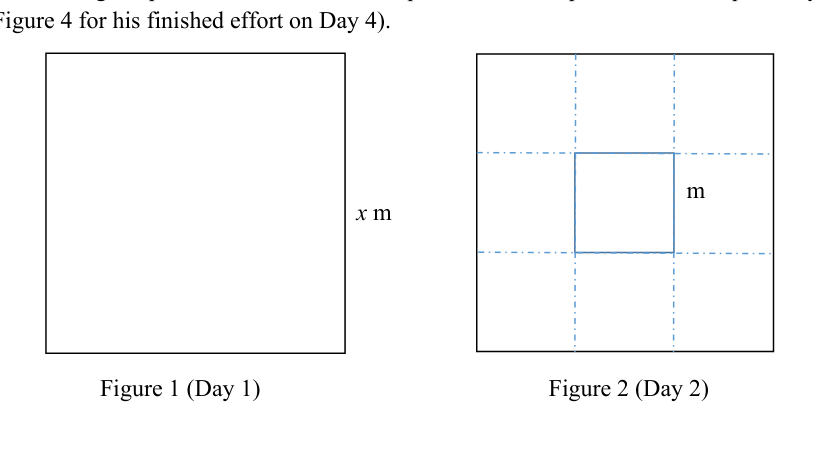
一位著名的艺术家想要创作一件只使用正方形的艺术品。第一天,他画了一个边长为 米的正方形的周长,如图 1 所示。第二天,他将该正方形分成 9 个相等的正方形,并画出中间正方形的周长,如图 2 所示。第三天,他将第二天剩下的 8 个空正方形分别分成 9 个相等的正方形,并画出这些中间正方形的周长,如图 3 所示。在随后的日子里重复这种“画出中间正方形周长”的步骤(图 4 展示了他第四天完成的作品)。
- (i)
写出艺术家在第 3 天和第 4 天绘制的新正方形的数量。
由此,写出艺术家在第 天()绘制的新正方形的数量。
- (ii)
写出艺术家在第 3 天 and 第 4 天绘制的新正方形的边长。
由此,写出艺术家在第 天()绘制的新正方形的边长。
- (iii)
证明该艺术家在第 天()画出的新正方形的总周长为
。
- (iv)
因此,写出截至第 天结束时(),该艺术家画出的所有正方形的总周长。
- (v)
一家公司想要支持这位艺术家。该公司决定为画出的第一个正方形资助 10 美元。对于艺术家画出的每一个后续正方形,公司资助的金额都会比前一个正方形多 1 美元。(对于画出的第二个正方形,艺术家将获得 11 美元;对于画出的第三个正方形,他将获得 12 美元,依此类推。)艺术家决定在完成第 6 天的所有正方形后停止绘画。
公司的一位董事听说了这项资助,决定个人出资支付艺术家画出的第 个正方形。求这位董事个人将支付的金额。
它不会直接告诉你答案,而是问你卡在哪一步看看 AI 是怎么陪你一步步弄懂这道题的
完整解法
11(i)
1. Write down the number of new squares drawn on Day 3 and Day 4.
On Day 2, there are empty squares remaining.
On Day 3, each of these squares is divided, and middle square is drawn in each.
Number of new squares on Day 3
This leaves empty squares.
On Day 4, each of the empty squares is divided, and middle square is drawn in each.
Number of new squares on Day 4
2. Formulate an expression for the number of new squares on Day $N$.
For , the number of new squares drawn each day forms the sequence
We can express these as consecutive powers of :
Day 2 ():
Day 3 ():
Day 4 ():
Following this pattern, the exponent is always . Thus, for Day , the number of new squares is .
Day 3: , Day 4:
Day :
11(ii)
1. Find the side lengths for Day 3 and Day 4.
Each day, the squares from the previous day are divided into a 3 by 3 grid, so the side length of a new square is of the side length of a square from the previous day.
Length on Day 2 = m.
Length on Day 3 = m.
Length on Day 4 = m.
2. Generalise the side length to find the formula for Day $N$.
The side lengths follow a geometric progression:
Day 2 ():
Day 3 ():
Day 4 ():
Therefore, on Day (for ), the power of in the denominator is . The side length is m.
Day 3: m; Day 4: m; Day : m
11(iii)
1. State the expressions for the number of squares and the side length of each square on Day $N$ from earlier parts.
From (i), the number of new squares on Day is .
From (ii), the side length of a new square on Day is m.
2. Formulate the expression for the total perimeter of the new squares.
3. Use the laws of indices to rearrange the expression into the required form.
11(iv)
1. Identify that the total perimeter requires adding the Day 1 perimeter to the sum of perimeters from Day 2 to Day $N$.
\text{Perimeter drawn on Day 1} = 4x
\text{Total perimeter} = 4x + \sum_{k=2}^{N} \frac{x}{2}\left(\frac{8}{3}\right)^{k-1}
2. Calculate the sum of the geometric progression for the perimeters from Day 2 to Day $N$.
\text{The perimeters from Day 2 to } N ext{ form a geometric progression with:}
a = \frac{x}{2}\left(\frac{8}{3}\right)^{2-1} = \frac{4x}{3}
r = \frac{8}{3}
\text{Number of terms } n = N - 1
S_{n} = \frac{a(r^{n} - 1)}{r - 1} = \frac{\frac{4x}{3} \left( \left(\frac{8}{3}\right)^{N-1} - 1 \right)}{\frac{8}{3} - 1}
S_{n} = \frac{\frac{4x}{3} \left( \left(\frac{8}{3}\right)^{N-1} - 1 \right)}{\frac{5}{3}} = \frac{4x}{5} \left( \left(\frac{8}{3}\right)^{N-1} - 1 \right)
3. Combine the Day 1 perimeter with the GP sum and simplify.
\text{Total perimeter} = 4x + \frac{4x}{5} \left( \left(\frac{8}{3}\right)^{N-1} - 1 \right)
= \frac{20x}{5} - \frac{4x}{5} + \frac{4x}{5}\left(\frac{8}{3}\right)^{N-1}
= \frac{16x}{5} + \frac{4x}{5}\left(\frac{8}{3}\right)^{N-1}
= \frac{4x}{5} \left( 4 + \left(\frac{8}{3}\right)^{N-1} \right)
11(v)
1. Find the total number of squares drawn by the artist by the end of Day 6.
Based on the pattern, the artist draws square on Day 1. For Day (), the artist draws new squares.
By the end of Day 6, the total number of squares drawn is:
Using the sum formula for a geometric progression:
2. Determine the number of squares the director personally pays for.
The director pays for the squares. Their positions form an arithmetic progression with a general term of .
To find the maximum number of squares the director pays for:
Since must be an integer, .
The director pays for squares (the last being the square).
3. Formulate the sequence of payments made by the director.
The pledge for the -th square is dollars.
The amounts paid by the director form an arithmetic progression:
First payment ():
Second payment ():
Third payment ():
This sequence is an arithmetic progression with first term and common difference .
4. Calculate the total amount paid by the director.
We use the sum of an arithmetic progression formula with , , and :
The director will personally pay .
$3,668,350
AI 分析,可能出错
用 AI 批改,圈出写错的那一步,并自动将你的薄弱点存入错题本,形成你的错因库。