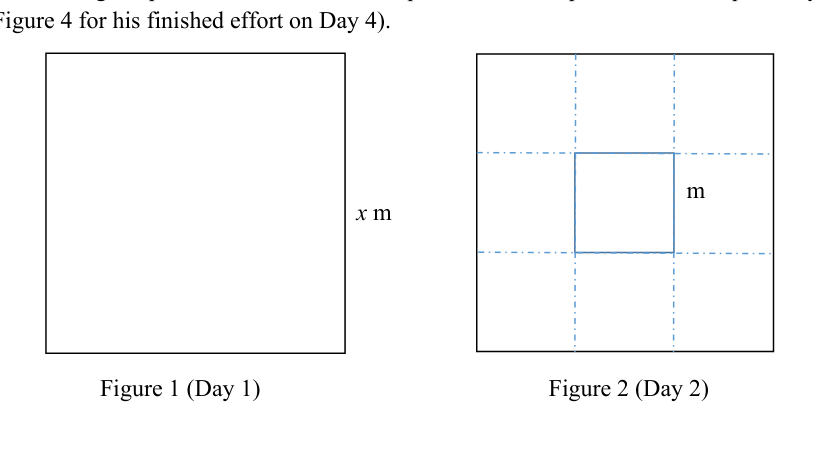
A famous artist wants to create an artwork that uses squares only. On the first day, he draws the perimeter of a square with length m as shown in Figure 1. On the second day, he divides the square into 9 equal squares and draws the perimeter of the middle square as shown in Figure 2. On the third day, he divides the remaining 8 empty squares from Day 2 into 9 equal squares, and draws the perimeters of the middle squares as shown in Figure 3. This procedure of "drawing the perimeters of the middle squares" is then repeated for subsequent days (see Figure 4 for his finished effort on Day 4).
- (i)
Write down the number of new squares the artist draws on Day 3 and Day 4.
Hence write down the number of new squares the artist draws on Day ().
- (ii)
Write down the length of one side of a new square the artist draws on Day 3 and Day 4.
Hence write down the length of one side of a new square the artist draws on Day ().
- (iii)
Show that the total perimeter of new squares the artist draws on Day () is
.
- (iv)
Hence write the total perimeter of all the squares the artist would have drawn by the end of the -th day ().
- (v)
A company wants to support the artist. It decides to pledge 1 more than what was pledged for the previous square. (For the second square drawn, the artist will receive 12, and so on.) The artist decides to stop drawing after he completes all the squares on Day 6.
A director of the company hears about the pledge, and he decides to personally pay for the square that the artist draws. Find the amount of money the director will personally pay.
It won't just hand you the answer — it asks where you're stuck.How the checker works
Worked solution
11(i)
1. Write down the number of new squares drawn on Day 3 and Day 4.
On Day 2, there are empty squares remaining.
On Day 3, each of these squares is divided, and middle square is drawn in each.
Number of new squares on Day 3
This leaves empty squares.
On Day 4, each of the empty squares is divided, and middle square is drawn in each.
Number of new squares on Day 4
2. Formulate an expression for the number of new squares on Day $N$.
For , the number of new squares drawn each day forms the sequence
We can express these as consecutive powers of :
Day 2 ():
Day 3 ():
Day 4 ():
Following this pattern, the exponent is always . Thus, for Day , the number of new squares is .
Day 3: , Day 4:
Day :
11(ii)
1. Find the side lengths for Day 3 and Day 4.
Each day, the squares from the previous day are divided into a 3 by 3 grid, so the side length of a new square is of the side length of a square from the previous day.
Length on Day 2 = m.
Length on Day 3 = m.
Length on Day 4 = m.
2. Generalise the side length to find the formula for Day $N$.
The side lengths follow a geometric progression:
Day 2 ():
Day 3 ():
Day 4 ():
Therefore, on Day (for ), the power of in the denominator is . The side length is m.
Day 3: m; Day 4: m; Day : m
11(iii)
1. State the expressions for the number of squares and the side length of each square on Day $N$ from earlier parts.
From (i), the number of new squares on Day is .
From (ii), the side length of a new square on Day is m.
2. Formulate the expression for the total perimeter of the new squares.
3. Use the laws of indices to rearrange the expression into the required form.
11(iv)
1. Identify that the total perimeter requires adding the Day 1 perimeter to the sum of perimeters from Day 2 to Day $N$.
\text{Perimeter drawn on Day 1} = 4x
\text{Total perimeter} = 4x + \sum_{k=2}^{N} \frac{x}{2}\left(\frac{8}{3}\right)^{k-1}
2. Calculate the sum of the geometric progression for the perimeters from Day 2 to Day $N$.
\text{The perimeters from Day 2 to } N ext{ form a geometric progression with:}
a = \frac{x}{2}\left(\frac{8}{3}\right)^{2-1} = \frac{4x}{3}
r = \frac{8}{3}
\text{Number of terms } n = N - 1
S_{n} = \frac{a(r^{n} - 1)}{r - 1} = \frac{\frac{4x}{3} \left( \left(\frac{8}{3}\right)^{N-1} - 1 \right)}{\frac{8}{3} - 1}
S_{n} = \frac{\frac{4x}{3} \left( \left(\frac{8}{3}\right)^{N-1} - 1 \right)}{\frac{5}{3}} = \frac{4x}{5} \left( \left(\frac{8}{3}\right)^{N-1} - 1 \right)
3. Combine the Day 1 perimeter with the GP sum and simplify.
\text{Total perimeter} = 4x + \frac{4x}{5} \left( \left(\frac{8}{3}\right)^{N-1} - 1 \right)
= \frac{20x}{5} - \frac{4x}{5} + \frac{4x}{5}\left(\frac{8}{3}\right)^{N-1}
= \frac{16x}{5} + \frac{4x}{5}\left(\frac{8}{3}\right)^{N-1}
= \frac{4x}{5} \left( 4 + \left(\frac{8}{3}\right)^{N-1} \right)
11(v)
1. Find the total number of squares drawn by the artist by the end of Day 6.
Based on the pattern, the artist draws square on Day 1. For Day (), the artist draws new squares.
By the end of Day 6, the total number of squares drawn is:
Using the sum formula for a geometric progression:
2. Determine the number of squares the director personally pays for.
The director pays for the squares. Their positions form an arithmetic progression with a general term of .
To find the maximum number of squares the director pays for:
Since must be an integer, .
The director pays for squares (the last being the square).
3. Formulate the sequence of payments made by the director.
The pledge for the -th square is dollars.
The amounts paid by the director form an arithmetic progression:
First payment ():
Second payment ():
Third payment ():
This sequence is an arithmetic progression with first term and common difference .
4. Calculate the total amount paid by the director.
We use the sum of an arithmetic progression formula with , , and :
The director will personally pay .
$3,668,350
AI analysis — may contain mistakes.
Worked this one out on paper? Snap your steps and Gigle's AI math checker will circle the step where it went wrong.