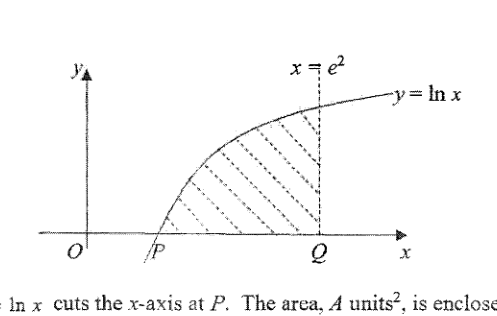
曲线 y=ln⁡xy = \ln x 与 xx 轴交于点 PP。由该曲线、xx 轴及直线 x=e2x = e^2 所围成的面积为 AA 平方单位。 解释为什么 e2−1<∫1e2y dx<2(e2−1)e^2 - 1 < \int_{1}^{e^2} y \, dx < 2(e^2 - 1)。

先不看答案,让 AI 诊断你卡在哪里?

它不会直接告诉你答案,而是问你卡在哪一步看看 AI 是怎么陪你一步步弄懂这道题的

完整解法

4

1. Find the coordinates of the endpoints of the region

At the xx-axis, y=0  ⟹  ln⁡x=0  ⟹  x=1y = 0 \implies \ln x = 0 \implies x = 1. So PP is (1,0)(1, 0).
At x=e2x = e^2, y=ln⁡(e2)=2ln⁡e=2y = \ln(e^2) = 2\ln e = 2.
The endpoints of the curve segment are (1,0)(1, 0) and (e2,2)(e^2, 2).

2. Explain the upper bound using a bounding rectangle

The integral ∫1e2y dx\int_{1}^{e^2} y \, dx represents the exact area under the curve y=ln⁡xy = \ln x from x=1x = 1 to x=e2x = e^2.
The region is entirely contained within a rectangle of width (e2−1)(e^2 - 1) and height 22.
Area of this rectangle =2(e2−1)= 2(e^2 - 1).
Since the curve is strictly increasing and lies below the line y=2y = 2 for 1⩽x<e21 \leqslant x < e^2, the area under the curve is strictly less than the area of the rectangle:
∫1e2y dx<2(e2−1)\int_{1}^{e^2} y \, dx < 2(e^2 - 1)

3. Explain the lower bound using an inscribed triangle

Consider the triangle formed by the points (1,0)(1, 0), (e2,0)(e^2, 0), and (e2,2)(e^2, 2).
Area of this triangle =12×base×height=12(e2−1)(2)=e2−1= \frac{1}{2} \times \text{base} \times \text{height} = \frac{1}{2}(e^2 - 1)(2) = e^2 - 1.
The curve y=ln⁡xy = \ln x is concave downwards (its gradient decreases as xx increases), so the curve lies above the chord connecting (1,0)(1, 0) and (e2,2)(e^2, 2).
Therefore, the area under the curve is strictly greater than the area of the triangle:
∫1e2y dx>e2−1\int_{1}^{e^2} y \, dx > e^2 - 1

4. Combine the inequalities

Combining the two results, we have:
e2−1<∫1e2y dx<2(e2−1)e^2 - 1 < \int_{1}^{e^2} y \, dx < 2(e^2 - 1)

答案

The integral represents the area under the curve, which is bounded below by the inscribed triangle of area e2−1e^2 - 1 and above by the circumscribed rectangle of area 2(e2−1)2(e^2 - 1).

AI 分析,可能出错

用 AI 批改,圈出写错的那一步,并自动将你的薄弱点存入错题本,形成你的错因库。

同一知识点的其他题

  1. 1图中显示了曲线 y=g(x)y = g(x) 的一部分。(2,8)(2, 8) 和 (6,1)(6, 1) 是曲线上的两个点。 已知 ∫26y dx=32\int_{2}^{6} y \text{ } dx = 32,求 ∫18x dy\int_{1}^{8} x \text{ } dy…
  2. 2定积分∫01(2x−x2)dx\int_{0}^{1}(\sqrt{2x{-}x^{2}})dx等于()({ }) A. π4\dfrac{\pi}{4} B. π2\dfrac{\pi}{2} C. π−14\dfrac{\pi{-}1}{4}…
  3. 3图中显示了曲线 y=3x+4y = \sqrt{3x + 4} 的一部分。直线 ABAB 在点 AA 处与曲线相切。点 BB 和 CC 位于 xx 轴上,且 CC 是曲线上的一个点。已知该曲线在点 AA 处的切线斜率为 32\frac{3}{2}…
  4. 4如图所示为曲线 y=(1−x)(x−4)y = (1 - x)(x - 4) 的一部分以及两条直线 l1l_1 和 l2l_2。直线 l1l_1 和 l2l_2 分别是曲线在点 PP 和 QQ 处的切线,斜率分别为 22 和 −2-2。 证明 PP 和…
  5. 5∫−22(sin⁡x+4−x2)dx=()∫_{-2}^{2}(\sin x+\sqrt{4-x^{2}}){\rm d}x=(\quad) A. 44 B. 2π2π C. 4+2π4+2π D. 88