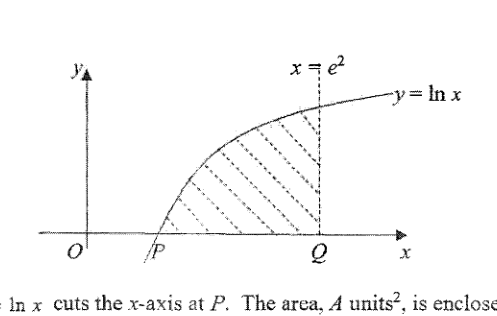
The curve cuts the -axis at . The area, units, is enclosed by the curve, the -axis and the line . Explain why .
It won't just hand you the answer — it asks where you're stuck.How the checker works
Worked solution
4
1. Find the coordinates of the endpoints of the region
At the -axis, . So is .
At , .
The endpoints of the curve segment are and .
2. Explain the upper bound using a bounding rectangle
The integral represents the exact area under the curve from to .
The region is entirely contained within a rectangle of width and height .
Area of this rectangle .
Since the curve is strictly increasing and lies below the line for , the area under the curve is strictly less than the area of the rectangle:
3. Explain the lower bound using an inscribed triangle
Consider the triangle formed by the points , , and .
Area of this triangle .
The curve is concave downwards (its gradient decreases as increases), so the curve lies above the chord connecting and .
Therefore, the area under the curve is strictly greater than the area of the triangle:
4. Combine the inequalities
Combining the two results, we have:
The integral represents the area under the curve, which is bounded below by the inscribed triangle of area and above by the circumscribed rectangle of area .
AI analysis — may contain mistakes.
Worked this one out on paper? Snap your steps and Gigle's AI math checker will circle the step where it went wrong.