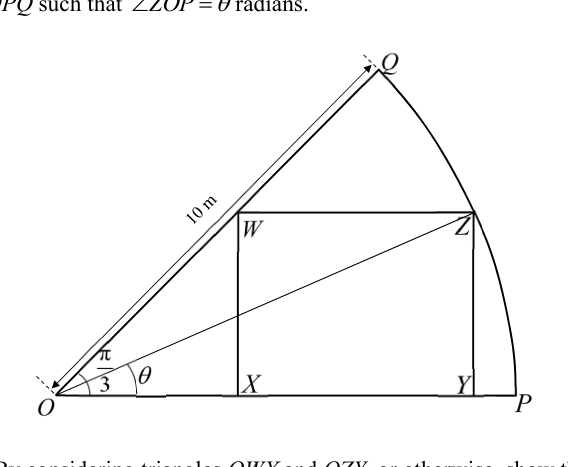
[已知半径为 rr、圆心角为 θ\theta 的圆扇形面积为 12r2θ\frac{1}{2}r^2\theta。] 一位花商拥有一个形状为以 OO 为圆心的圆扇形 OPQOPQ 的温室,并打算围出一块矩形区域来种植玫瑰。 花园在下图中由一个固定的扇形 OPQOPQ 表示,其中 OP=OQ=10 mOP = OQ = 10\text{ m} 且 ∠POQ=π3\angle POQ = \frac{\pi}{3} 弧度。矩形区域 WXYZWXYZ 内接于扇形 OPQOPQ,使得 ∠ZOP=θ\angle ZOP = \theta 弧度。

  1. (i)

    通过考虑三角形 OWXOWX 和 OZYOZY(或用其他方法),证明矩形 WXYZWXYZ 的面积 A=50(sin⁡2θ−233sin⁡2θ)A = 50\left(\sin 2\theta - \frac{2\sqrt{3}}{3}\sin^2\theta\right)。

  2. (ii)

    利用求导,求 AA 的最大值的精确形式。

  3. (iii)

    该花商随后决定利用扇形中的其余区域种植万寿菊。

    每月维护植物的成本为 $C,可细分为玫瑰 $5/m2^2 以及万寿菊 $4/m2^2。

    草拟 CC 随 θ\theta 变化的函数图像,并标出所有的极值点和端点。

  4. (iv)

    由此确定 θ\theta 的取值范围,使花商的维护成本低于 $220。

先不看答案,让 AI 诊断你卡在哪里?

它不会直接告诉你答案,而是问你卡在哪一步看看 AI 是怎么陪你一步步弄懂这道题的

完整解法

11(i)

1. Find the lengths of $ZY$ and $OY$ in terms of $\theta$.

In the right-angled △OZY\triangle OZY, OZ=10OZ = 10 m (since ZZ lies on the arc of the sector with radius 10) and ∠ZOY=θ\angle ZOY = \theta.
sin⁡θ=ZY10  ⟹  ZY=10sin⁡θ\sin \theta = \frac{ZY}{10} \implies ZY = 10\sin\theta
cos⁡θ=OY10  ⟹  OY=10cos⁡θ\cos \theta = \frac{OY}{10} \implies OY = 10\cos\theta

2. Find the length of $OX$ using $\triangle OWX$.

Since WXYZWXYZ is a rectangle, WX=ZY=10sin⁡θWX = ZY = 10\sin\theta.
In the right-angled △OWX\triangle OWX, ∠WOX=π3\angle WOX = \frac{\pi}{3}.
tan⁡(π3)=WXOX\tan\left(\frac{\pi}{3}\right) = \frac{WX}{OX}
3=10sin⁡θOX\sqrt{3} = \frac{10\sin\theta}{OX}
OX=10sin⁡θ3OX = \frac{10\sin\theta}{\sqrt{3}}

3. Find the area of the rectangle and simplify to the required form using double angle identity.

The width of the rectangle is XY=OY−OX=10cos⁡θ−10sin⁡θ3XY = OY - OX = 10\cos\theta - \frac{10\sin\theta}{\sqrt{3}}.
The area AA of the rectangle is given by XY×ZYXY \times ZY:
A=(10cos⁡θ−10sin⁡θ3)(10sin⁡θ)A = \left(10\cos\theta - \frac{10\sin\theta}{\sqrt{3}}\right)(10\sin\theta)
A=100sin⁡θcos⁡θ−1003sin⁡2θA = 100\sin\theta\cos\theta - \frac{100}{\sqrt{3}}\sin^2\theta
Using the identity sin⁡2θ=2sin⁡θcos⁡θ\sin 2\theta = 2\sin\theta\cos\theta and rationalising 1003\frac{100}{\sqrt{3}}:
A=50(2sin⁡θcos⁡θ)−50(233)sin⁡2θA = 50(2\sin\theta\cos\theta) - 50\left(\frac{2\sqrt{3}}{3}\right)\sin^2\theta
A=50(sin⁡2θ−233sin⁡2θ)A = 50\left(\sin 2\theta - \frac{2\sqrt{3}}{3}\sin^2\theta\right) (Shown)

答案

A=50(sin⁡2θ−233sin⁡2θ)A = 50\left(\sin 2\theta - \frac{2\sqrt{3}}{3}\sin^2\theta\right)

11(ii)

1. Differentiate the area function $A$ with respect to $\theta$.

A=50(sin⁡2θ−233sin⁡2θ)A = 50\left(\sin 2\theta - \frac{2\sqrt{3}}{3}\sin^2\theta\right)
dAdθ=50(2cos⁡2θ−233(2sin⁡θcos⁡θ))\frac{\mathrm{d}A}{\mathrm{d}\theta} = 50\left(2\cos 2\theta - \frac{2\sqrt{3}}{3}(2\sin\theta\cos\theta)\right)
Using the double angle identity 2sin⁡θcos⁡θ=sin⁡2θ2\sin\theta\cos\theta = \sin 2\theta:
dAdθ=50(2cos⁡2θ−233sin⁡2θ)\frac{\mathrm{d}A}{\mathrm{d}\theta} = 50\left(2\cos 2\theta - \frac{2\sqrt{3}}{3}\sin 2\theta\right)

2. Set the derivative to zero and solve for $\theta$.

For a stationary point, dAdθ=0\frac{\mathrm{d}A}{\mathrm{d}\theta} = 0:
50(2cos⁡2θ−233sin⁡2θ)=050\left(2\cos 2\theta - \frac{2\sqrt{3}}{3}\sin 2\theta\right) = 0
2cos⁡2θ=233sin⁡2θ2\cos 2\theta = \frac{2\sqrt{3}}{3}\sin 2\theta
tan⁡2θ=2233=623=3\tan 2\theta = \frac{2}{\frac{2\sqrt{3}}{3}} = \frac{6}{2\sqrt{3}} = \sqrt{3}
Since the rectangle is inside a sector of angle π3\frac{\pi}{3}, 0<θ<π30 < \theta < \frac{\pi}{3}, so 0<2θ<2π30 < 2\theta < \frac{2\pi}{3}.
2θ=π3  ⟹  θ=π62\theta = \frac{\pi}{3} \implies \theta = \frac{\pi}{6}

3. Perform the second derivative test to verify it is a maximum point.

d2Adθ2=50(−4sin⁡2θ−433cos⁡2θ)\frac{\mathrm{d}^2A}{\mathrm{d}\theta^2} = 50\left(-4\sin 2\theta - \frac{4\sqrt{3}}{3}\cos 2\theta\right)
When θ=π6\theta = \frac{\pi}{6} (so 2θ=π32\theta = \frac{\pi}{3}):
d2Adθ2=50(−4sin⁡π3−433cos⁡π3)\frac{\mathrm{d}^2A}{\mathrm{d}\theta^2} = 50\left(-4\sin\frac{\pi}{3} - \frac{4\sqrt{3}}{3}\cos\frac{\pi}{3}\right)
d2Adθ2=50(−4(32)−433(12))\frac{\mathrm{d}^2A}{\mathrm{d}\theta^2} = 50\left(-4\left(\frac{\sqrt{3}}{2}\right) - \frac{4\sqrt{3}}{3}\left(\frac{1}{2}\right)\right)
Since both terms are negative, d2Adθ2<0\frac{\mathrm{d}^2A}{\mathrm{d}\theta^2} < 0. Hence, the area is maximised when θ=π6\theta = \frac{\pi}{6}.

4. Calculate the exact maximum area.

Substitute θ=π6\theta = \frac{\pi}{6} into the expression for AA:
A=50(sin⁡(2(π6))−233sin⁡2(π6))A = 50\left(\sin\left(2\left(\frac{\pi}{6}\right)\right) - \frac{2\sqrt{3}}{3}\sin^2\left(\frac{\pi}{6}\right)\right)
A=50(sin⁡π3−233(12)2)A = 50\left(\sin\frac{\pi}{3} - \frac{2\sqrt{3}}{3}\left(\frac{1}{2}\right)^2\right)
A=50(32−233(14))A = 50\left(\frac{\sqrt{3}}{2} - \frac{2\sqrt{3}}{3}\left(\frac{1}{4}\right)\right)
A=50(32−36)A = 50\left(\frac{\sqrt{3}}{2} - \frac{\sqrt{3}}{6}\right)
A=50(336−36)=50(236)=5033A = 50\left(\frac{3\sqrt{3}}{6} - \frac{\sqrt{3}}{6}\right) = 50\left(\frac{2\sqrt{3}}{6}\right) = \frac{50\sqrt{3}}{3}

答案

5033 m2\frac{50\sqrt{3}}{3}\text{ m}^2

11(iii)

1. Formulate the expression for the total cost $C$ in terms of the area $A$.

The area of the sector OPQOPQ is 12r2α=12(10)2(π3)=50π3\frac{1}{2}r^2\alpha = \frac{1}{2}(10)^2\left(\frac{\pi}{3}\right) = \frac{50\pi}{3}.

The area left for marigolds is the remaining area: 50π3−A\frac{50\pi}{3} - A.

The total cost CC is given by:
C=5A+4(50π3−A)=A+200π3C = 5A + 4\left(\frac{50\pi}{3} - A\right) = A + \frac{200\pi}{3}

2. Find the coordinates of the turning point using the maximum value of $A$.

From part (ii), the maximum value of AA occurs at θ=π6\theta = \frac{\pi}{6} and is Amax=5033A_{\text{max}} = \frac{50\sqrt{3}}{3}.

Substituting this into the expression for CC gives the maximum cost:
Cmax=5033+200π3=503+200π3C_{\text{max}} = \frac{50\sqrt{3}}{3} + \frac{200\pi}{3} = \frac{50\sqrt{3} + 200\pi}{3}

Hence, the turning point is a maximum at (π6,503+200π3)\left(\frac{\pi}{6}, \frac{50\sqrt{3} + 200\pi}{3}\right).

3. Determine the domain of $\theta$ and the coordinates of the end points.

Based on the geometry of the sector, the inscribed rectangle is constrained by 0≤θ≤π30 \le \theta \le \frac{\pi}{3}.

At θ=0\theta = 0, A=0A = 0, so C=200π3C = \frac{200\pi}{3}.
At θ=π3\theta = \frac{\pi}{3}, evaluating AA gives 50(sin⁡2π3−233sin⁡2π3)=50(32−233(34))=050\left(\sin\frac{2\pi}{3} - \frac{2\sqrt{3}}{3}\sin^2\frac{\pi}{3}\right) = 50\left(\frac{\sqrt{3}}{2} - \frac{2\sqrt{3}}{3}\left(\frac{3}{4}\right)\right) = 0, so C=200π3C = \frac{200\pi}{3}.

The end points are (0,200π3)\left(0, \frac{200\pi}{3}\right) and (π3,200π3)\left(\frac{\pi}{3}, \frac{200\pi}{3}\right).

4. Describe the required sketch.

Draw a set of axes for CC against θ\theta. The graph is an inverted U-shape starting from the point (0,200π3)\left(0, \frac{200\pi}{3}\right), smoothly rising to the maximum turning point at (π6,503+200π3)\left(\frac{\pi}{6}, \frac{50\sqrt{3} + 200\pi}{3}\right), and symmetrically falling back down to the end point at (π3,200π3)\left(\frac{\pi}{3}, \frac{200\pi}{3}\right).

答案

[A sketch of a concave-down, bell-shaped curve is required]

  • End points: (0,200π3)\left(0, \frac{200\pi}{3}\right) and (π3,200π3)\left(\frac{\pi}{3}, \frac{200\pi}{3}\right)
  • Turning point (Maximum): (π6,503+200π3)\left(\frac{\pi}{6}, \frac{50\sqrt{3} + 200\pi}{3}\right)

11(iv)

1. Formulate the total maintenance cost $C$ in terms of $\theta$ and set up the inequality.

The total area of the sector OPQOPQ is:
Area=12r2α=12(10)2(π3)=50π3 m2\text{Area} = \frac{1}{2}r^2\alpha = \frac{1}{2}(10)^2\left(\frac{\pi}{3}\right) = \frac{50\pi}{3} \text{ m}^2
The maintenance cost, CC, involves $5/m2^2 for the rectangular area AA and $4/m2^2 for the remaining sector area:
C=5A+4(50π3−A)=A+200π3C = 5A + 4\left(\frac{50\pi}{3} - A\right) = A + \frac{200\pi}{3}
To find when the cost is less than $220, we set up the inequality:
A+200π3<220A + \frac{200\pi}{3} < 220
50(sin⁡2θ−233sin⁡2θ)+200π3<22050\left(\sin 2\theta - \frac{2\sqrt{3}}{3}\sin^2\theta\right) + \frac{200\pi}{3} < 220

2. Solve for the boundary values of $\theta$ using a graphing calculator.

Using a graphing calculator, we find the values of θ\theta that satisfy the equation 50(sin⁡2θ−233sin⁡2θ)+200π3=22050\left(\sin 2\theta - \frac{2\sqrt{3}}{3}\sin^2\theta\right) + \frac{200\pi}{3} = 220.
The points of intersection are:
θ≈0.11403andθ≈0.93316\theta \approx 0.11403 \quad \text{and} \quad \theta \approx 0.93316

3. Determine the valid range of $\theta$ by interpreting the roots alongside the geometric domain.

The physical domain of the inscribed rectangle requires θ\theta to be within 0<θ<π30 < \theta < \frac{\pi}{3}.
From the shape of the graph of CC sketched in part (iii) (an inverted U-shape starting from a minimum value of ≈209.4\approx 209.4 at the boundaries), the cost is strictly less than $220 in the intervals outside the two roots.
Hence, restricting to 3 significant figures, the range of values for θ\theta is:
0<θ<0.114or0.933<θ<π30 < \theta < 0.114 \quad \text{or} \quad 0.933 < \theta < \frac{\pi}{3}

答案

0<θ<0.114 or 0.933<θ<π30 < \theta < 0.114 \text{ or } 0.933 < \theta < \frac{\pi}{3}

AI 分析,可能出错

用 AI 批改,圈出写错的那一步,并自动将你的薄弱点存入错题本,形成你的错因库。

同一知识点的其他题

  1. 1[底面半径为 rr、高为 hh 的圆锥体积由 V=13πr2hV = \frac{1}{3}\pi r^2 h 给出。] 某制造商用同一种材料制作了一个漏斗状的装饰品,它由两部分组成,如图 1所示。 * 一个半径为 rr cm、高为 hh…
  2. 2一个圆心角为 θ\theta 弧度、半径为 4π cm4\pi\text{ cm} 的扇形被用来围成一个直圆锥的侧面,且没有重叠。证明该圆锥的体积为 8π34π2θ4−θ6 cm3.\hfill[3]\frac{8\pi}{3}\sqrt{4\pi^2\theta^4 - \theta^6}\text{ cm}^3. \hfill [3]…
  3. 3作为艺术项目的一部分,一个学生设计了一个如图所示的八面体灯笼。灯笼的框架由十二根直铁丝组成,端点相连,形成两个相同的正四棱锥(其底面为边长为 4x m4x\text{ m} 的正方形,侧棱长为 y my\text{ m})。铁丝框架用彩色纸紧紧包…
  4. 4下图显示了一个体积固定为 4k34k\sqrt{3} 单位3^{3} 的梯形柱体的尺寸,其中变量为 xx 和 yy。 该柱体的顶面 ABCDABCD 是一个等腰梯形,其中 ABAB 的长度为 5x5x 单位,DCDC 的长度为 3x3x 单…
  5. 5[半径为 rr、高为 hh 的直圆锥的体积为 13πr2h\frac{1}{3}\pi r^2 h。] 一名学生为他自制的3D打印机制作了一个打印机喷嘴。该打印机喷嘴由一个厚度可忽略的空心倒置直圆锥(其半径为 rr mm,其中 0<r<20 < r < 2…