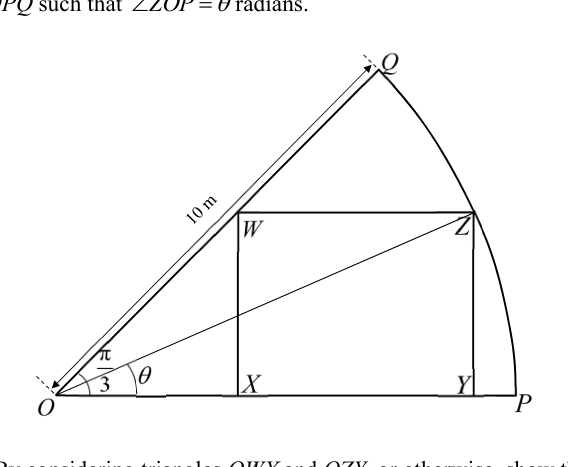
[It is given that the area of a sector of a circle with radius rr and angle θ\theta is given by 12r2θ\frac{1}{2}r^2\theta.] A florist owns a greenhouse in the shape of a circular sector OPQOPQ, with center OO, and intends to enclose a rectangular area to grow roses. The garden is represented in the diagram below by a fixed sector OPQOPQ where OP=OQ=10 mOP = OQ = 10\text{ m} and ∠POQ=π3\angle POQ = \frac{\pi}{3} radians. The rectangular area WXYZWXYZ is inscribed in sector OPQOPQ such that ∠ZOP=θ\angle ZOP = \theta radians.

  1. (i)

    By considering triangles OWXOWX and OZYOZY, or otherwise, show that the area of rectangle WXYZWXYZ, A=50(sin⁡2θ−233sin⁡2θ)A = 50\left(\sin 2\theta - \frac{2\sqrt{3}}{3}\sin^2\theta\right).

  2. (ii)

    Using differentiation, find the maximum value of AA in exact form.

  3. (iii)

    The florist subsequently decides to use remaining regions in the sector to grow marigolds.

    The cost of maintaining the plants each month, $C, can be broken down into $5/m2^2 for roses and $4/m2^2 for marigolds.

    Sketch the graph of CC as θ\theta varies, indicating any turning point(s) and end point(s).

  4. (iv)

    Hence determine the range of values of θ\theta for the florist to have a maintenance cost of less than $220.

Work through it with AI →

It won't just hand you the answer — it asks where you're stuck.How the checker works

Worked solution

11(i)

1. Find the lengths of $ZY$ and $OY$ in terms of $\theta$.

In the right-angled △OZY\triangle OZY, OZ=10OZ = 10 m (since ZZ lies on the arc of the sector with radius 10) and ∠ZOY=θ\angle ZOY = \theta.
sin⁡θ=ZY10  ⟹  ZY=10sin⁡θ\sin \theta = \frac{ZY}{10} \implies ZY = 10\sin\theta
cos⁡θ=OY10  ⟹  OY=10cos⁡θ\cos \theta = \frac{OY}{10} \implies OY = 10\cos\theta

2. Find the length of $OX$ using $\triangle OWX$.

Since WXYZWXYZ is a rectangle, WX=ZY=10sin⁡θWX = ZY = 10\sin\theta.
In the right-angled △OWX\triangle OWX, ∠WOX=π3\angle WOX = \frac{\pi}{3}.
tan⁡(π3)=WXOX\tan\left(\frac{\pi}{3}\right) = \frac{WX}{OX}
3=10sin⁡θOX\sqrt{3} = \frac{10\sin\theta}{OX}
OX=10sin⁡θ3OX = \frac{10\sin\theta}{\sqrt{3}}

3. Find the area of the rectangle and simplify to the required form using double angle identity.

The width of the rectangle is XY=OY−OX=10cos⁡θ−10sin⁡θ3XY = OY - OX = 10\cos\theta - \frac{10\sin\theta}{\sqrt{3}}.
The area AA of the rectangle is given by XY×ZYXY \times ZY:
A=(10cos⁡θ−10sin⁡θ3)(10sin⁡θ)A = \left(10\cos\theta - \frac{10\sin\theta}{\sqrt{3}}\right)(10\sin\theta)
A=100sin⁡θcos⁡θ−1003sin⁡2θA = 100\sin\theta\cos\theta - \frac{100}{\sqrt{3}}\sin^2\theta
Using the identity sin⁡2θ=2sin⁡θcos⁡θ\sin 2\theta = 2\sin\theta\cos\theta and rationalising 1003\frac{100}{\sqrt{3}}:
A=50(2sin⁡θcos⁡θ)−50(233)sin⁡2θA = 50(2\sin\theta\cos\theta) - 50\left(\frac{2\sqrt{3}}{3}\right)\sin^2\theta
A=50(sin⁡2θ−233sin⁡2θ)A = 50\left(\sin 2\theta - \frac{2\sqrt{3}}{3}\sin^2\theta\right) (Shown)

Answer

A=50(sin⁡2θ−233sin⁡2θ)A = 50\left(\sin 2\theta - \frac{2\sqrt{3}}{3}\sin^2\theta\right)

11(ii)

1. Differentiate the area function $A$ with respect to $\theta$.

A=50(sin⁡2θ−233sin⁡2θ)A = 50\left(\sin 2\theta - \frac{2\sqrt{3}}{3}\sin^2\theta\right)
dAdθ=50(2cos⁡2θ−233(2sin⁡θcos⁡θ))\frac{\mathrm{d}A}{\mathrm{d}\theta} = 50\left(2\cos 2\theta - \frac{2\sqrt{3}}{3}(2\sin\theta\cos\theta)\right)
Using the double angle identity 2sin⁡θcos⁡θ=sin⁡2θ2\sin\theta\cos\theta = \sin 2\theta:
dAdθ=50(2cos⁡2θ−233sin⁡2θ)\frac{\mathrm{d}A}{\mathrm{d}\theta} = 50\left(2\cos 2\theta - \frac{2\sqrt{3}}{3}\sin 2\theta\right)

2. Set the derivative to zero and solve for $\theta$.

For a stationary point, dAdθ=0\frac{\mathrm{d}A}{\mathrm{d}\theta} = 0:
50(2cos⁡2θ−233sin⁡2θ)=050\left(2\cos 2\theta - \frac{2\sqrt{3}}{3}\sin 2\theta\right) = 0
2cos⁡2θ=233sin⁡2θ2\cos 2\theta = \frac{2\sqrt{3}}{3}\sin 2\theta
tan⁡2θ=2233=623=3\tan 2\theta = \frac{2}{\frac{2\sqrt{3}}{3}} = \frac{6}{2\sqrt{3}} = \sqrt{3}
Since the rectangle is inside a sector of angle π3\frac{\pi}{3}, 0<θ<π30 < \theta < \frac{\pi}{3}, so 0<2θ<2π30 < 2\theta < \frac{2\pi}{3}.
2θ=π3  ⟹  θ=π62\theta = \frac{\pi}{3} \implies \theta = \frac{\pi}{6}

3. Perform the second derivative test to verify it is a maximum point.

d2Adθ2=50(−4sin⁡2θ−433cos⁡2θ)\frac{\mathrm{d}^2A}{\mathrm{d}\theta^2} = 50\left(-4\sin 2\theta - \frac{4\sqrt{3}}{3}\cos 2\theta\right)
When θ=π6\theta = \frac{\pi}{6} (so 2θ=π32\theta = \frac{\pi}{3}):
d2Adθ2=50(−4sin⁡π3−433cos⁡π3)\frac{\mathrm{d}^2A}{\mathrm{d}\theta^2} = 50\left(-4\sin\frac{\pi}{3} - \frac{4\sqrt{3}}{3}\cos\frac{\pi}{3}\right)
d2Adθ2=50(−4(32)−433(12))\frac{\mathrm{d}^2A}{\mathrm{d}\theta^2} = 50\left(-4\left(\frac{\sqrt{3}}{2}\right) - \frac{4\sqrt{3}}{3}\left(\frac{1}{2}\right)\right)
Since both terms are negative, d2Adθ2<0\frac{\mathrm{d}^2A}{\mathrm{d}\theta^2} < 0. Hence, the area is maximised when θ=π6\theta = \frac{\pi}{6}.

4. Calculate the exact maximum area.

Substitute θ=π6\theta = \frac{\pi}{6} into the expression for AA:
A=50(sin⁡(2(π6))−233sin⁡2(π6))A = 50\left(\sin\left(2\left(\frac{\pi}{6}\right)\right) - \frac{2\sqrt{3}}{3}\sin^2\left(\frac{\pi}{6}\right)\right)
A=50(sin⁡π3−233(12)2)A = 50\left(\sin\frac{\pi}{3} - \frac{2\sqrt{3}}{3}\left(\frac{1}{2}\right)^2\right)
A=50(32−233(14))A = 50\left(\frac{\sqrt{3}}{2} - \frac{2\sqrt{3}}{3}\left(\frac{1}{4}\right)\right)
A=50(32−36)A = 50\left(\frac{\sqrt{3}}{2} - \frac{\sqrt{3}}{6}\right)
A=50(336−36)=50(236)=5033A = 50\left(\frac{3\sqrt{3}}{6} - \frac{\sqrt{3}}{6}\right) = 50\left(\frac{2\sqrt{3}}{6}\right) = \frac{50\sqrt{3}}{3}

Answer

5033 m2\frac{50\sqrt{3}}{3}\text{ m}^2

11(iii)

1. Formulate the expression for the total cost $C$ in terms of the area $A$.

The area of the sector OPQOPQ is 12r2α=12(10)2(π3)=50π3\frac{1}{2}r^2\alpha = \frac{1}{2}(10)^2\left(\frac{\pi}{3}\right) = \frac{50\pi}{3}.

The area left for marigolds is the remaining area: 50π3−A\frac{50\pi}{3} - A.

The total cost CC is given by:
C=5A+4(50π3−A)=A+200π3C = 5A + 4\left(\frac{50\pi}{3} - A\right) = A + \frac{200\pi}{3}

2. Find the coordinates of the turning point using the maximum value of $A$.

From part (ii), the maximum value of AA occurs at θ=π6\theta = \frac{\pi}{6} and is Amax=5033A_{\text{max}} = \frac{50\sqrt{3}}{3}.

Substituting this into the expression for CC gives the maximum cost:
Cmax=5033+200π3=503+200π3C_{\text{max}} = \frac{50\sqrt{3}}{3} + \frac{200\pi}{3} = \frac{50\sqrt{3} + 200\pi}{3}

Hence, the turning point is a maximum at (π6,503+200π3)\left(\frac{\pi}{6}, \frac{50\sqrt{3} + 200\pi}{3}\right).

3. Determine the domain of $\theta$ and the coordinates of the end points.

Based on the geometry of the sector, the inscribed rectangle is constrained by 0≤θ≤π30 \le \theta \le \frac{\pi}{3}.

At θ=0\theta = 0, A=0A = 0, so C=200π3C = \frac{200\pi}{3}.
At θ=π3\theta = \frac{\pi}{3}, evaluating AA gives 50(sin⁡2π3−233sin⁡2π3)=50(32−233(34))=050\left(\sin\frac{2\pi}{3} - \frac{2\sqrt{3}}{3}\sin^2\frac{\pi}{3}\right) = 50\left(\frac{\sqrt{3}}{2} - \frac{2\sqrt{3}}{3}\left(\frac{3}{4}\right)\right) = 0, so C=200π3C = \frac{200\pi}{3}.

The end points are (0,200π3)\left(0, \frac{200\pi}{3}\right) and (π3,200π3)\left(\frac{\pi}{3}, \frac{200\pi}{3}\right).

4. Describe the required sketch.

Draw a set of axes for CC against θ\theta. The graph is an inverted U-shape starting from the point (0,200π3)\left(0, \frac{200\pi}{3}\right), smoothly rising to the maximum turning point at (π6,503+200π3)\left(\frac{\pi}{6}, \frac{50\sqrt{3} + 200\pi}{3}\right), and symmetrically falling back down to the end point at (π3,200π3)\left(\frac{\pi}{3}, \frac{200\pi}{3}\right).

Answer

[A sketch of a concave-down, bell-shaped curve is required]

  • End points: (0,200π3)\left(0, \frac{200\pi}{3}\right) and (π3,200π3)\left(\frac{\pi}{3}, \frac{200\pi}{3}\right)
  • Turning point (Maximum): (π6,503+200π3)\left(\frac{\pi}{6}, \frac{50\sqrt{3} + 200\pi}{3}\right)

11(iv)

1. Formulate the total maintenance cost $C$ in terms of $\theta$ and set up the inequality.

The total area of the sector OPQOPQ is:
Area=12r2α=12(10)2(π3)=50π3 m2\text{Area} = \frac{1}{2}r^2\alpha = \frac{1}{2}(10)^2\left(\frac{\pi}{3}\right) = \frac{50\pi}{3} \text{ m}^2
The maintenance cost, CC, involves $5/m2^2 for the rectangular area AA and $4/m2^2 for the remaining sector area:
C=5A+4(50π3−A)=A+200π3C = 5A + 4\left(\frac{50\pi}{3} - A\right) = A + \frac{200\pi}{3}
To find when the cost is less than $220, we set up the inequality:
A+200π3<220A + \frac{200\pi}{3} < 220
50(sin⁡2θ−233sin⁡2θ)+200π3<22050\left(\sin 2\theta - \frac{2\sqrt{3}}{3}\sin^2\theta\right) + \frac{200\pi}{3} < 220

2. Solve for the boundary values of $\theta$ using a graphing calculator.

Using a graphing calculator, we find the values of θ\theta that satisfy the equation 50(sin⁡2θ−233sin⁡2θ)+200π3=22050\left(\sin 2\theta - \frac{2\sqrt{3}}{3}\sin^2\theta\right) + \frac{200\pi}{3} = 220.
The points of intersection are:
θ≈0.11403andθ≈0.93316\theta \approx 0.11403 \quad \text{and} \quad \theta \approx 0.93316

3. Determine the valid range of $\theta$ by interpreting the roots alongside the geometric domain.

The physical domain of the inscribed rectangle requires θ\theta to be within 0<θ<π30 < \theta < \frac{\pi}{3}.
From the shape of the graph of CC sketched in part (iii) (an inverted U-shape starting from a minimum value of ≈209.4\approx 209.4 at the boundaries), the cost is strictly less than $220 in the intervals outside the two roots.
Hence, restricting to 3 significant figures, the range of values for θ\theta is:
0<θ<0.114or0.933<θ<π30 < \theta < 0.114 \quad \text{or} \quad 0.933 < \theta < \frac{\pi}{3}

Answer

0<θ<0.114 or 0.933<θ<π30 < \theta < 0.114 \text{ or } 0.933 < \theta < \frac{\pi}{3}

AI analysis — may contain mistakes.

Worked this one out on paper? Snap your steps and Gigle's AI math checker will circle the step where it went wrong.

More questions on this topic

  1. 1[The volume of a cone of base radius rr and height hh is given by V=13πr2hV = \frac{1}{3}\pi r^2 h.] A manufacturer makes a…
  2. 2A sector of angle θ\theta radians and radius 4π cm4\pi\text{ cm} is used to form the curved surface of a right circular co…
  3. 3As part of an Art Project, a student designed a lantern in the shape of an octahedron as shown in the diagram. The frame…
  4. 4The following diagram shows the dimensions of a trapezoidal prism with fixed volume 4k34k\sqrt{3} units3^{3}, with varia…
  5. 5[The volume of a right circular cone of radius rr and height hh is 13πr2h\frac{1}{3}\pi r^2 h.] A student makes a printer…