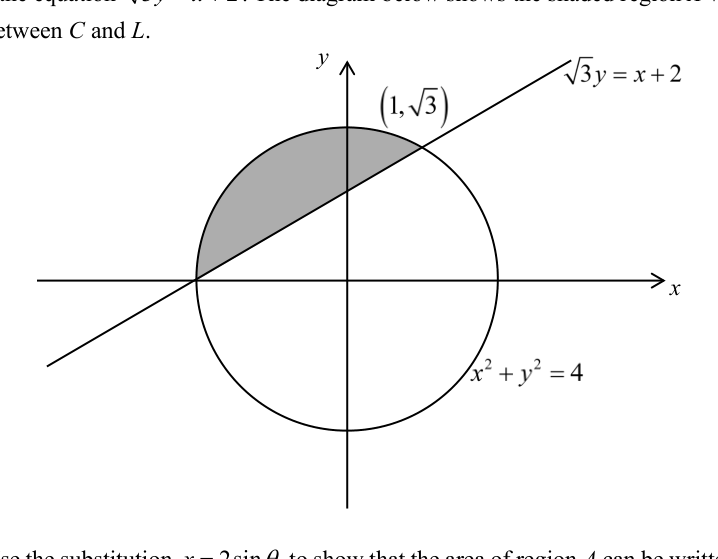
曲线 CC 是一个半径为 2、圆心在原点的圆,其方程为 x2+y2=4x^2 + y^2 = 4。直线 LL 的方程为 3y=x+2\sqrt{3}y = x + 2。下图显示了由 CC 和 LL 所围成的阴影区域 AA。

  1. (a)

    利用换元法 x=2sin⁡θx = 2\sin\theta 证明区域 AA 的面积可以表示为 ∫ab4cos⁡2θ dθ−c\displaystyle\int_a^b 4\cos^2\theta\ d\theta - c,其中 aa、bb 和 cc 是待确定的确切常数。由此求出该面积的精确值。

  2. (b)

    区域 BB 由曲线 CC、直线 LL 以及直线 x=2x = 2 围成。求区域 BB 绕 y 轴旋转 2π2\pi 弧度所产生的旋转体体积。保留两位小数。

先不看答案,让 AI 诊断你卡在哪里?

它不会直接告诉你答案,而是问你卡在哪一步看看 AI 是怎么陪你一步步弄懂这道题的

完整解法

7(a)

1. Set up the area of region $A$ as the difference between the integral of the curve $C$ and the line $L$.

From the circle equation x2+y2=4x^2 + y^2 = 4, the upper semicircle is y=4−x2y = \sqrt{4-x^2}.
From the line LL, y=x+23y = \frac{x+2}{\sqrt{3}}.
Area A=∫−214−x2 dx−∫−21x+23 dxA = \int_{-2}^{1} \sqrt{4-x^2}\ dx - \int_{-2}^{1} \frac{x+2}{\sqrt{3}}\ dx

2. Apply the substitution $x = 2\sin\theta$ to the first integral and find the new limits.

Let x=2sin⁡θx = 2\sin\theta. Then dxdθ=2cos⁡θ  ⟹  dx=2cos⁡θ dθ\frac{dx}{d\theta} = 2\cos\theta \implies dx = 2\cos\theta\ d\theta.
Find the new limits for θ\theta:
When x=1x = 1, 2sin⁡θ=1  ⟹  sin⁡θ=12  ⟹  θ=π62\sin\theta = 1 \implies \sin\theta = \frac{1}{2} \implies \theta = \frac{\pi}{6}.
When x=−2x = -2, 2sin⁡θ=−2  ⟹  sin⁡θ=−1  ⟹  θ=−π22\sin\theta = -2 \implies \sin\theta = -1 \implies \theta = -\frac{\pi}{2}.

3. Transform the first integral completely into terms of $\theta$.

∫−214−x2 dx=∫−π/2π/64−(2sin⁡θ)2(2cos⁡θ) dθ\int_{-2}^{1} \sqrt{4-x^2}\ dx = \int_{-\pi/2}^{\pi/6} \sqrt{4 - (2\sin\theta)^2} (2\cos\theta)\ d\theta
=∫−π/2π/64(1−sin⁡2θ)(2cos⁡θ) dθ= \int_{-\pi/2}^{\pi/6} \sqrt{4(1-\sin^2\theta)} (2\cos\theta)\ d\theta
=∫−π/2π/6(2cos⁡θ)(2cos⁡θ) dθ= \int_{-\pi/2}^{\pi/6} (2\cos\theta)(2\cos\theta)\ d\theta
=∫−π/2π/64cos⁡2θ dθ= \int_{-\pi/2}^{\pi/6} 4\cos^2\theta\ d\theta

4. Evaluate the second integral (the area under the line) to determine the exact constants $a, b,$ and $c$.

∫−21x+23 dx=13[x22+2x]−21\int_{-2}^{1} \frac{x+2}{\sqrt{3}}\ dx = \frac{1}{\sqrt{3}} \left[ \frac{x^2}{2} + 2x \right]_{-2}^{1}
=13((12+2)−(42−4))= \frac{1}{\sqrt{3}} \left( \left(\frac{1}{2} + 2\right) - \left(\frac{4}{2} - 4\right) \right)
=13(52−(−2))=923=332= \frac{1}{\sqrt{3}} \left( \frac{5}{2} - (-2) \right) = \frac{9}{2\sqrt{3}} = \frac{3\sqrt{3}}{2}
Hence, Area A=∫−π/2π/64cos⁡2θ dθ−332A = \int_{-\pi/2}^{\pi/6} 4\cos^2\theta\ d\theta - \frac{3\sqrt{3}}{2}, where a=−π2a = -\frac{\pi}{2}, b=π6b = \frac{\pi}{6}, and c=332c = \frac{3\sqrt{3}}{2}.

5. Integrate $4\cos^2\theta$ using the double angle identity.

Using cos⁡2θ=2cos⁡2θ−1\cos 2\theta = 2\cos^2\theta - 1, we have 4cos⁡2θ=2(1+cos⁡2θ)4\cos^2\theta = 2(1 + \cos 2\theta).
∫−π/2π/62(1+cos⁡2θ) dθ=[2θ+sin⁡2θ]−π/2π/6\int_{-\pi/2}^{\pi/6} 2(1 + \cos 2\theta)\ d\theta = \left[ 2\theta + \sin 2\theta \right]_{-\pi/2}^{\pi/6}

6. Evaluate the limits to find the exact area of region $A$.

=(2(π6)+sin⁡(π3))−(2(−π2)+sin⁡(−π))= \left( 2\left(\frac{\pi}{6}\right) + \sin\left(\frac{\pi}{3}\right) \right) - \left( 2\left(-\frac{\pi}{2}\right) + \sin(-\pi) \right)
=(π3+32)−(−π+0)=4π3+32= \left( \frac{\pi}{3} + \frac{\sqrt{3}}{2} \right) - (-\pi + 0) = \frac{4\pi}{3} + \frac{\sqrt{3}}{2}
Exact Area =(4π3+32)−332=4π3−3= \left(\frac{4\pi}{3} + \frac{\sqrt{3}}{2}\right) - \frac{3\sqrt{3}}{2} = \frac{4\pi}{3} - \sqrt{3}

答案

\frac{4\pi}{3} - \sqrt{3}

7(b)

1. Express the equations of curve $C$ and line $L$ with $x$ as the subject.

For curve CC: x2+y2=4  ⟹  x=4−y2x^2 + y^2 = 4 \implies x = \sqrt{4 - y^2} (taking the positive root as the region is in the first quadrant where x>0x > 0).

For line LL: 3y=x+2  ⟹  x=3y−2\sqrt{3}y = x + 2 \implies x = \sqrt{3}y - 2.

2. Determine the $y$-coordinates of the intersections that bound Region $B$.

Region BB is bounded on the right by x=2x = 2.

  • Line x=2x = 2 intersects curve CC (x2+y2=4x^2 + y^2 = 4) at 22+y2=4  ⟹  y=02^2 + y^2 = 4 \implies y = 0.
  • Line x=2x = 2 intersects line LL (x=3y−2x = \sqrt{3}y - 2) at 2=3y−2  ⟹  3y=4  ⟹  y=432 = \sqrt{3}y - 2 \implies \sqrt{3}y = 4 \implies y = \frac{4}{\sqrt{3}}.
  • As given from earlier parts, CC and LL intersect at (1,3)(1, \sqrt{3}).

Thus, the region BB spans from y=0y = 0 to y=43y = \frac{4}{\sqrt{3}}.

3. Set up the integral for the volume generated by rotating Region $B$ about the $y$-axis.

When rotating about the yy-axis, the volume is V=π∫(xouter2−xinner2) dyV = \pi \int (x_{\text{outer}}^2 - x_{\text{inner}}^2) \, dy.
The outer boundary is consistently x=2x = 2.
The inner boundary changes at the intersection y=3y = \sqrt{3}.

  • For 0≤y≤30 \le y \le \sqrt{3}, the inner boundary is the curve CC.
  • For 3≤y≤43\sqrt{3} \le y \le \frac{4}{\sqrt{3}}, the inner boundary is the line LL.

Hence, the volume splits into two parts: V=V1+V2V = V_1 + V_2.
V=π∫03[22−(4−y2)2] dy+π∫34/3[22−(3y−2)2] dyV = \pi \int_{0}^{\sqrt{3}} \left[ 2^2 - (\sqrt{4 - y^2})^2 \right] \, dy + \pi \int_{\sqrt{3}}^{4/\sqrt{3}} \left[ 2^2 - (\sqrt{3}y - 2)^2 \right] \, dy

4. Evaluate the first volume integral, $V_1$.

V1=π∫03(4−(4−y2)) dyV_1 = \pi \int_{0}^{\sqrt{3}} \left( 4 - (4 - y^2) \right) \, dy
V1=π∫03y2 dyV_1 = \pi \int_{0}^{\sqrt{3}} y^2 \, dy
V1=π[y33]03=π(333)=π3V_1 = \pi \left[ \frac{y^3}{3} \right]_{0}^{\sqrt{3}} = \pi \left( \frac{3\sqrt{3}}{3} \right) = \pi \sqrt{3}

5. Evaluate the second volume integral, $V_2$.

V2=π∫34/3[4−(3y2−43y+4)] dyV_2 = \pi \int_{\sqrt{3}}^{4/\sqrt{3}} \left[ 4 - (3y^2 - 4\sqrt{3}y + 4) \right] \, dy
V2=π∫34/3(43y−3y2) dyV_2 = \pi \int_{\sqrt{3}}^{4/\sqrt{3}} (4\sqrt{3}y - 3y^2) \, dy
V2=π[23y2−y3]34/3V_2 = \pi \left[ 2\sqrt{3}y^2 - y^3 \right]_{\sqrt{3}}^{4/\sqrt{3}}

Substitute the upper limit (y=43y = \frac{4}{\sqrt{3}}):
23(163)−(6433)=3233−6439=963−6439=32392\sqrt{3}\left(\frac{16}{3}\right) - \left(\frac{64}{3\sqrt{3}}\right) = \frac{32\sqrt{3}}{3} - \frac{64\sqrt{3}}{9} = \frac{96\sqrt{3} - 64\sqrt{3}}{9} = \frac{32\sqrt{3}}{9}

Substitute the lower limit (y=3y = \sqrt{3}):
23(3)−(3)3=63−33=33=27392\sqrt{3}(3) - (\sqrt{3})^3 = 6\sqrt{3} - 3\sqrt{3} = 3\sqrt{3} = \frac{27\sqrt{3}}{9}

V2=π(3239−2739)=539πV_2 = \pi \left( \frac{32\sqrt{3}}{9} - \frac{27\sqrt{3}}{9} \right) = \frac{5\sqrt{3}}{9}\pi

6. Sum the volumes and compute the final numerical answer to two decimal places.

Vtotal=V1+V2=π3+539π=1439πV_{\text{total}} = V_1 + V_2 = \pi \sqrt{3} + \frac{5\sqrt{3}}{9}\pi = \frac{14\sqrt{3}}{9}\pi
Vtotal≈8.4636V_{\text{total}} \approx 8.4636
Rounding to 2 decimal places gives 8.468.46.

答案

8.46

AI 分析,可能出错

用 AI 批改,圈出写错的那一步,并自动将你的薄弱点存入错题本,形成你的错因库。

同一知识点的其他题

  1. 1[剑桥/9709/2010] 图中显示了曲线 y=9−x3y = 9 - x^3 和 y=8x3y = \frac{8}{x^3} 的部分图像以及它们的交点 PP 和 QQ。PP 和 QQ 的 xx 坐标分别为 aa 和 bb。 证…
  2. 2已知 1a+bx\dfrac{1}{a+bx} 展开式的前三项为 12+14x+cx2\dfrac{1}{2}+\dfrac{1}{4}x+cx^2,求 aa、bb 和 cc 的值。 利用第 (i) 小题的答案,求由曲线 y=1a+bxy = \dfrac{1}{a+bx}…
  3. 3曲线 C 的参数方程为 x=at,  y=at3x = at,\; y = at^{3},其中 aa 为正常数。 曲线上的点 P 的参数为 pp,曲线在点 P 处的切线与 yy 轴交于点 S,与 xx 轴交于点 T。点 M 是 ST 的中点。求当 pp…
  4. 4将方程为 y=f(x)y=f(x) 的曲线先关于 y 轴进行反射,接着沿 x 轴负方向平移 1 个单位,最后在平行于 y 轴的方向上进行拉伸(缩放因子为 2)。所得曲线的方程由 y=g(x)y=g(x) 给出,其中 g(x)=14−x2  ,−2<x<0g(x)=\dfrac{1}{\sqrt{4-x^{2}}}\;,\quad -2<x<0…
  5. 5曲线 CC 的方程为 y=x−2kx2+x−2y = \frac{x - 2}{kx^2 + x - 2},其中 k>1k > 1。 求 CC 与 yy 轴相交的点 AA 处的切线方程。 画出 CC 的草图,并用含 kk 的式子给出渐近线方程、极值点…