Curve is a circle with radius 2 and center at the origin with equation . Line has the equation . The diagram below shows the shaded region which is enclosed between and .
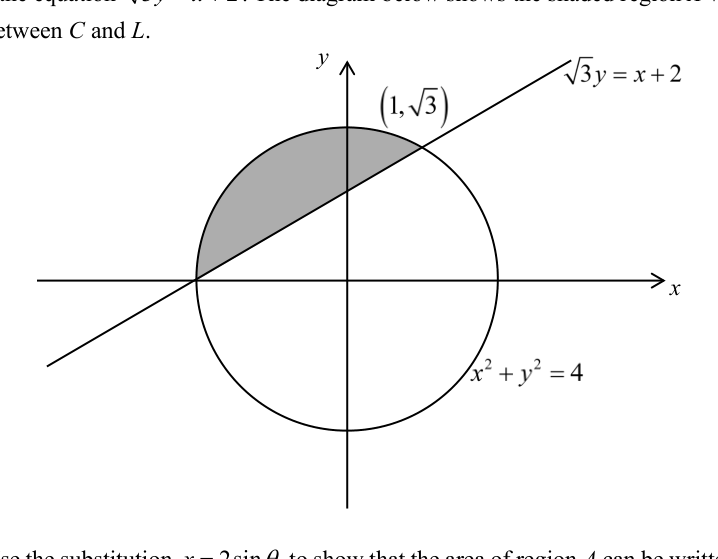
- (a)
Use the substitution to show that the area of region can be written in the expression , where , and are exact constants to be determined. Hence evaluate this area exactly.
- (b)
The region is bounded by the curve , the line and the line . Find the volume generated when region is rotated through radians about the y-axis. Give your answer to two decimal places.
It won't just hand you the answer — it asks where you're stuck.How the checker works
Worked solution
7(a)
1. Set up the area of region $A$ as the difference between the integral of the curve $C$ and the line $L$.
From the circle equation , the upper semicircle is .
From the line , .
Area
2. Apply the substitution $x = 2\sin\theta$ to the first integral and find the new limits.
Let . Then .
Find the new limits for :
When , .
When , .
3. Transform the first integral completely into terms of $\theta$.
4. Evaluate the second integral (the area under the line) to determine the exact constants $a, b,$ and $c$.
Hence, Area , where , , and .
5. Integrate $4\cos^2\theta$ using the double angle identity.
Using , we have .
6. Evaluate the limits to find the exact area of region $A$.
Exact Area
\frac{4\pi}{3} - \sqrt{3}
7(b)
1. Express the equations of curve $C$ and line $L$ with $x$ as the subject.
For curve : (taking the positive root as the region is in the first quadrant where ).
For line : .
2. Determine the $y$-coordinates of the intersections that bound Region $B$.
Region is bounded on the right by .
- Line intersects curve () at .
- Line intersects line () at .
- As given from earlier parts, and intersect at .
Thus, the region spans from to .
3. Set up the integral for the volume generated by rotating Region $B$ about the $y$-axis.
When rotating about the -axis, the volume is .
The outer boundary is consistently .
The inner boundary changes at the intersection .
- For , the inner boundary is the curve .
- For , the inner boundary is the line .
Hence, the volume splits into two parts: .
4. Evaluate the first volume integral, $V_1$.
5. Evaluate the second volume integral, $V_2$.
Substitute the upper limit ():
Substitute the lower limit ():
6. Sum the volumes and compute the final numerical answer to two decimal places.
Rounding to 2 decimal places gives .
8.46
AI analysis — may contain mistakes.
Worked this one out on paper? Snap your steps and Gigle's AI math checker will circle the step where it went wrong.
More questions on this topic
- 1[Cambridge/9709/2010] The diagram shows parts of the curves and and their points o…
- 2Given that the first three terms in the expansion of are , find the v…
- 3The parametric equations of a curve C are , where is a positive constant. The point P on the c…
- 4A curve with equation is transformed by a reflection in the y-axis, followed by a translation of 1 unit in the…
- 5The curve has equation , where . Find the equation of the tangent at the poin…