的图像在 处有一个转向点,并经过点 和 。 的图像在原点处有一个拐点。 在不同的图示中,分别画出下列函数的图像草图,并指出任何渐近线的方程、任何驻点的坐标以及与坐标轴交点的坐标。
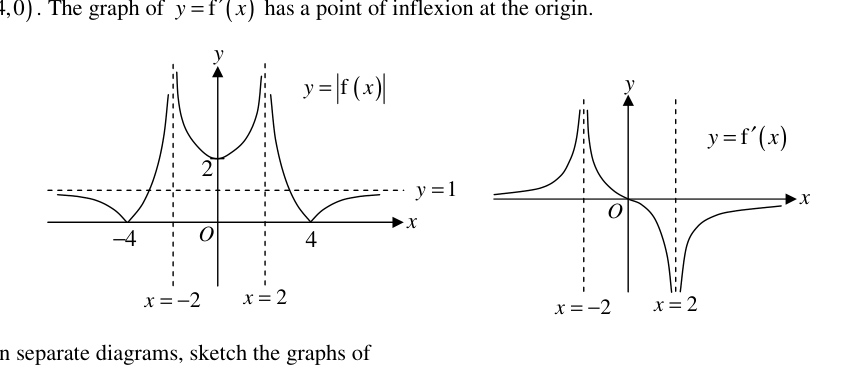
- (i)
,
- (ii)
,
它不会直接告诉你答案,而是问你卡在哪一步看看 AI 是怎么陪你一步步弄懂这道题的
完整解法
1(i)
1. Identify the geometrical transformations mapping the original graph to the new graph.
To sketch from , we apply two transformations:
- A horizontal scaling by a scale factor of parallel to the -axis.
- A reflection in the -axis.
2. Determine the transformed asymptotes and axis intersections.
Under the transformation :
- The vertical asymptotes and map to and .
- The horizontal asymptote (the -axis) remains unchanged at .
- The origin , which is the only point of intersection and a point of inflexion, remains at .
3. Determine the shape and position of the new curve branches.
Due to the reflection in the -axis and scaling:
- The branch initially in () moves to ().
- The branch initially in () moves to ().
- The central branch () passing through with a negative gradient reflects horizontally to become an increasing curve on , passing through with a positive gradient.
A sketched graph of with the following features:
- Vertical asymptotes at and .
- Horizontal asymptote at .
- Point of inflexion and point of intersection with the axes at .
- For , the curve is below the -axis, approaching as and as .
- For , the curve passes through with a positive gradient, going to as and as .
- For , the curve is above the -axis, approaching as and as .
1(ii)
1. Determine the coordinates and nature of the stationary point for the middle branch.
From the graph of , we have for and for , with .
This indicates that is increasing then decreasing, giving a local maximum at .
Since the graph of has a minimum at and goes to at , must be negative in this interval to reflect into a minimum on the modulus graph.
Thus, the turning point is a local maximum at , and the curve approaches as and .
2. Determine the properties of the outer branches.
For , , so is strictly increasing. Since it passes through the -axis at and goes towards , it must be negative for . As has a horizontal asymptote , must approach a negative value, giving the horizontal asymptote as .
Similarly, for , , so is strictly decreasing. It passes through , coming from , so it is negative for . Thus, it also approaches the horizontal asymptote as .
3. Summarise the features for the final sketch.
The sketch of requires:
- Vertical asymptotes at and .
- A horizontal asymptote at .
- -intercepts at and .
- A -intercept and local maximum at .
Key features to state and show on the sketch:
- Asymptotes: , ,
- Stationary point: (local maximum)
- Axial intercepts: , and
(The sketch should show a strictly increasing branch from through up to the vertical asymptote; an inverted U-shaped branch between and with a maximum at ; and a strictly decreasing branch from the asymptote down through to .)
AI 分析,可能出错
用 AI 批改,圈出写错的那一步,并自动将你的薄弱点存入错题本,形成你的错因库。