如图所示为一个实心棱柱 ABCDEF,其横截面为等腰三角形。已知 , 且 。
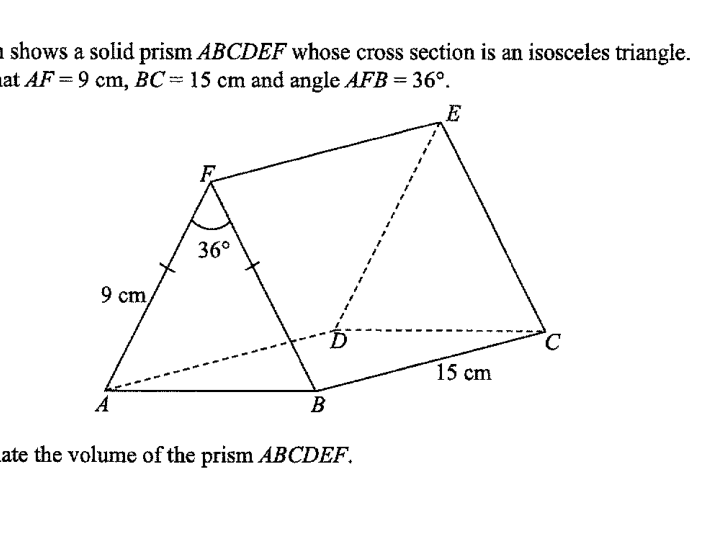
- (a)
计算棱柱 ABCDEF 的体积。
答案 ... cm^3
- (b)
然后将该棱柱熔化并铸造成半径为 0.8 cm 的较小球体。强尼声称将形成 166 个球体。
清晰地写出你的计算过程,并说明强尼的说法是否正确。
答案 ...
...
它不会直接告诉你答案,而是问你卡在哪一步看看 AI 是怎么陪你一步步弄懂这道题的
完整解法
3(a)
1. Find the area of the triangular cross-section $\triangle AFB$.
Since and ,
2. Multiply the cross-sectional area by the prism length to get the volume.
答案
3(b)
1. Find the volume of one sphere of radius $0.8$ cm.
Volume of one sphere
2. Divide the prism volume by the volume of one sphere.
Using the volume of the prism from part (a),
3. Compare the calculated number with Johnny's claim.
Therefore Johnny's claim is correct.
答案
Johnny's claim is correct. There will be spheres.
AI 分析,可能出错
用 AI 批改,圈出写错的那一步,并自动将你的薄弱点存入错题本,形成你的错因库。
同一知识点的其他题
- 1一个长方体的体积为 250 cm^3(精确到最接近的立方厘米)。该长方体的高度为 8.4 cm(精确到一位小数)。 计算该长方体可能的最大底面积。 答 ... cm^2 在图中,AC 和 PQ 是平行线。P 在 AB 上,使得 AP : P…
- 2Isaiah 沿着一个硬纸板立方体的部分边缘将其剪开,形成右图所示的平面图形,该图形的面积为 平方厘米。请问这个立方体的体积是多少立方厘米? A. B. C. D. …
- 3Alex和Felicia他们都有宠物猫。Alex买的宠物猫粮是装在底面直径为厘米,高度厘米的圆柱形罐子里的。Felicia买的猫粮则装在底面直径是厘米,高为厘米的圆柱形罐子里。问Alex的罐子的体积和Felici…
- 4把一个长方体正好分割成两个完全相同正方体,若分割后的正方体的棱长为4cm,则分割后比分割前表面积增加了 ,总体积增加了 .
- 5下图是由棱长为 的正方体组成的。这个图形的体积是多少? 答:___