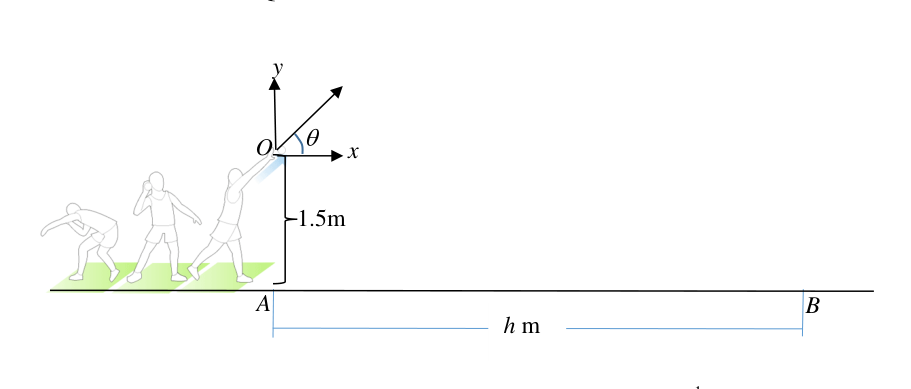
如图所示,一个铅球以速度 v ms−1v\ \mathrm{ms}^{-1} 从点 OO 抛出,与水平方向成 θ\theta 角。点 OO 在地面点 AA 上方 1.5 m1.5\ \mathrm{m} 处。以包含该抛体运动轨迹的平面为 xx-yy 平面,其中 xx 轴与水平方向平行,点 OO 为原点。已知该抛体运动的轨迹方程为 y=xtan⁡θ−gx22v2cos⁡2θ,y = x\tan\theta - \dfrac{g x^2}{2v^2\cos^2\theta}, 其中 g ms−2g\ \mathrm{ms}^{-2} 为重力加速度。 常数 gg 取为 10,点 AA 和点 BB 之间的距离记为 h mh\ \mathrm{m}。

  1. ((a))

    已知 v=10v = 10,证明 hh 满足方程

    h2−10hsin⁡2θ−15cos⁡2θ−15=0.h^2 - 10h\sin 2\theta - 15\cos 2\theta - 15 = 0.

  2. ((b))

    随着 θ\theta 的变化,hh 也随之变化。证明:当 θ\theta 满足以下方程时,hh 取得驻值

    3tan⁡22θ−20sin⁡2θtan⁡2θ−20cos⁡2θ−20=0.3\tan^2 2\theta - 20\sin 2\theta\tan 2\theta - 20\cos 2\theta - 20 = 0.

  3. ((c))

    由此求 hh 的驻值。

先不看答案,让 AI 诊断你卡在哪里?

它不会直接告诉你答案,而是问你卡在哪一步看看 AI 是怎么陪你一步步弄懂这道题的

完整解法

6((a))

1. Identify the coordinates of the landing point and substitute them into the trajectory equation.

From the given context, the origin OO is 1.5 m1.5\text{ m} above the ground point AA. Thus, the ground lies at y=−1.5y = -1.5.
At point BB, the horizontal distance from AA is hh, giving its coordinates as (h,−1.5)(h, -1.5).
Substitute x=hx = h, y=−1.5y = -1.5, v=10v = 10, and g=10g = 10 into the trajectory equation y=xtan⁡θ−gx22v2cos⁡2θy = x\tan\theta - \dfrac{g x^2}{2v^2\cos^2\theta}:
−1.5=htan⁡θ−10h22(10)2cos⁡2θ-1.5 = h\tan\theta - \dfrac{10h^2}{2(10)^2\cos^2\theta}

2. Simplify the equation by clearing fractions.

Express tan⁡θ\tan\theta as sin⁡θcos⁡θ\dfrac{\sin\theta}{\cos\theta} and simplify the fraction on the right:
−1.5=hsin⁡θcos⁡θ−10h2200cos⁡2θ-1.5 = \dfrac{h\sin\theta}{\cos\theta} - \dfrac{10h^2}{200\cos^2\theta}
−1.5=hsin⁡θcos⁡θ−h220cos⁡2θ-1.5 = \dfrac{h\sin\theta}{\cos\theta} - \dfrac{h^2}{20\cos^2\theta}
Multiply the entire equation by 20cos⁡2θ20\cos^2\theta to eliminate the denominators:
−30cos⁡2θ=20hsin⁡θcos⁡θ−h2-30\cos^2\theta = 20h\sin\theta\cos\theta - h^2
Rearranging the terms to bring h2h^2 to the front with a positive coefficient:
h2−20hsin⁡θcos⁡θ−30cos⁡2θ=0h^2 - 20h\sin\theta\cos\theta - 30\cos^2\theta = 0

3. Apply double angle identities to reach the final 'shown' form.

Recall the double angle identities sin⁡2θ=2sin⁡θcos⁡θ\sin 2\theta = 2\sin\theta\cos\theta and cos⁡2θ=2cos⁡2θ−1\cos 2\theta = 2\cos^2\theta - 1 (which rearranges to 2cos⁡2θ=cos⁡2θ+12\cos^2\theta = \cos 2\theta + 1).
Factor out constants to match these identities:
h2−10h(2sin⁡θcos⁡θ)−15(2cos⁡2θ)=0h^2 - 10h(2\sin\theta\cos\theta) - 15(2\cos^2\theta) = 0
Substitute the double angle identities into the equation:
h2−10hsin⁡2θ−15(cos⁡2θ+1)=0h^2 - 10h\sin 2\theta - 15(\cos 2\theta + 1) = 0
Expand and simplify to obtain the required equation:
h2−10hsin⁡2θ−15cos⁡2θ−15=0(shown)h^2 - 10h\sin 2\theta - 15\cos 2\theta - 15 = 0 \quad \text{(shown)}

答案

h2−10hsin⁡2θ−15cos⁡2θ−15=0(shown)h^2 - 10h\sin 2\theta - 15\cos 2\theta - 15 = 0 \quad \text{(shown)}

6((b))

1. Differentiate the equation from part (a) implicitly with respect to $\theta$.

Given the equation from (a):
h2−10hsin⁡2θ−15cos⁡2θ−15=0h^2 - 10h\sin 2\theta - 15\cos 2\theta - 15 = 0

Differentiating both sides with respect to θ\theta:
2hdhdθ−(10dhdθsin⁡2θ+10h(2cos⁡2θ))−15(−2sin⁡2θ)−0=02h \frac{dh}{d\theta} - \left( 10 \frac{dh}{d\theta} \sin 2\theta + 10h(2\cos 2\theta) \right) - 15(-2\sin 2\theta) - 0 = 0
2hdhdθ−10dhdθsin⁡2θ−20hcos⁡2θ+30sin⁡2θ=02h \frac{dh}{d\theta} - 10 \frac{dh}{d\theta} \sin 2\theta - 20h\cos 2\theta + 30\sin 2\theta = 0

2. Apply the condition for a stationary value and express $h$ in terms of $\theta$.

For a stationary value of hh as θ\theta varies, we must have dhdθ=0\frac{dh}{d\theta} = 0.
Substituting dhdθ=0\frac{dh}{d\theta} = 0 into the differentiated equation yields:
−20hcos⁡2θ+30sin⁡2θ=0-20h\cos 2\theta + 30\sin 2\theta = 0
20hcos⁡2θ=30sin⁡2θ20h\cos 2\theta = 30\sin 2\theta
h=30sin⁡2θ20cos⁡2θ=32tan⁡2θh = \frac{30\sin 2\theta}{20\cos 2\theta} = \frac{3}{2}\tan 2\theta

3. Substitute the expression for $h$ back into the original equation.

Substitute h=32tan⁡2θh = \frac{3}{2}\tan 2\theta into the original equation from (a):
(32tan⁡2θ)2−10(32tan⁡2θ)sin⁡2θ−15cos⁡2θ−15=0\left(\frac{3}{2}\tan 2\theta\right)^2 - 10\left(\frac{3}{2}\tan 2\theta\right)\sin 2\theta - 15\cos 2\theta - 15 = 0
94tan⁡22θ−15tan⁡2θsin⁡2θ−15cos⁡2θ−15=0\frac{9}{4}\tan^2 2\theta - 15\tan 2\theta\sin 2\theta - 15\cos 2\theta - 15 = 0

4. Multiply the equation by a constant to obtain the target form.

Multiply the entire equation by 43\frac{4}{3} to clear the fraction and match the required coefficients:
43(94tan⁡22θ)−43(15tan⁡2θsin⁡2θ)−43(15cos⁡2θ)−43(15)=0\frac{4}{3}\left(\frac{9}{4}\tan^2 2\theta\right) - \frac{4}{3}(15\tan 2\theta\sin 2\theta) - \frac{4}{3}(15\cos 2\theta) - \frac{4}{3}(15) = 0
3tan⁡22θ−20sin⁡2θtan⁡2θ−20cos⁡2θ−20=0 (shown)3\tan^2 2\theta - 20\sin 2\theta\tan 2\theta - 20\cos 2\theta - 20 = 0 \text{ (shown)}

答案

3tan⁡22θ−20sin⁡2θtan⁡2θ−20cos⁡2θ−20=0 (shown)3\tan^2 2\theta - 20\sin 2\theta\tan 2\theta - 20\cos 2\theta - 20 = 0 \text{ (shown)}

6((c))

1. Solve the equation from part (b) to find exact trigonometric ratios for $2\theta$.

3tan⁡22θ−20sin⁡2θtan⁡2θ−20cos⁡2θ−20=03\tan^2 2\theta - 20\sin 2\theta\tan 2\theta - 20\cos 2\theta - 20 = 0
Rewrite tan⁡2θ\tan 2\theta in terms of sine and cosine:
3(sec⁡22θ−1)−20(sin⁡22θcos⁡2θ+cos⁡2θ)−20=03(\sec^2 2\theta - 1) - 20\left(\frac{\sin^2 2\theta}{\cos 2\theta} + \cos 2\theta\right) - 20 = 0
3sec⁡22θ−3−20(sin⁡22θ+cos⁡22θcos⁡2θ)−20=03\sec^2 2\theta - 3 - 20\left(\frac{\sin^2 2\theta + \cos^2 2\theta}{\cos 2\theta}\right) - 20 = 0
3sec⁡22θ−20sec⁡2θ−23=03\sec^2 2\theta - 20\sec 2\theta - 23 = 0
Factorise the quadratic in sec⁡2θ\sec 2\theta:
(3sec⁡2θ−23)(sec⁡2θ+1)=0(3\sec 2\theta - 23)(\sec 2\theta + 1) = 0
Since the angle of projection θ\theta must be acute, sec⁡2θ≠−1\sec 2\theta \neq -1 (which would imply projecting vertically, giving h=0h=0). Thus, sec⁡2θ=233\sec 2\theta = \frac{23}{3}.
This gives cos⁡2θ=323\cos 2\theta = \frac{3}{23} and sin⁡2θ=1−(323)2=213023\sin 2\theta = \sqrt{1 - \left(\frac{3}{23}\right)^2} = \frac{2\sqrt{130}}{23}.

2. Substitute the trigonometric values into the equation from part (a) to find $h$.

h2−10hsin⁡2θ−15cos⁡2θ−15=0h^2 - 10h\sin 2\theta - 15\cos 2\theta - 15 = 0
Substitute sin⁡2θ=213023\sin 2\theta = \frac{2\sqrt{130}}{23} and cos⁡2θ=323\cos 2\theta = \frac{3}{23}:
h2−10h(213023)−15(323)−15=0h^2 - 10h\left(\frac{2\sqrt{130}}{23}\right) - 15\left(\frac{3}{23}\right) - 15 = 0
Multiply through by 2323:
23h2−20130h−390=023h^2 - 20\sqrt{130}h - 390 = 0
Use the quadratic formula, keeping in mind that h>0h > 0:
h=20130+(20130)2−4(23)(−390)2(23)h = \frac{20\sqrt{130} + \sqrt{(20\sqrt{130})^2 - 4(23)(-390)}}{2(23)}
h=20130+52000+3588046h = \frac{20\sqrt{130} + \sqrt{52000 + 35880}}{46}
h=20130+8788046=20130+2613046h = \frac{20\sqrt{130} + \sqrt{87880}}{46} = \frac{20\sqrt{130} + 26\sqrt{130}}{46}
h=4613046=130h = \frac{46\sqrt{130}}{46} = \sqrt{130}

答案

h=130h = \sqrt{130} (or 11.411.4 to 3 s.f.)

AI 分析,可能出错

用 AI 批改,圈出写错的那一步,并自动将你的薄弱点存入错题本,形成你的错因库。

同一知识点的其他题

  1. 1曲线 C 的方程为 x+y=(x−y)2x + y = (x - y)^2。 已知 C 只有一个转向点。 证明 1−dydx=21+2x−2y1 - \frac{dy}{dx} = \frac{2}{1 + 2x - 2y}。 由此,或用其他方法,证明 d2ydx2=(1−dydx)3\displaystyle \frac{d^2 y}{dx^2} = \left(1 - \frac{dy}{dx}\right)^3…
  2. 2曲线 C 的方程为 x+y=(x−y)2.x + y = (x - y)^2. 已知 C 只有一个驻点。 证明 1−dydx=21+2x−2y1 - \dfrac{dy}{dx} = \dfrac{2}{1 + 2x - 2y}。 由此或用其他方法,证明 d2ydx2=(1−dydx)3.\dfrac{d^2y}{dx^2} = \left(1 - \dfrac{dy}{dx}\right)^3.…
  3. 3曲线 C1C_1 的方程为 p2x2−y2=p2p^2x^2 - y^2 = p^2,其中 p>1p > 1。 画出 C1C_1 的草图,用 pp 表示出其与坐标轴的所有交点坐标、所有驻点坐标以及所有渐近线方程。 C1C_1 经过单一变换得到 C2C_2。…
  4. 4曲线 CC 的参数方程为 x=2cos⁡θ+cos⁡2θ,y=2sin⁡θ−sin⁡2θ,x = 2\cos\theta + \cos 2\theta, \quad y = 2\sin\theta - \sin 2\theta, 其中 0<θ<2π0 < \theta < 2\pi 且 θ≠2π3,π,4π3\theta \ne \frac{2\pi}{3}, \pi, \frac{4\pi}{3}…
  5. 5已知 y=1+tan⁡−12xy = \sqrt{1 + \tan^{-1} 2x},其中 −12<x<12-\frac{1}{2} < x < \frac{1}{2}。证明 yd2ydx2+(dydx)2+8x(1+4x2)2=0.y \frac{\mathrm{d}^2 y}{\mathrm{d}x^2} + \left(\frac{\mathrm{d}y}{\mathrm{d}x}\right)^2 + \frac{8x}{(1 + 4x^2)^2} = 0.…