The diagram shows a shot put being projected with a velocity from the point at an angle made with the horizontal. The point is above the point on the ground. The - plane is taken to be the plane that contains the trajectory of this projectile motion with -axis parallel to the horizontal and being the origin. The equation of the trajectory of this projectile motion is known to be where is the acceleration due to gravity. The constant is taken to be 10 and the distance between and is denoted by .
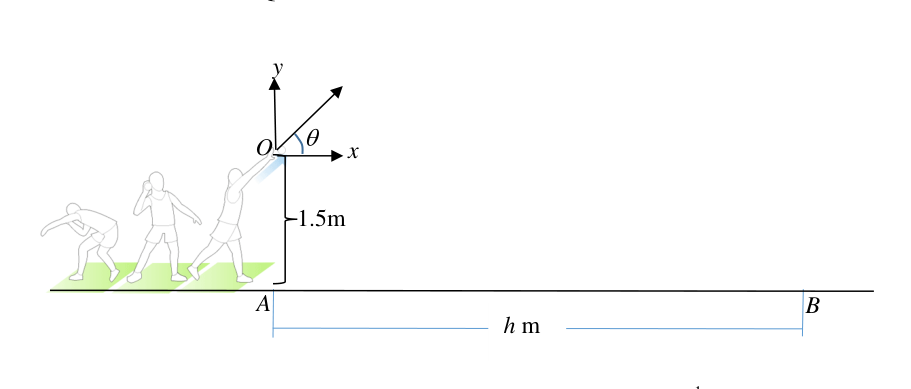
- ((a))
Given that , show that satisfies the equation
- ((b))
As varies, varies. Show that stationary value of occurs when satisfies the following equation
- ((c))
Hence find the stationary value of .
It won't just hand you the answer — it asks where you're stuck.How the checker works
Worked solution
6((a))
1. Identify the coordinates of the landing point and substitute them into the trajectory equation.
From the given context, the origin is above the ground point . Thus, the ground lies at .
At point , the horizontal distance from is , giving its coordinates as .
Substitute , , , and into the trajectory equation :
2. Simplify the equation by clearing fractions.
Express as and simplify the fraction on the right:
Multiply the entire equation by to eliminate the denominators:
Rearranging the terms to bring to the front with a positive coefficient:
3. Apply double angle identities to reach the final 'shown' form.
Recall the double angle identities and (which rearranges to ).
Factor out constants to match these identities:
Substitute the double angle identities into the equation:
Expand and simplify to obtain the required equation:
6((b))
1. Differentiate the equation from part (a) implicitly with respect to $\theta$.
Given the equation from (a):
Differentiating both sides with respect to :
2. Apply the condition for a stationary value and express $h$ in terms of $\theta$.
For a stationary value of as varies, we must have .
Substituting into the differentiated equation yields:
3. Substitute the expression for $h$ back into the original equation.
Substitute into the original equation from (a):
4. Multiply the equation by a constant to obtain the target form.
Multiply the entire equation by to clear the fraction and match the required coefficients:
6((c))
1. Solve the equation from part (b) to find exact trigonometric ratios for $2\theta$.
Rewrite in terms of sine and cosine:
Factorise the quadratic in :
Since the angle of projection must be acute, (which would imply projecting vertically, giving ). Thus, .
This gives and .
2. Substitute the trigonometric values into the equation from part (a) to find $h$.
Substitute and :
Multiply through by :
Use the quadratic formula, keeping in mind that :
(or to 3 s.f.)
AI analysis — may contain mistakes.
Worked this one out on paper? Snap your steps and Gigle's AI math checker will circle the step where it went wrong.
More questions on this topic
- 1The curve C has equation . It is given that C has only one turning point. Show that …
- 2The curve C has equation It is given that C has only one turning point. Show that …
- 3A curve has the equation where . Sketch , stating the coordinates of any points o…
- 4A curve has parametric equations where …
- 5It is given that where . Show that …