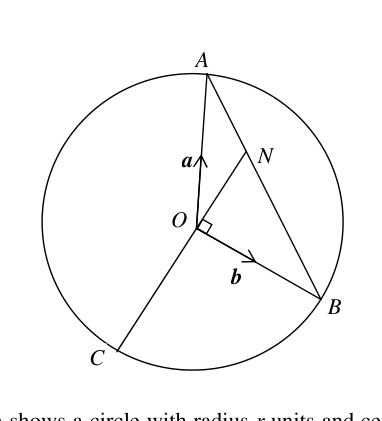
上图显示了一个半径为 rr 单位且圆心为 OO 的圆。圆上的点 AA 和 BB 满足 OA→=a\overrightarrow{OA} = \mathbf{a},OB→=b\overrightarrow{OB} = \mathbf{b} 且 ∠AOB=120∘\angle AOB = 120^\circ。点 NN 以 λ:1−λ\lambda : 1-\lambda 的比例分割 ABAB,且 ONON 垂直于 OBOB。

  1. ((i))

    证明 ON→=13(2a+b)\overrightarrow{ON} = \frac{1}{3}(2\mathbf{a}+\mathbf{b}),并由此求三角形 OANOAN 的面积,表示为 k∣a×b∣k|\mathbf{a} \times \mathbf{b}| 的形式,其中 kk 是待求常数。

  2. ((ii))

    已知点 CC 在该圆上,使得 OO、NN、CC 共线。通过考虑 ONON 的长度,用 a\mathbf{a} 和 b\mathbf{b} 表示 OC→\overrightarrow{OC}。

先不看答案,让 AI 诊断你卡在哪里?

它不会直接告诉你答案,而是问你卡在哪一步看看 AI 是怎么陪你一步步弄懂这道题的

完整解法

6((i))

1. Express $\overrightarrow{ON}$ in terms of $\mathbf{a}$, $\mathbf{b}$ and $\lambda$ using the ratio theorem.

Since NN divides ABAB in the ratio λ:1−λ\lambda : 1-\lambda, by the ratio theorem:
ON→=(1−λ)OA→+λOB→λ+(1−λ)=(1−λ)a+λb\overrightarrow{ON} = \frac{(1-\lambda)\overrightarrow{OA} + \lambda\overrightarrow{OB}}{\lambda + (1-\lambda)} = (1-\lambda)\mathbf{a} + \lambda\mathbf{b}

2. Formulate an equation using the perpendicularity condition.

Since ONON is perpendicular to OBOB, their dot product is zero:
ON→⋅OB→=0\overrightarrow{ON} \cdot \overrightarrow{OB} = 0
((1−λ)a+λb)⋅b=0((1-\lambda)\mathbf{a} + \lambda\mathbf{b}) \cdot \mathbf{b} = 0
(1−λ)(a⋅b)+λ(b⋅b)=0(1-\lambda)(\mathbf{a} \cdot \mathbf{b}) + \lambda(\mathbf{b} \cdot \mathbf{b}) = 0

3. Evaluate the dot products using the given lengths and angle.

Since AA and BB lie on the circle with radius rr, ∣a∣=∣b∣=r|\mathbf{a}| = |\mathbf{b}| = r.
b⋅b=∣b∣2=r2\mathbf{b} \cdot \mathbf{b} = |\mathbf{b}|^2 = r^2
a⋅b=∣a∣∣b∣cos⁡120∘=(r)(r)(−12)=−12r2\mathbf{a} \cdot \mathbf{b} = |\mathbf{a}||\mathbf{b}|\cos 120^\circ = (r)(r)\left(-\frac{1}{2}\right) = -\frac{1}{2}r^2
Substituting these into the equation:
(1−λ)(−12r2)+λ(r2)=0(1-\lambda)\left(-\frac{1}{2}r^2\right) + \lambda(r^2) = 0

4. Solve for $\lambda$ to establish the given expression for $\overrightarrow{ON}$.

Dividing both sides by r2r^2 (since r≠0r \neq 0):
−12(1−λ)+λ=0-\frac{1}{2}(1-\lambda) + \lambda = 0
−12+12λ+λ=0-\frac{1}{2} + \frac{1}{2}\lambda + \lambda = 0
32λ=12  ⟹  λ=13\frac{3}{2}\lambda = \frac{1}{2} \implies \lambda = \frac{1}{3}
Substitute λ=13\lambda = \frac{1}{3} back into the expression for ON→\overrightarrow{ON}:
ON→=(1−13)a+13b=23a+13b=13(2a+b)(shown)\overrightarrow{ON} = \left(1-\frac{1}{3}\right)\mathbf{a} + \frac{1}{3}\mathbf{b} = \frac{2}{3}\mathbf{a} + \frac{1}{3}\mathbf{b} = \frac{1}{3}(2\mathbf{a} + \mathbf{b}) \quad \text{(shown)}

5. Use the cross product to formulate the area of triangle $OAN$.

The area of triangle OANOAN is given by 12∣OA→×ON→∣\frac{1}{2} |\overrightarrow{OA} \times \overrightarrow{ON}|.
Area=12∣a×13(2a+b)∣\text{Area} = \frac{1}{2} \left| \mathbf{a} \times \frac{1}{3}(2\mathbf{a} + \mathbf{b}) \right|

6. Expand the cross product to find the constant $k$.

Using the distributive property of the cross product:
a×13(2a+b)=23(a×a)+13(a×b)\mathbf{a} \times \frac{1}{3}(2\mathbf{a} + \mathbf{b}) = \frac{2}{3}(\mathbf{a} \times \mathbf{a}) + \frac{1}{3}(\mathbf{a} \times \mathbf{b})
Since the cross product of a vector with itself is the zero vector (a×a=0\mathbf{a} \times \mathbf{a} = \mathbf{0}), this simplifies to:
13(a×b)\frac{1}{3}(\mathbf{a} \times \mathbf{b})
Therefore, the area is:
12∣13(a×b)∣=16∣a×b∣\frac{1}{2} \left| \frac{1}{3}(\mathbf{a} \times \mathbf{b}) \right| = \frac{1}{6} |\mathbf{a} \times \mathbf{b}|
Thus, k=16k = \frac{1}{6}.

答案

k=16k = \frac{1}{6}

6((ii))

1. Calculate the magnitude of $\overrightarrow{ON}$ using the scalar product.

Using the expression from part (i), ON→=13(2a+b)\overrightarrow{ON} = \frac{1}{3}(2\mathbf{a}+\mathbf{b}).
We find the square of its magnitude using the scalar product:

∣ON→∣2=ON→⋅ON→=[13(2a+b)]⋅[13(2a+b)]=19(4a⋅a+4a⋅b+b⋅b) \begin{align*} |\overrightarrow{ON}|^2 &= \overrightarrow{ON} \cdot \overrightarrow{ON} \\ &= \left[ \frac{1}{3}(2\mathbf{a}+\mathbf{b}) \right] \cdot \left[ \frac{1}{3}(2\mathbf{a}+\mathbf{b}) \right] \\ &= \frac{1}{9} (4\mathbf{a}\cdot\mathbf{a} + 4\mathbf{a}\cdot\mathbf{b} + \mathbf{b}\cdot\mathbf{b}) \end{align*}

Since AA and BB lie on the circle of radius rr, ∣a∣=∣b∣=r|\mathbf{a}| = |\mathbf{b}| = r, giving a⋅a=r2\mathbf{a}\cdot\mathbf{a} = r^2 and b⋅b=r2\mathbf{b}\cdot\mathbf{b} = r^2.
The angle between a\mathbf{a} and b\mathbf{b} is 120∘120^\circ, so:
a⋅b=∣a∣∣b∣cos⁡120∘=r(r)(−12)=−12r2\mathbf{a}\cdot\mathbf{b} = |\mathbf{a}||\mathbf{b}| \cos 120^\circ = r(r)\left(-\frac{1}{2}\right) = -\frac{1}{2}r^2
Substituting these into the expression:
∣ON→∣2=19(4r2+4(−12r2)+r2)=19(3r2)=13r2|\overrightarrow{ON}|^2 = \frac{1}{9} \left( 4r^2 + 4\left(-\frac{1}{2}r^2\right) + r^2 \right) = \frac{1}{9}(3r^2) = \frac{1}{3}r^2
Thus, ∣ON→∣=r3|\overrightarrow{ON}| = \frac{r}{\sqrt{3}}.

(Alternatively, one could use simple geometry: in right-angled △ONB\triangle ONB, OB=rOB = r and ∠OBN=30∘\angle OBN = 30^\circ, directly giving ON=rtan⁡30∘=r3ON = r \tan 30^\circ = \frac{r}{\sqrt{3}}).

2. Relate $\overrightarrow{OC}$ to $\overrightarrow{ON}$ using their lengths and collinearity.

Since point CC lies on the circle, its distance from the centre OO is exactly the radius rr, so ∣OC→∣=r|\overrightarrow{OC}| = r.
Because OO, NN, and CC are collinear, OC→\overrightarrow{OC} is a scalar multiple of ON→\overrightarrow{ON}:
OC→=kON→\overrightarrow{OC} = k \overrightarrow{ON}
Taking magnitudes on both sides:
∣OC→∣=∣k∣∣ON→∣  ⟹  r=∣k∣(r3)  ⟹  ∣k∣=3|\overrightarrow{OC}| = |k| |\overrightarrow{ON}| \implies r = |k| \left(\frac{r}{\sqrt{3}}\right) \implies |k| = \sqrt{3}
This gives k=±3k = \pm \sqrt{3}.
Thus, the possible expressions for OC→\overrightarrow{OC} are:
OC→=±3[13(2a+b)]=±33(2a+b)\overrightarrow{OC} = \pm \sqrt{3} \left[ \frac{1}{3}(2\mathbf{a}+\mathbf{b}) \right] = \pm \frac{\sqrt{3}}{3}(2\mathbf{a}+\mathbf{b})

(Note: Analytically, both directions satisfy the condition. If the diagram strictly visualises OO as between CC and NN, it narrows the answer to only the negative scalar variation).

答案

\pm \frac{\sqrt{3}}{3}(2\mathbf{a}+\mathbf{b})

AI 分析,可能出错

用 AI 批改,圈出写错的那一步,并自动将你的薄弱点存入错题本,形成你的错因库。

同一知识点的其他题

  1. 1直线 l1l_1 和 l2l_2 的方程分别为 r=(4110)+λ(1−1−6),λ∈R\mathbf{r} = \begin{pmatrix} 4 \\ 1 \\ 10 \end{pmatrix} + \lambda \begin{pmatrix} 1 \\ -1 \\ -6 \end{pmatrix}, \lambda \in \mathbb{R}…
  2. 2已知向量 a\mathbf{a} 和 b\mathbf{b} 为 a=i+(sin⁡θ)j+(cos⁡θ)k\mathbf{a}=\mathbf{i}+(\sin\theta)\mathbf{j}+(\cos\theta)\mathbf{k}\quad 且 b=i+(sin⁡ϕ)j+(cos⁡ϕ)k\quad\mathbf{b}=\mathbf{i}+(\sin\phi)\mathbf{j}+(\cos\phi)\mathbf{k}…
  3. 3以原点 OO 为基准,点 AA、PP 和 QQ 的位置向量分别为 a\mathbf{a}、p\mathbf{p} 和 q\mathbf{q}。一条穿过点 AA 的直线 ll 平行于单位向量 e\mathbf{e}。 点…
  4. 4平面 Π1\Pi_1 的方程为 x+y+z=3x + y + z = 3。一条直线穿过点 PP 和 QQ,它们的位置向量分别为 i+j+2k\mathbf{i} + \mathbf{j} + 2\mathbf{k} 和 4i+2j−k4\mathbf{i} + 2\mathbf{j} - \mathbf{k}…
  5. 5平面 Π1\Pi_1 和 Π2\Pi_2 的向量方程分别为 r=λ1(i+j−k)+μ1(2i−j+k)andr=λ2(i+2j+k)+μ2(3i+j−k)\mathbf{r} = \lambda_1(\mathbf{i} + \mathbf{j} - \mathbf{k}) + \mu_1(2\mathbf{i} - \mathbf{j} + \mathbf{k}) \quad \text{and} \quad \mathbf{r} = \lambda_2(\mathbf{i} + 2\mathbf{j} + \mathbf{k}) + \mu_2(3\mathbf{i} + \mathbf{j} - \mathbf{k})…