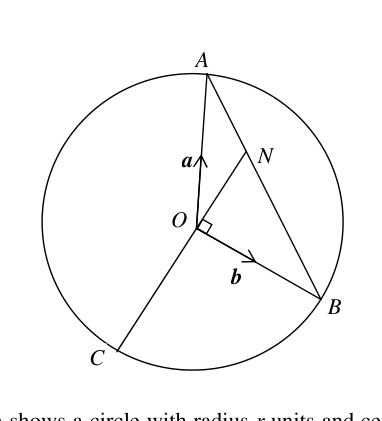
The above diagram shows a circle with radius rr units and centre OO. The points AA and BB on the circle are such that OA→=a\overrightarrow{OA} = \mathbf{a}, OB→=b\overrightarrow{OB} = \mathbf{b} and ∠AOB=120∘\angle AOB = 120^\circ. The point NN divides ABAB in the ratio λ:1−λ\lambda : 1-\lambda and ONON is perpendicular to OBOB.

  1. ((i))

    Show that ON→=13(2a+b)\overrightarrow{ON} = \frac{1}{3}(2\mathbf{a}+\mathbf{b}) and hence find the area of triangle OANOAN in the form of k∣a×b∣k|\mathbf{a} \times \mathbf{b}|, where kk is a constant to be determined.

  2. ((ii))

    It is given that the point CC lies on the circle such that OO, NN and CC are collinear. By considering the length of ONON, find OC→\overrightarrow{OC} in terms of a\mathbf{a} and b\mathbf{b}.

Work through it with AI →

It won't just hand you the answer — it asks where you're stuck.How the checker works

Worked solution

6((i))

1. Express $\overrightarrow{ON}$ in terms of $\mathbf{a}$, $\mathbf{b}$ and $\lambda$ using the ratio theorem.

Since NN divides ABAB in the ratio λ:1−λ\lambda : 1-\lambda, by the ratio theorem:
ON→=(1−λ)OA→+λOB→λ+(1−λ)=(1−λ)a+λb\overrightarrow{ON} = \frac{(1-\lambda)\overrightarrow{OA} + \lambda\overrightarrow{OB}}{\lambda + (1-\lambda)} = (1-\lambda)\mathbf{a} + \lambda\mathbf{b}

2. Formulate an equation using the perpendicularity condition.

Since ONON is perpendicular to OBOB, their dot product is zero:
ON→⋅OB→=0\overrightarrow{ON} \cdot \overrightarrow{OB} = 0
((1−λ)a+λb)⋅b=0((1-\lambda)\mathbf{a} + \lambda\mathbf{b}) \cdot \mathbf{b} = 0
(1−λ)(a⋅b)+λ(b⋅b)=0(1-\lambda)(\mathbf{a} \cdot \mathbf{b}) + \lambda(\mathbf{b} \cdot \mathbf{b}) = 0

3. Evaluate the dot products using the given lengths and angle.

Since AA and BB lie on the circle with radius rr, ∣a∣=∣b∣=r|\mathbf{a}| = |\mathbf{b}| = r.
b⋅b=∣b∣2=r2\mathbf{b} \cdot \mathbf{b} = |\mathbf{b}|^2 = r^2
a⋅b=∣a∣∣b∣cos⁡120∘=(r)(r)(−12)=−12r2\mathbf{a} \cdot \mathbf{b} = |\mathbf{a}||\mathbf{b}|\cos 120^\circ = (r)(r)\left(-\frac{1}{2}\right) = -\frac{1}{2}r^2
Substituting these into the equation:
(1−λ)(−12r2)+λ(r2)=0(1-\lambda)\left(-\frac{1}{2}r^2\right) + \lambda(r^2) = 0

4. Solve for $\lambda$ to establish the given expression for $\overrightarrow{ON}$.

Dividing both sides by r2r^2 (since r≠0r \neq 0):
−12(1−λ)+λ=0-\frac{1}{2}(1-\lambda) + \lambda = 0
−12+12λ+λ=0-\frac{1}{2} + \frac{1}{2}\lambda + \lambda = 0
32λ=12  ⟹  λ=13\frac{3}{2}\lambda = \frac{1}{2} \implies \lambda = \frac{1}{3}
Substitute λ=13\lambda = \frac{1}{3} back into the expression for ON→\overrightarrow{ON}:
ON→=(1−13)a+13b=23a+13b=13(2a+b)(shown)\overrightarrow{ON} = \left(1-\frac{1}{3}\right)\mathbf{a} + \frac{1}{3}\mathbf{b} = \frac{2}{3}\mathbf{a} + \frac{1}{3}\mathbf{b} = \frac{1}{3}(2\mathbf{a} + \mathbf{b}) \quad \text{(shown)}

5. Use the cross product to formulate the area of triangle $OAN$.

The area of triangle OANOAN is given by 12∣OA→×ON→∣\frac{1}{2} |\overrightarrow{OA} \times \overrightarrow{ON}|.
Area=12∣a×13(2a+b)∣\text{Area} = \frac{1}{2} \left| \mathbf{a} \times \frac{1}{3}(2\mathbf{a} + \mathbf{b}) \right|

6. Expand the cross product to find the constant $k$.

Using the distributive property of the cross product:
a×13(2a+b)=23(a×a)+13(a×b)\mathbf{a} \times \frac{1}{3}(2\mathbf{a} + \mathbf{b}) = \frac{2}{3}(\mathbf{a} \times \mathbf{a}) + \frac{1}{3}(\mathbf{a} \times \mathbf{b})
Since the cross product of a vector with itself is the zero vector (a×a=0\mathbf{a} \times \mathbf{a} = \mathbf{0}), this simplifies to:
13(a×b)\frac{1}{3}(\mathbf{a} \times \mathbf{b})
Therefore, the area is:
12∣13(a×b)∣=16∣a×b∣\frac{1}{2} \left| \frac{1}{3}(\mathbf{a} \times \mathbf{b}) \right| = \frac{1}{6} |\mathbf{a} \times \mathbf{b}|
Thus, k=16k = \frac{1}{6}.

Answer

k=16k = \frac{1}{6}

6((ii))

1. Calculate the magnitude of $\overrightarrow{ON}$ using the scalar product.

Using the expression from part (i), ON→=13(2a+b)\overrightarrow{ON} = \frac{1}{3}(2\mathbf{a}+\mathbf{b}).
We find the square of its magnitude using the scalar product:

∣ON→∣2=ON→⋅ON→=[13(2a+b)]⋅[13(2a+b)]=19(4a⋅a+4a⋅b+b⋅b) \begin{align*} |\overrightarrow{ON}|^2 &= \overrightarrow{ON} \cdot \overrightarrow{ON} \\ &= \left[ \frac{1}{3}(2\mathbf{a}+\mathbf{b}) \right] \cdot \left[ \frac{1}{3}(2\mathbf{a}+\mathbf{b}) \right] \\ &= \frac{1}{9} (4\mathbf{a}\cdot\mathbf{a} + 4\mathbf{a}\cdot\mathbf{b} + \mathbf{b}\cdot\mathbf{b}) \end{align*}

Since AA and BB lie on the circle of radius rr, ∣a∣=∣b∣=r|\mathbf{a}| = |\mathbf{b}| = r, giving a⋅a=r2\mathbf{a}\cdot\mathbf{a} = r^2 and b⋅b=r2\mathbf{b}\cdot\mathbf{b} = r^2.
The angle between a\mathbf{a} and b\mathbf{b} is 120∘120^\circ, so:
a⋅b=∣a∣∣b∣cos⁡120∘=r(r)(−12)=−12r2\mathbf{a}\cdot\mathbf{b} = |\mathbf{a}||\mathbf{b}| \cos 120^\circ = r(r)\left(-\frac{1}{2}\right) = -\frac{1}{2}r^2
Substituting these into the expression:
∣ON→∣2=19(4r2+4(−12r2)+r2)=19(3r2)=13r2|\overrightarrow{ON}|^2 = \frac{1}{9} \left( 4r^2 + 4\left(-\frac{1}{2}r^2\right) + r^2 \right) = \frac{1}{9}(3r^2) = \frac{1}{3}r^2
Thus, ∣ON→∣=r3|\overrightarrow{ON}| = \frac{r}{\sqrt{3}}.

(Alternatively, one could use simple geometry: in right-angled △ONB\triangle ONB, OB=rOB = r and ∠OBN=30∘\angle OBN = 30^\circ, directly giving ON=rtan⁡30∘=r3ON = r \tan 30^\circ = \frac{r}{\sqrt{3}}).

2. Relate $\overrightarrow{OC}$ to $\overrightarrow{ON}$ using their lengths and collinearity.

Since point CC lies on the circle, its distance from the centre OO is exactly the radius rr, so ∣OC→∣=r|\overrightarrow{OC}| = r.
Because OO, NN, and CC are collinear, OC→\overrightarrow{OC} is a scalar multiple of ON→\overrightarrow{ON}:
OC→=kON→\overrightarrow{OC} = k \overrightarrow{ON}
Taking magnitudes on both sides:
∣OC→∣=∣k∣∣ON→∣  ⟹  r=∣k∣(r3)  ⟹  ∣k∣=3|\overrightarrow{OC}| = |k| |\overrightarrow{ON}| \implies r = |k| \left(\frac{r}{\sqrt{3}}\right) \implies |k| = \sqrt{3}
This gives k=±3k = \pm \sqrt{3}.
Thus, the possible expressions for OC→\overrightarrow{OC} are:
OC→=±3[13(2a+b)]=±33(2a+b)\overrightarrow{OC} = \pm \sqrt{3} \left[ \frac{1}{3}(2\mathbf{a}+\mathbf{b}) \right] = \pm \frac{\sqrt{3}}{3}(2\mathbf{a}+\mathbf{b})

(Note: Analytically, both directions satisfy the condition. If the diagram strictly visualises OO as between CC and NN, it narrows the answer to only the negative scalar variation).

Answer

\pm \frac{\sqrt{3}}{3}(2\mathbf{a}+\mathbf{b})

AI analysis — may contain mistakes.

Worked this one out on paper? Snap your steps and Gigle's AI math checker will circle the step where it went wrong.

More questions on this topic

  1. 1The lines l1l_1 and l2l_2 have equations r=(4110)+λ(1−1−6),λ∈R\mathbf{r} = \begin{pmatrix} 4 \\ 1 \\ 10 \end{pmatrix} + \lambda \begin{pmatrix} 1 \\ -1 \\ -6 \end{pmatrix}, \lambda \in \mathbb{R}…
  2. 2The vectors a\mathbf{a} and b\mathbf{b} are given by a=i+(sin⁡θ)j+(cos⁡θ)k\mathbf{a}=\mathbf{i}+(\sin\theta)\mathbf{j}+(\cos\theta)\mathbf{k}\quad…
  3. 3With reference to the origin OO, the points AA, PP and QQ have position vectors a\mathbf{a}, p\mathbf{p} and q\mathbf{q}…
  4. 4A plane Π1\Pi_1 has equation x+y+z=3x + y + z = 3. A line passes through the points PP and QQ with position vectors i+j+2k\mathbf{i} + \mathbf{j} + 2\mathbf{k}…
  5. 5The planes Π1\Pi_1 and Π2\Pi_2 have vector equations r=λ1(i+j−k)+μ1(2i−j+k)andr=λ2(i+2j+k)+μ2(3i+j−k)\mathbf{r} = \lambda_1(\mathbf{i} + \mathbf{j} - \mathbf{k}) + \mu_1(2\mathbf{i} - \mathbf{j} + \mathbf{k}) \quad \text{and} \quad \mathbf{r} = \lambda_2(\mathbf{i} + 2\mathbf{j} + \mathbf{k}) + \mu_2(3\mathbf{i} + \mathbf{j} - \mathbf{k})…