下图显示了 的图像。该曲线穿过 轴的点为 和 ,并且有一个最大值点,其坐标为 。直线 和 是该图像的渐近线。 在可能的情况下,指出所有渐近线的方程、与坐标轴的交点坐标以及驻点坐标,并画出以下函数的图像:
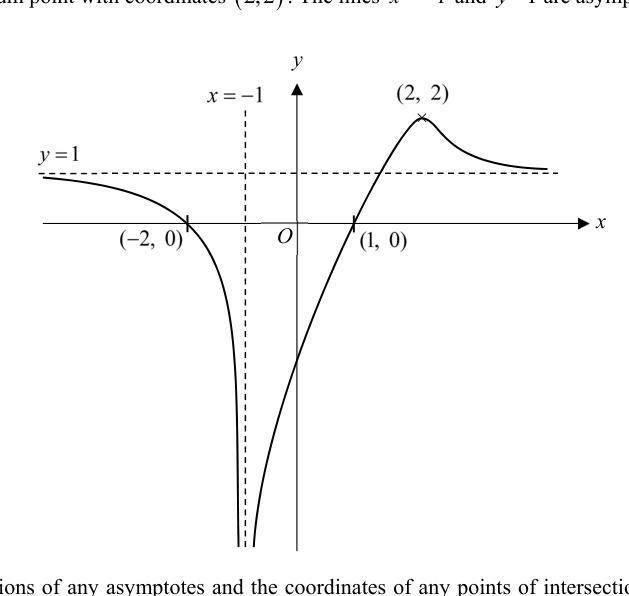
- (a)
,其中 是一个满足 的正常数,
- (b)
。
它不会直接告诉你答案,而是问你卡在哪一步看看 AI 是怎么陪你一步步弄懂这道题的
完整解法
2(a)
1. Identify the geometrical transformations required
The equation indicates two transformations on the graph of :
- A translation by units in the negative -direction (shift left by ).
- A vertical stretch by a scale factor of parallel to the -axis.
2. Find the equations of the new asymptotes
Original vertical asymptote:
Translated left by :
Original horizontal asymptote:
Stretched vertically by 3:
3. Find the coordinates of the new stationary point
Original maximum point:
Translated left by and stretched vertically by 3:
Since , we have , so the new maximum point lies in the first quadrant.
4. Determine the new intersections with the axes
Original -intercepts: and
Translated left by (vertical stretch does not affect -intercepts):
Since , we have , meaning both -intercepts lie on the negative -axis.
The new -intercept occurs at , giving . From the original graph, for , . Hence , and the curve intersects the positive -axis (the exact coordinate cannot be determined).
5. Sketch the final transformed graph
Sketch the two branches based on the transformed features:
- Left branch: Bounded by and , passing through .
- Right branch: Starts near the bottom of , crosses the -axis at , crosses the positive -axis, peaks at the maximum , and approaches from above as .
Sketch Features:
- Shape: Two branches similar to .
- Asymptotes: Vertical line and horizontal line .
- Axes Intersections: -intercepts at and . The graph intersects the positive -axis.
- Stationary Point: Maximum point at .
2(b)
1. Determine the equations of the asymptotes for $y = \text{f}'(x)$.
Since the graph of has a vertical asymptote at , the gradient is undefined and its magnitude approaches infinity. Thus, is a vertical asymptote for .
As , the curve approaches the horizontal asymptote , meaning the curve flattens out and the gradient approaches . Thus, (the -axis) is a horizontal asymptote for .
2. Determine the coordinates of intersection with the axes.
At the maximum point on , the gradient is . Therefore, , giving an -intercept at .
The exact -intercept cannot be calculated from the given information, but it must be positive since is strictly increasing at .
3. Analyse the sign of the gradient in each interval to deduce the shape of the derivative graph.
For , is strictly decreasing, so . The curve comes from as and plunges to as .
For , is strictly increasing, so . The curve falls from as , and decreases to cross the -axis at .
For , is strictly decreasing, so . The curve dips below the -axis. Since it must approach the horizontal asymptote as , it must reach a local minimum point before turning upwards. (The exact coordinates of this minimum cannot be determined).
Asymptotes: ,
Points of intersection: on the -axis. (The exact -intercept cannot be determined, but must be plotted as positive).
Stationary points: A local minimum exists for some (exact coordinates cannot be determined).
Sketch instructions:
- Left branch (): Drawn entirely below the -axis. Approaches from below as , and approaches going towards .
- Right branch (): Comes down from near , crosses the -axis at a positive value, crosses the -axis at , reaches a local minimum (with a negative -value), and curves back up to approach from below as .
AI 分析,可能出错
用 AI 批改,圈出写错的那一步,并自动将你的薄弱点存入错题本,形成你的错因库。