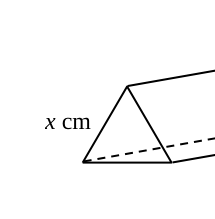
上图显示了一个三角形棱柱形状的微型模型。一根长 36 cm 的铁丝穿过该三角形棱柱的所有棱。棱柱的横截面是边长为 cm 的等边三角形,棱柱的长度为 cm。
- (i)
证明该棱柱的总表面积 A cm^2 满足
- (ii)
已知 是可变的,求使 取得驻值的 的值。
- (iii)
论证在该 值下 是最大值还是最小值,并求出该 的驻值。
它不会直接告诉你答案,而是问你卡在哪一步看看 AI 是怎么陪你一步步弄懂这道题的
完整解法
4(i)
1. Form an equation for the total length of the wire to express $y$ in terms of $x$.
The prism has 2 triangular ends (each with 3 edges of length ) and 3 rectangular faces (each with 1 edge of length connecting the ends).
Total length of wire
2. Find the area of the two triangular ends.
Area of one equilateral triangle
Area of two triangular ends
3. Find the area of the three rectangular faces.
Area of one rectangular face
Area of three rectangular faces
Substitute :
Area
4. Combine the areas to show the total surface area $A$.
(Shown)
Shown
4(ii)
1. Differentiate $A$ with respect to $x$
2. Equate the derivative to zero to find the stationary point
For a stationary value,
3. Solve for $x$ and simplify
(to 3 s.f.)
or (to 3 s.f.)
4(iii)
1. Find the second derivative of $A$ with respect to $x$ to determine the nature of the stationary point.
From (i), .
Since , the stationary value of is a maximum.
2. Substitute the value of $x$ from (ii) into the expression for $A$ to find the stationary value.
From (ii), .
Substitute into :
3. Rationalise the denominator to find the exact or numerical value of $A$.
Maximum, (or )
AI 分析,可能出错
用 AI 批改,圈出写错的那一步,并自动将你的薄弱点存入错题本,形成你的错因库。