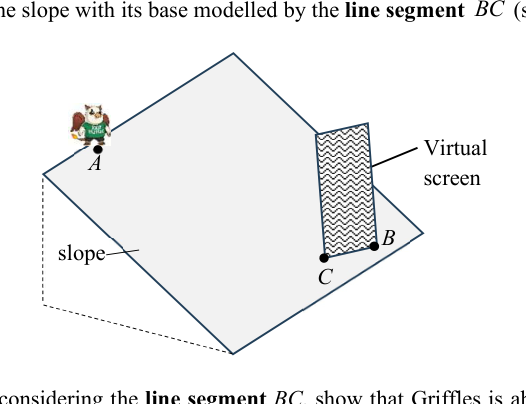
在电脑游戏中,一个斜坡可以建模为经过 A(1,0,−3)A(1, 0, -3)、B(1,4,−15)B(1, 4, -15) 和 C(2,3,−14)C(2, 3, -14) 这三个点的平面 pp。

  1. (a)

    证明 pp 的方程为 r⋅(231)=−1\mathbf{r} \cdot \begin{pmatrix} 2 \\ 3 \\ 1 \end{pmatrix} = -1。

  2. (b)

    在游戏的第 1 阶段,Griffles 从 AA 出发沿着斜坡移动,其路径方程为
    r=(10−3)+λ(1mn),\mathbf{r} = \begin{pmatrix} 1 \\ 0 \\ -3 \end{pmatrix} + \lambda \begin{pmatrix} 1 \\ m \\ n \end{pmatrix},
    其中 mm 和 nn 是常数,λ\lambda 是实参数。

    求一个关于 mm 和 nn 的关系式。

  3. (c)

    在问题的其余部分中,已知 m=13m = \frac{1}{3},n=−3n = -3,且 Griffles 被建模为在斜坡上移动的一个点。斜坡上立着一个呈矩形虚拟屏幕形状的障碍物,其底部被建模为线段 BCBC(见图)。

    通过考虑线段 BCBC,证明 Griffles 能够成功绕过该障碍物而不与之相撞。

  4. (d)

    一个配有传感器的激光枪安装在斜面上方的点 E(5,2,1)E(5, 2, 1) 处。当物体在 5 个单位的范围内时,传感器会被触发。

    证明 Griffles 不会触发该传感器。

  5. (e)

    在完成第 1 阶段后,Griffles 被传送到了另一个斜面。该斜面可以建模为一个与 pp 平行的平面 qq,使得 EE 到 pp 和 qq 的距离相等。

    求 qq 的笛卡尔方程。

先不看答案,让 AI 诊断你卡在哪里?

它不会直接告诉你答案,而是问你卡在哪一步看看 AI 是怎么陪你一步步弄懂这道题的

完整解法

4(a)

1. Find two non-parallel vectors lying on the plane, such as $\vec{AB}$ and $\vec{AC}$.

AB⃗=OB⃗−OA⃗=(14−15)−(10−3)=(04−12)\vec{AB} = \vec{OB} - \vec{OA} = \begin{pmatrix} 1 \\ 4 \\ -15 \end{pmatrix} - \begin{pmatrix} 1 \\ 0 \\ -3 \end{pmatrix} = \begin{pmatrix} 0 \\ 4 \\ -12 \end{pmatrix}

AC⃗=OC⃗−OA⃗=(23−14)−(10−3)=(13−11)\vec{AC} = \vec{OC} - \vec{OA} = \begin{pmatrix} 2 \\ 3 \\ -14 \end{pmatrix} - \begin{pmatrix} 1 \\ 0 \\ -3 \end{pmatrix} = \begin{pmatrix} 1 \\ 3 \\ -11 \end{pmatrix}

2. Calculate a normal vector to the plane using the cross product of $\vec{AB}$ and $\vec{AC}$.

n=AB⃗×AC⃗=(04−12)×(13−11)=(4(−11)−(−12)(3)−12(1)−0(−11)0(3)−4(1))\mathbf{n} = \vec{AB} \times \vec{AC} = \begin{pmatrix} 0 \\ 4 \\ -12 \end{pmatrix} \times \begin{pmatrix} 1 \\ 3 \\ -11 \end{pmatrix} = \begin{pmatrix} 4(-11) - (-12)(3) \\ -12(1) - 0(-11) \\ 0(3) - 4(1) \end{pmatrix}

n=(−44+36−12−00−4)=(−8−12−4)\mathbf{n} = \begin{pmatrix} -44 + 36 \\ -12 - 0 \\ 0 - 4 \end{pmatrix} = \begin{pmatrix} -8 \\ -12 \\ -4 \end{pmatrix}

3. Use the normal vector and point $A$ to formulate the scalar product equation of the plane.

A simpler normal vector parallel to n\mathbf{n} is obtained by dividing by −4-4:
n′=(231)\mathbf{n}' = \begin{pmatrix} 2 \\ 3 \\ 1 \end{pmatrix}

Equation of plane pp is r⋅n′=OA⃗⋅n′\mathbf{r} \cdot \mathbf{n}' = \vec{OA} \cdot \mathbf{n}':
r⋅(231)=(10−3)⋅(231)\mathbf{r} \cdot \begin{pmatrix} 2 \\ 3 \\ 1 \end{pmatrix} = \begin{pmatrix} 1 \\ 0 \\ -3 \end{pmatrix} \cdot \begin{pmatrix} 2 \\ 3 \\ 1 \end{pmatrix}
r⋅(231)=1(2)+0(3)+(−3)(1)=2+0−3\mathbf{r} \cdot \begin{pmatrix} 2 \\ 3 \\ 1 \end{pmatrix} = 1(2) + 0(3) + (-3)(1) = 2 + 0 - 3
r⋅(231)=−1 (shown)\mathbf{r} \cdot \begin{pmatrix} 2 \\ 3 \\ 1 \end{pmatrix} = -1 \text{ (shown)}

答案

r⋅(231)=−1 (shown)\mathbf{r} \cdot \begin{pmatrix} 2 \\ 3 \\ 1 \end{pmatrix} = -1 \text{ (shown)}

4(b)

1. State the geometric condition for the path to lie entirely on the slope (plane $p$).

Since Griffles travels on the slope, the path lies on plane pp. Therefore, the direction vector of the line must be perpendicular to the normal vector of the plane, which means their scalar product is zero.

2. Evaluate the scalar product to form the equation.

(1mn)⋅(231)=0\begin{pmatrix} 1 \\ m \\ n \end{pmatrix} \cdot \begin{pmatrix} 2 \\ 3 \\ 1 \end{pmatrix} = 0
1(2)+m(3)+n(1)=01(2) + m(3) + n(1) = 0
3m+n+2=03m + n + 2 = 0

答案

3m+n+2=03m + n + 2 = 0

4(c)

1. Find the vector equation of the line passing through $B$ and $C$.

Let the line passing through BB and CC be lBCl_{BC}.
The direction vector BC⃗=OC⃗−OB⃗=(23−14)−(14−15)=(1−11)\vec{BC} = \vec{OC} - \vec{OB} = \begin{pmatrix} 2 \\ 3 \\ -14 \end{pmatrix} - \begin{pmatrix} 1 \\ 4 \\ -15 \end{pmatrix} = \begin{pmatrix} 1 \\ -1 \\ 1 \end{pmatrix}.
The vector equation of the line is r=(14−15)+μ(1−11)\mathbf{r} = \begin{pmatrix} 1 \\ 4 \\ -15 \end{pmatrix} + \mu \begin{pmatrix} 1 \\ -1 \\ 1 \end{pmatrix}.
For the point to lie on the line segment BCBC, the parameter μ\mu is restricted to 0≤μ≤10 \le \mu \le 1.

2. Set up a system of equations to find the intersection between Griffles' path and the line $BC$.

Equating the position vectors of Griffles' path and lBCl_{BC}:
(10−3)+λ(11/3−3)=(14−15)+μ(1−11)\begin{pmatrix} 1 \\ 0 \\ -3 \end{pmatrix} + \lambda \begin{pmatrix} 1 \\ 1/3 \\ -3 \end{pmatrix} = \begin{pmatrix} 1 \\ 4 \\ -15 \end{pmatrix} + \mu \begin{pmatrix} 1 \\ -1 \\ 1 \end{pmatrix}
This yields the system of linear equations:
1+λ=1+μ— (1)1 + \lambda = 1 + \mu \quad \text{--- (1)}
13λ=4−μ— (2)\frac{1}{3}\lambda = 4 - \mu \quad \text{--- (2)}
−3−3λ=−15+μ— (3)-3 - 3\lambda = -15 + \mu \quad \text{--- (3)}

3. Solve the system to find the intersection point and show it lies outside the segment $BC$.

From (1), we have λ=μ\lambda = \mu.
Substituting into (2):
13μ=4−μ\frac{1}{3}\mu = 4 - \mu
43μ=4  ⟹  μ=3\frac{4}{3}\mu = 4 \implies \mu = 3
(Checking consistency with equation (3): −3−3(3)=−12-3 - 3(3) = -12 and −15+3=−12-15 + 3 = -12. The lines indeed intersect).
Since the intersection occurs at μ=3\mu = 3, which falls outside the required range of 0≤μ≤10 \le \mu \le 1 for the line segment BCBC, the intersection point does not lie on the obstacle's base.
Alternatively, the point of intersection is (4,1,−12)(4, 1, -12), which has an xx-coordinate of 44, falling outside the xx-coordinates of BB and CC (11 and 22 respectively).
Thus, Griffles successfully navigates the obstacle without colliding into it (shown).

答案

Since the intersection point lies outside the line segment BCBC, Griffles does not collide with the obstacle.

4(d)

1. Find the vector $\vec{AE}$ and state the direction vector of the path.

Given the starting point A(1,0,−3)A(1, 0, -3) and the sensor at E(5,2,1)E(5, 2, 1), the vector from AA to EE is:
AE⃗=OE⃗−OA⃗=(521)−(10−3)=(424)\vec{AE} = \vec{OE} - \vec{OA} = \begin{pmatrix} 5 \\ 2 \\ 1 \end{pmatrix} - \begin{pmatrix} 1 \\ 0 \\ -3 \end{pmatrix} = \begin{pmatrix} 4 \\ 2 \\ 4 \end{pmatrix}
From part (b) and (c), the path has direction vector u=(11/3−3)\mathbf{u} = \begin{pmatrix} 1 \\ 1/3 \\ -3 \end{pmatrix}. To avoid fractions, we can use a parallel direction vector d=3u=(31−9)\mathbf{d} = 3\mathbf{u} = \begin{pmatrix} 3 \\ 1 \\ -9 \end{pmatrix}.

2. Calculate the squared magnitude of $\vec{AE}$, $\mathbf{d}$, and their dot product.

To find the shortest distance from EE to the path, we can use the dot product to find the length of the projection of AE⃗\vec{AE} onto the path's direction.
∣AE⃗∣2=42+22+42=36|\vec{AE}|^2 = 4^2 + 2^2 + 4^2 = 36
∣d∣2=32+12+(−9)2=91|\mathbf{d}|^2 = 3^2 + 1^2 + (-9)^2 = 91
AE⃗⋅d=(4)(3)+(2)(1)+(4)(−9)=12+2−36=−22\vec{AE} \cdot \mathbf{d} = (4)(3) + (2)(1) + (4)(-9) = 12 + 2 - 36 = -22

3. Use Pythagoras' theorem to find the shortest perpendicular distance.

The square of the shortest distance hh from EE to the line is given by h2=∣AE⃗∣2−(AE⃗⋅d∣d∣)2h^2 = |\vec{AE}|^2 - \left( \frac{\vec{AE} \cdot \mathbf{d}}{|\mathbf{d}|} \right)^2.
h2=36−(−22)291=36−48491=3276−48491=279291h^2 = 36 - \frac{(-22)^2}{91} = 36 - \frac{484}{91} = \frac{3276 - 484}{91} = \frac{2792}{91}
h=279291≈5.539 unitsh = \sqrt{\frac{2792}{91}} \approx 5.539 \text{ units}

4. Compare the shortest distance with the sensor's range and conclude.

Since the minimum possible distance from the sensor EE to any point on Griffles' path is approximately 5.545.54 units, which is strictly greater than the sensor's trigger range of 55 units, Griffles will never enter the zone. Thus, he does not activate the sensor.

答案

The shortest distance to the path is ≈5.54\approx 5.54 units. Since 5.54>55.54 > 5, Griffles does not activate the sensor.

4(e)

1. State the general equation of plane $q$ using the fact that it is parallel to $p$.

Since plane qq is parallel to plane pp, it shares the same normal vector n=(231)\mathbf{n} = \begin{pmatrix} 2 \\ 3 \\ 1 \end{pmatrix}.
Let the cartesian equation of qq be 2x+3y+z=d2x + 3y + z = d.

2. Calculate the perpendicular distance from point $E$ to plane $p$.

The cartesian equation of plane pp is 2x+3y+z=−12x + 3y + z = -1, which can be written as 2x+3y+z+1=02x + 3y + z + 1 = 0.
Using the perpendicular distance formula for point E(5,2,1)E(5, 2, 1) to plane pp:
Distance=∣2(5)+3(2)+1(1)+1∣22+32+12\text{Distance} = \frac{|2(5) + 3(2) + 1(1) + 1|}{\sqrt{2^2 + 3^2 + 1^2}}
Distance=∣10+6+1+1∣14=1814\text{Distance} = \frac{|10 + 6 + 1 + 1|}{\sqrt{14}} = \frac{18}{\sqrt{14}}

3. Use the given equidistant condition to find $d$ and state the final cartesian equation of $q$.

Since EE is equidistant from planes pp and qq, the distance from EE to qq is also 1814\frac{18}{\sqrt{14}}.
∣2(5)+3(2)+1(1)−d∣14=1814\frac{|2(5) + 3(2) + 1(1) - d|}{\sqrt{14}} = \frac{18}{\sqrt{14}}
∣17−d∣=18|17 - d| = 18
17−d=18or17−d=−1817 - d = 18 \quad \text{or} \quad 17 - d = -18
d=−1ord=35d = -1 \quad \text{or} \quad d = 35
Since qq is a different plane from pp (d=−1d = -1 corresponds to plane pp), we have d=35d = 35.
The cartesian equation of qq is 2x+3y+z=352x + 3y + z = 35.

答案

2x+3y+z=352x + 3y + z = 35

AI 分析,可能出错

用 AI 批改,圈出写错的那一步,并自动将你的薄弱点存入错题本,形成你的错因库。

同一知识点的其他题

  1. 1直线 l1l_1 和 l2l_2 的方程分别为 r=(4110)+λ(1−1−6),λ∈R\mathbf{r} = \begin{pmatrix} 4 \\ 1 \\ 10 \end{pmatrix} + \lambda \begin{pmatrix} 1 \\ -1 \\ -6 \end{pmatrix}, \lambda \in \mathbb{R}…
  2. 2一家钻探公司计划在山中铺设一条直管道 ABAB。点 (x,y,z)(x, y, z) 是相对于山脚下坐标为 (0,0,0)(0, 0, 0) 的主控制中心定义的,其中单位为米。xx 轴指向东,yy 轴指向北,zz 轴垂直向上。点 AA 的坐标为 (−200,150,10)(-200, 150, 10)…
  3. 3平面 Π1\Pi_1 的方程为 x+y+z=3x + y + z = 3。一条直线穿过点 PP 和 QQ,它们的位置向量分别为 i+j+2k\mathbf{i} + \mathbf{j} + 2\mathbf{k} 和 4i+2j−k4\mathbf{i} + 2\mathbf{j} - \mathbf{k}…
  4. 4平面 Π1\Pi_1 和 Π2\Pi_2 的向量方程分别为 r=λ1(i+j−k)+μ1(2i−j+k)andr=λ2(i+2j+k)+μ2(3i+j−k)\mathbf{r} = \lambda_1(\mathbf{i} + \mathbf{j} - \mathbf{k}) + \mu_1(2\mathbf{i} - \mathbf{j} + \mathbf{k}) \quad \text{and} \quad \mathbf{r} = \lambda_2(\mathbf{i} + 2\mathbf{j} + \mathbf{k}) + \mu_2(3\mathbf{i} + \mathbf{j} - \mathbf{k})…
  5. 5一位室内设计师正计划设计一个下拉式衣柜升降机。为了测试他的设想,设计师制作了一个它的微缩模型。在这个模型中,点 (x,y,z)(x, y, z) 是相对于模型的一个拐角 O(0,0,0)O(0, 0, 0) 来定义的。模型中使用的杆可以用直线方程来建模。 主杆可…