In a computer game, a slope can be modelled as a plane containing three points, , and .
- (a)
Show that has equation .
- (b)
In Stage 1 of the game, Griffles travels on the slope from along a path with equation
where and are constants and is a real parameter.Find an equation relating and .
- (c)
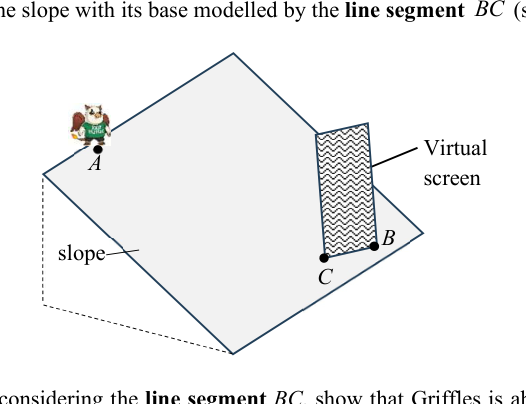
In the rest of the question, it is given that , and Griffles is modelled as a point travelling on the slope. An obstacle in the form of a rectangular virtual screen stands on the slope with its base modelled by the line segment (see diagram).
By considering the line segment , show that Griffles is able to successfully navigate this obstacle without colliding into it.
- (d)
A laser gun with a sensor is mounted at the point above the slope. The sensor is activated when an object is within a range of 5 units.
Show that Griffles does not activate the sensor.
- (e)
After completing Stage 1, Griffles is teleported to another slope. This slope can be modelled as a plane parallel to such that is equidistant from and .
Find the cartesian equation of .
It won't just hand you the answer — it asks where you're stuck.How the checker works
Worked solution
4(a)
1. Find two non-parallel vectors lying on the plane, such as $\vec{AB}$ and $\vec{AC}$.
2. Calculate a normal vector to the plane using the cross product of $\vec{AB}$ and $\vec{AC}$.
3. Use the normal vector and point $A$ to formulate the scalar product equation of the plane.
A simpler normal vector parallel to is obtained by dividing by :
Equation of plane is :
4(b)
1. State the geometric condition for the path to lie entirely on the slope (plane $p$).
Since Griffles travels on the slope, the path lies on plane . Therefore, the direction vector of the line must be perpendicular to the normal vector of the plane, which means their scalar product is zero.
2. Evaluate the scalar product to form the equation.
4(c)
1. Find the vector equation of the line passing through $B$ and $C$.
Let the line passing through and be .
The direction vector .
The vector equation of the line is .
For the point to lie on the line segment , the parameter is restricted to .
2. Set up a system of equations to find the intersection between Griffles' path and the line $BC$.
Equating the position vectors of Griffles' path and :
This yields the system of linear equations:
3. Solve the system to find the intersection point and show it lies outside the segment $BC$.
From (1), we have .
Substituting into (2):
(Checking consistency with equation (3): and . The lines indeed intersect).
Since the intersection occurs at , which falls outside the required range of for the line segment , the intersection point does not lie on the obstacle's base.
Alternatively, the point of intersection is , which has an -coordinate of , falling outside the -coordinates of and ( and respectively).
Thus, Griffles successfully navigates the obstacle without colliding into it (shown).
Since the intersection point lies outside the line segment , Griffles does not collide with the obstacle.
4(d)
1. Find the vector $\vec{AE}$ and state the direction vector of the path.
Given the starting point and the sensor at , the vector from to is:
From part (b) and (c), the path has direction vector . To avoid fractions, we can use a parallel direction vector .
2. Calculate the squared magnitude of $\vec{AE}$, $\mathbf{d}$, and their dot product.
To find the shortest distance from to the path, we can use the dot product to find the length of the projection of onto the path's direction.
3. Use Pythagoras' theorem to find the shortest perpendicular distance.
The square of the shortest distance from to the line is given by .
4. Compare the shortest distance with the sensor's range and conclude.
Since the minimum possible distance from the sensor to any point on Griffles' path is approximately units, which is strictly greater than the sensor's trigger range of units, Griffles will never enter the zone. Thus, he does not activate the sensor.
The shortest distance to the path is units. Since , Griffles does not activate the sensor.
4(e)
1. State the general equation of plane $q$ using the fact that it is parallel to $p$.
Since plane is parallel to plane , it shares the same normal vector .
Let the cartesian equation of be .
2. Calculate the perpendicular distance from point $E$ to plane $p$.
The cartesian equation of plane is , which can be written as .
Using the perpendicular distance formula for point to plane :
3. Use the given equidistant condition to find $d$ and state the final cartesian equation of $q$.
Since is equidistant from planes and , the distance from to is also .
Since is a different plane from ( corresponds to plane ), we have .
The cartesian equation of is .
AI analysis — may contain mistakes.
Worked this one out on paper? Snap your steps and Gigle's AI math checker will circle the step where it went wrong.
More questions on this topic
- 1The lines and have equations …
- 2A drilling company plans to install a straight pipeline through a mountain. Points are defined relative…
- 3A plane has equation . A line passes through the points and with position vectors …
- 4The planes and have vector equations …
- 5A home interior designer is looking to design a pull-down wardrobe lift. To test his concept, the designer built a small…