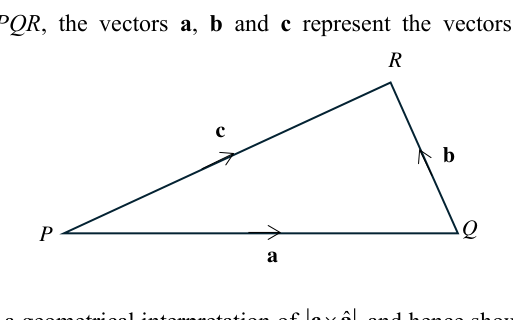
在三角形 PQRPQR 中,向量 a\mathbf{a}、b\mathbf{b} 和 c\mathbf{c} 分别表示向量 PQ⃗\vec{PQ}、QR⃗\vec{QR} 和 PR⃗\vec{PR}。

  1. (a)

    阐述 ∣c×a^∣|\mathbf{c} \times \mathbf{\hat{a}}| 的几何意义,并由此证明三角形 PQRPQR 的面积可以表示为 12∣c×a∣ units2\frac{1}{2}|\mathbf{c} \times \mathbf{a}|\text{ units}^2。

  2. (b)

    给出清晰的解释,证明 ∣c×a∣=∣b×a∣|\mathbf{c} \times \mathbf{a}| = |\mathbf{b} \times \mathbf{a}| 并推导出
    ∣c∣sin⁡∠PQR=∣b∣sin⁡∠QPR (Sine Rule).\frac{|\mathbf{c}|}{\sin \angle PQR} = \frac{|\mathbf{b}|}{\sin \angle QPR}\text{ (Sine Rule)}.

先不看答案,让 AI 诊断你卡在哪里?

它不会直接告诉你答案,而是问你卡在哪一步看看 AI 是怎么陪你一步步弄懂这道题的

完整解法

5(a)

1. State the geometrical interpretation of $|\mathbf{c} \times \mathbf{\hat{a}}|$.

∣c×a^∣|\mathbf{c} \times \mathbf{\hat{a}}| represents the perpendicular distance from point RR to the line passing through PP and QQ (i.e. the height of △PQR\triangle PQR when PQPQ is taken as the base).

2. Express the area of triangle $PQR$ in terms of the base and this height.

Taking PQPQ as the base, the length of the base is ∣a∣|\mathbf{a}|.

Area of △PQR=12×base×height\text{Area of } \triangle PQR = \frac{1}{2} \times \text{base} \times \text{height}
Area=12∣a∣∣c×a^∣\text{Area} = \frac{1}{2} |\mathbf{a}| |\mathbf{c} \times \mathbf{\hat{a}}|

3. Substitute the definition of the unit vector $\mathbf{\hat{a}}$ to show the required area formula.

Since a^=a∣a∣\mathbf{\hat{a}} = \frac{\mathbf{a}}{|\mathbf{a}|}, we can substitute this into the expression:

Area=12∣a∣∣c×a∣a∣∣\text{Area} = \frac{1}{2} |\mathbf{a}| \left| \mathbf{c} \times \frac{\mathbf{a}}{|\mathbf{a}|} \right|

Because 1∣a∣\frac{1}{|\mathbf{a}|} is a positive scalar, it can be factored out of the magnitude:

Area=12∣a∣(1∣a∣)∣c×a∣\text{Area} = \frac{1}{2} |\mathbf{a}| \left( \frac{1}{|\mathbf{a}|} \right) |\mathbf{c} \times \mathbf{a}|
Area=12∣c×a∣ units2 (shown)\text{Area} = \frac{1}{2} |\mathbf{c} \times \mathbf{a}| \text{ units}^2 \text{ (shown)}

答案

∣c×a^∣|\mathbf{c} \times \mathbf{\hat{a}}| represents the perpendicular distance from RR to the line passing through PP and QQ (or the height of triangle PQRPQR with PQPQ as the base).

(Proof shown in working)

5(b)

1. Use vector addition and properties of the cross product to show that $|\mathbf{c} \times \mathbf{a}| = |\mathbf{b} \times \mathbf{a}|$.

By the triangle law of vector addition, PR⃗=PQ⃗+QR⃗\vec{PR} = \vec{PQ} + \vec{QR}, so c=a+b\mathbf{c} = \mathbf{a} + \mathbf{b}.

Taking the cross product with a\mathbf{a} on both sides:
c×a=(a+b)×a\mathbf{c} \times \mathbf{a} = (\mathbf{a} + \mathbf{b}) \times \mathbf{a}
c×a=a×a+b×a\mathbf{c} \times \mathbf{a} = \mathbf{a} \times \mathbf{a} + \mathbf{b} \times \mathbf{a}

Since the cross product of any vector with itself is the zero vector (a×a=0\mathbf{a} \times \mathbf{a} = \mathbf{0}):
c×a=b×a\mathbf{c} \times \mathbf{a} = \mathbf{b} \times \mathbf{a}

Taking the magnitude of both sides yields:
∣c×a∣=∣b×a∣|\mathbf{c} \times \mathbf{a}| = |\mathbf{b} \times \mathbf{a}|

2. Express the magnitude of both cross products using the definition involving angles.

The magnitude of a cross product is given by ∣u×v∣=∣u∣∣v∣sin⁡θ|\mathbf{u} \times \mathbf{v}| = |\mathbf{u}||\mathbf{v}|\sin \theta, where θ\theta is the angle between the vectors when placed tail-to-tail.

For c\mathbf{c} and a\mathbf{a}, both originate from point PP, so the angle between them is exactly the interior angle ∠QPR\angle QPR. Thus:
∣c×a∣=∣c∣∣a∣sin⁡∠QPR|\mathbf{c} \times \mathbf{a}| = |\mathbf{c}| |\mathbf{a}| \sin \angle QPR

For b\mathbf{b} (QR⃗\vec{QR}) and a\mathbf{a} (PQ⃗\vec{PQ}), placing them tail-to-tail at QQ means extending PQ⃗\vec{PQ}. The angle between them is the exterior angle of the triangle at QQ, which is 180∘−∠PQR180^\circ - \angle PQR. Thus:
∣b×a∣=∣b∣∣a∣sin⁡(180∘−∠PQR)|\mathbf{b} \times \mathbf{a}| = |\mathbf{b}| |\mathbf{a}| \sin(180^\circ - \angle PQR)

Since sin⁡(180∘−θ)=sin⁡θ\sin(180^\circ - \theta) = \sin \theta, this simplifies to:
∣b×a∣=∣b∣∣a∣sin⁡∠PQR|\mathbf{b} \times \mathbf{a}| = |\mathbf{b}| |\mathbf{a}| \sin \angle PQR

3. Equate the two expressions and rearrange to deduce the Sine Rule.

Substitute the expressions from Step 2 into the equality from Step 1:
∣c∣∣a∣sin⁡∠QPR=∣b∣∣a∣sin⁡∠PQR|\mathbf{c}| |\mathbf{a}| \sin \angle QPR = |\mathbf{b}| |\mathbf{a}| \sin \angle PQR

Since a\mathbf{a} forms a side of the triangle, its magnitude is non-zero (∣a∣≠0|\mathbf{a}| \neq 0). Dividing both sides by ∣a∣|\mathbf{a}| gives:
∣c∣sin⁡∠QPR=∣b∣sin⁡∠PQR|\mathbf{c}| \sin \angle QPR = |\mathbf{b}| \sin \angle PQR

Dividing both sides by sin⁡∠PQRsin⁡∠QPR\sin \angle PQR \sin \angle QPR, we obtain:
∣c∣sin⁡∠PQR=∣b∣sin⁡∠QPR(Shown)\frac{|\mathbf{c}|}{\sin \angle PQR} = \frac{|\mathbf{b}|}{\sin \angle QPR} \quad \text{(Shown)}

答案

Proof as shown in the steps.

AI 分析,可能出错

用 AI 批改,圈出写错的那一步,并自动将你的薄弱点存入错题本,形成你的错因库。

同一知识点的其他题

  1. 1一家钻探公司计划在山中铺设一条直管道 ABAB。点 (x,y,z)(x, y, z) 是相对于山脚下坐标为 (0,0,0)(0, 0, 0) 的主控制中心定义的,其中单位为米。xx 轴指向东,yy 轴指向北,zz 轴垂直向上。点 AA 的坐标为 (−200,150,10)(-200, 150, 10)…
  2. 2以原点 OO 为基准,点 AA、PP 和 QQ 的位置向量分别为 a\mathbf{a}、p\mathbf{p} 和 q\mathbf{q}。一条穿过点 AA 的直线 ll 平行于单位向量 e\mathbf{e}。 点…
  3. 3平面 Π1\Pi_1 的方程为 x+y+z=3x + y + z = 3。一条直线穿过点 PP 和 QQ,它们的位置向量分别为 i+j+2k\mathbf{i} + \mathbf{j} + 2\mathbf{k} 和 4i+2j−k4\mathbf{i} + 2\mathbf{j} - \mathbf{k}…
  4. 4平面 Π1\Pi_1 和 Π2\Pi_2 的向量方程分别为 r=λ1(i+j−k)+μ1(2i−j+k)andr=λ2(i+2j+k)+μ2(3i+j−k)\mathbf{r} = \lambda_1(\mathbf{i} + \mathbf{j} - \mathbf{k}) + \mu_1(2\mathbf{i} - \mathbf{j} + \mathbf{k}) \quad \text{and} \quad \mathbf{r} = \lambda_2(\mathbf{i} + 2\mathbf{j} + \mathbf{k}) + \mu_2(3\mathbf{i} + \mathbf{j} - \mathbf{k})…
  5. 5以原点 OO 为基准,点 AA 和点 BB 满足 OA→=a\overrightarrow{OA}=\mathbf{a} 且 OB→=b\overrightarrow{OB}=\mathbf{b}。点 CC 在 OBOB 上,使得 OC→=pOB→\overrightarrow{OC}=p\overrightarrow{OB}…