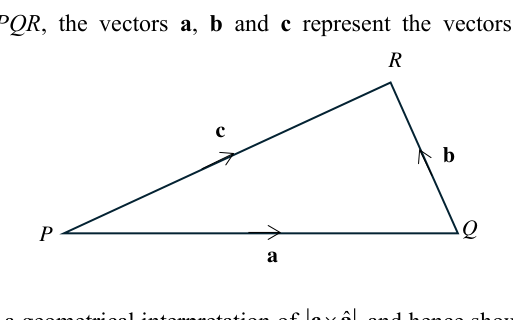
In triangle PQRPQR, the vectors a\mathbf{a}, b\mathbf{b} and c\mathbf{c} represent the vectors PQ⃗\vec{PQ}, QR⃗\vec{QR} and PR⃗\vec{PR} respectively.

  1. (a)

    State a geometrical interpretation of ∣c×a^∣|\mathbf{c} \times \mathbf{\hat{a}}| and hence show that the area of the triangle PQRPQR can be written as 12∣c×a∣ units2\frac{1}{2}|\mathbf{c} \times \mathbf{a}|\text{ units}^2.

  2. (b)

    With clear explanations, show that ∣c×a∣=∣b×a∣|\mathbf{c} \times \mathbf{a}| = |\mathbf{b} \times \mathbf{a}| and deduce that
    ∣c∣sin⁡∠PQR=∣b∣sin⁡∠QPR (Sine Rule).\frac{|\mathbf{c}|}{\sin \angle PQR} = \frac{|\mathbf{b}|}{\sin \angle QPR}\text{ (Sine Rule)}.

Work through it with AI →

It won't just hand you the answer — it asks where you're stuck.How the checker works

Worked solution

5(a)

1. State the geometrical interpretation of $|\mathbf{c} \times \mathbf{\hat{a}}|$.

∣c×a^∣|\mathbf{c} \times \mathbf{\hat{a}}| represents the perpendicular distance from point RR to the line passing through PP and QQ (i.e. the height of △PQR\triangle PQR when PQPQ is taken as the base).

2. Express the area of triangle $PQR$ in terms of the base and this height.

Taking PQPQ as the base, the length of the base is ∣a∣|\mathbf{a}|.

Area of △PQR=12×base×height\text{Area of } \triangle PQR = \frac{1}{2} \times \text{base} \times \text{height}
Area=12∣a∣∣c×a^∣\text{Area} = \frac{1}{2} |\mathbf{a}| |\mathbf{c} \times \mathbf{\hat{a}}|

3. Substitute the definition of the unit vector $\mathbf{\hat{a}}$ to show the required area formula.

Since a^=a∣a∣\mathbf{\hat{a}} = \frac{\mathbf{a}}{|\mathbf{a}|}, we can substitute this into the expression:

Area=12∣a∣∣c×a∣a∣∣\text{Area} = \frac{1}{2} |\mathbf{a}| \left| \mathbf{c} \times \frac{\mathbf{a}}{|\mathbf{a}|} \right|

Because 1∣a∣\frac{1}{|\mathbf{a}|} is a positive scalar, it can be factored out of the magnitude:

Area=12∣a∣(1∣a∣)∣c×a∣\text{Area} = \frac{1}{2} |\mathbf{a}| \left( \frac{1}{|\mathbf{a}|} \right) |\mathbf{c} \times \mathbf{a}|
Area=12∣c×a∣ units2 (shown)\text{Area} = \frac{1}{2} |\mathbf{c} \times \mathbf{a}| \text{ units}^2 \text{ (shown)}

Answer

∣c×a^∣|\mathbf{c} \times \mathbf{\hat{a}}| represents the perpendicular distance from RR to the line passing through PP and QQ (or the height of triangle PQRPQR with PQPQ as the base).

(Proof shown in working)

5(b)

1. Use vector addition and properties of the cross product to show that $|\mathbf{c} \times \mathbf{a}| = |\mathbf{b} \times \mathbf{a}|$.

By the triangle law of vector addition, PR⃗=PQ⃗+QR⃗\vec{PR} = \vec{PQ} + \vec{QR}, so c=a+b\mathbf{c} = \mathbf{a} + \mathbf{b}.

Taking the cross product with a\mathbf{a} on both sides:
c×a=(a+b)×a\mathbf{c} \times \mathbf{a} = (\mathbf{a} + \mathbf{b}) \times \mathbf{a}
c×a=a×a+b×a\mathbf{c} \times \mathbf{a} = \mathbf{a} \times \mathbf{a} + \mathbf{b} \times \mathbf{a}

Since the cross product of any vector with itself is the zero vector (a×a=0\mathbf{a} \times \mathbf{a} = \mathbf{0}):
c×a=b×a\mathbf{c} \times \mathbf{a} = \mathbf{b} \times \mathbf{a}

Taking the magnitude of both sides yields:
∣c×a∣=∣b×a∣|\mathbf{c} \times \mathbf{a}| = |\mathbf{b} \times \mathbf{a}|

2. Express the magnitude of both cross products using the definition involving angles.

The magnitude of a cross product is given by ∣u×v∣=∣u∣∣v∣sin⁡θ|\mathbf{u} \times \mathbf{v}| = |\mathbf{u}||\mathbf{v}|\sin \theta, where θ\theta is the angle between the vectors when placed tail-to-tail.

For c\mathbf{c} and a\mathbf{a}, both originate from point PP, so the angle between them is exactly the interior angle ∠QPR\angle QPR. Thus:
∣c×a∣=∣c∣∣a∣sin⁡∠QPR|\mathbf{c} \times \mathbf{a}| = |\mathbf{c}| |\mathbf{a}| \sin \angle QPR

For b\mathbf{b} (QR⃗\vec{QR}) and a\mathbf{a} (PQ⃗\vec{PQ}), placing them tail-to-tail at QQ means extending PQ⃗\vec{PQ}. The angle between them is the exterior angle of the triangle at QQ, which is 180∘−∠PQR180^\circ - \angle PQR. Thus:
∣b×a∣=∣b∣∣a∣sin⁡(180∘−∠PQR)|\mathbf{b} \times \mathbf{a}| = |\mathbf{b}| |\mathbf{a}| \sin(180^\circ - \angle PQR)

Since sin⁡(180∘−θ)=sin⁡θ\sin(180^\circ - \theta) = \sin \theta, this simplifies to:
∣b×a∣=∣b∣∣a∣sin⁡∠PQR|\mathbf{b} \times \mathbf{a}| = |\mathbf{b}| |\mathbf{a}| \sin \angle PQR

3. Equate the two expressions and rearrange to deduce the Sine Rule.

Substitute the expressions from Step 2 into the equality from Step 1:
∣c∣∣a∣sin⁡∠QPR=∣b∣∣a∣sin⁡∠PQR|\mathbf{c}| |\mathbf{a}| \sin \angle QPR = |\mathbf{b}| |\mathbf{a}| \sin \angle PQR

Since a\mathbf{a} forms a side of the triangle, its magnitude is non-zero (∣a∣≠0|\mathbf{a}| \neq 0). Dividing both sides by ∣a∣|\mathbf{a}| gives:
∣c∣sin⁡∠QPR=∣b∣sin⁡∠PQR|\mathbf{c}| \sin \angle QPR = |\mathbf{b}| \sin \angle PQR

Dividing both sides by sin⁡∠PQRsin⁡∠QPR\sin \angle PQR \sin \angle QPR, we obtain:
∣c∣sin⁡∠PQR=∣b∣sin⁡∠QPR(Shown)\frac{|\mathbf{c}|}{\sin \angle PQR} = \frac{|\mathbf{b}|}{\sin \angle QPR} \quad \text{(Shown)}

Answer

Proof as shown in the steps.

AI analysis — may contain mistakes.

Worked this one out on paper? Snap your steps and Gigle's AI math checker will circle the step where it went wrong.

More questions on this topic

  1. 1A drilling company plans to install a straight pipeline ABAB through a mountain. Points (x,y,z)(x, y, z) are defined relative…
  2. 2With reference to the origin OO, the points AA, PP and QQ have position vectors a\mathbf{a}, p\mathbf{p} and q\mathbf{q}…
  3. 3A plane Π1\Pi_1 has equation x+y+z=3x + y + z = 3. A line passes through the points PP and QQ with position vectors i+j+2k\mathbf{i} + \mathbf{j} + 2\mathbf{k}…
  4. 4The planes Π1\Pi_1 and Π2\Pi_2 have vector equations r=λ1(i+j−k)+μ1(2i−j+k)andr=λ2(i+2j+k)+μ2(3i+j−k)\mathbf{r} = \lambda_1(\mathbf{i} + \mathbf{j} - \mathbf{k}) + \mu_1(2\mathbf{i} - \mathbf{j} + \mathbf{k}) \quad \text{and} \quad \mathbf{r} = \lambda_2(\mathbf{i} + 2\mathbf{j} + \mathbf{k}) + \mu_2(3\mathbf{i} + \mathbf{j} - \mathbf{k})…
  5. 5Referred to the origin OO, the points AA and BB are such that OA→=a\overrightarrow{OA}=\mathbf{a} and OB→=b\overrightarrow{OB}=\mathbf{b}…